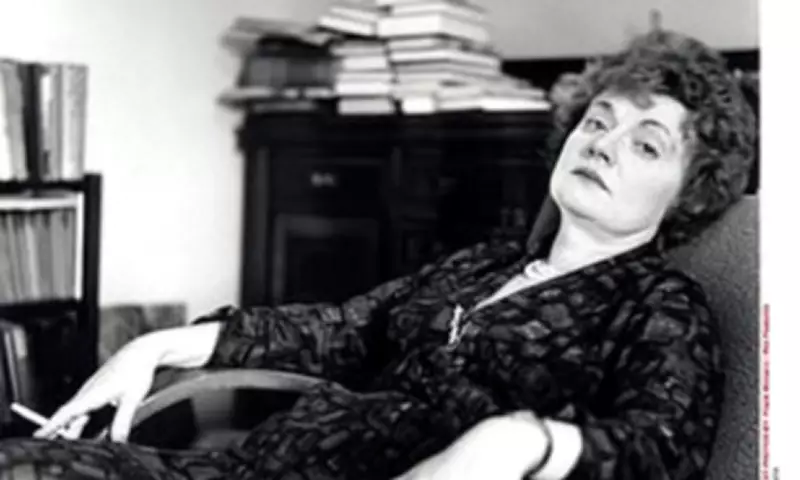
An interviewer once asked novelist Muriel Spark about the cruelty and violence she inflicted upon her characters. Did she hate them? 'Oh, no,' Spark replied. 'I love them most intensely, like a cat loves a bird. You know cats do love birds. They love to fondle them.' Yes, but they also love to torture them to death. Reading James Bailey's incisive book on 'the nine lives' of the feline, elusive and emotionally slippery Muriel Spark, I was reminded just how creepy her novels are—and also what a strange, cold person she was.
I didn't warm to her one bit—and I pitied her son Robin, whom she abandoned in southern Africa when he was six, sending him to board with nuns so she could escape from her dead marriage. It was 1943, and she claimed children couldn't travel during wartime. But you feel that really she just longed to rid herself of him. When Robin returned 18 months later, she sent him to live with her parents in Edinburgh and went back to London to work. Their relationship descended into mutual recrimination from then on.
'I haven't got much time for family,' she airily told interviewers who probed her on her relationship with her son. 'I'm not really very good at it. It's not my thing.' Five decades on, she callously condemned Robin in print. 'He can't sell his lousy paintings, and I have had a lot of success. He's never done anything for me except for being one big bore.'

From a feminist perspective, it was admirable that Spark put her work first, refusing to be hampered by domestic or maternal requirements. From a human perspective, it's quite chilling. She got a job at the Poetry Society, where she fell out with most of her colleagues, including vice president and birth-control advocate Marie Stopes. Spark cattily wrote of Stopes, 'I used to think it a pity that her mother rather than she had not thought of birth control.'
The writer Ved Mehta, who worked next to Spark in the New Yorker offices in the 1960s, said 'she went through people like pieces of Kleenex.' The only person she ever settled down with was a fan called Penelope Jardine, who invited her to stay in Tuscany in the 1970s, supposedly for a few weeks. Spark stayed for three decades. Heroically, Penelope took on the role of Spark's cook, cleaner and secretary. (Spark stated that they were not lesbians, but that Penelope was her 'friend and collaborator'. However, she did not 'collaborate,' Bailey emphasises. 'It was delegation.')
As for the stories: well, most of us are familiar with The Prime of Miss Jean Brodie (1961), in which a refined Morningside schoolmistress hones the minds of her favourite girls, whom she calls the 'crème de la crème' (you can hear Maggie Smith saying those words—she won an Oscar for the role in the film) while encouraging them to hero-worship her beloved Mussolini and his 'fascisti'. Brodie was inspired by Spark's own unashamedly elitist Edinburgh schoolmistress Miss Kay, who took her favourite girls on cultural outings.
That novel was so successful that it eclipsed Spark's 21 others, whose characters included 'murderers, fraudsters, fascists, ghouls, charlatans, sadists and blackmailers.' In one, The Driver's Seat, the heroine Lise asks to be murdered and instructs her murderer how to do so. In The Hothouse by the East River, Poppy breeds silkworms by incubating their eggs beneath her breasts. They hatch, sending worms spiralling from her flesh onto the carpet. That creepy detail is reminiscent of Patricia Highsmith breeding snails in her handbag. Indeed, Spark was an acquaintance of Highsmith in New York and inherited her cat, Spider.
Spark was obsessed with cats. Losing her appetite, she brought uneaten restaurant food back to them, overfeeding them while she became gaunt. If her cat Bluebell sat on her manuscript, that meant it was good. If she touched her paw on a page, that meant it was dubious.

Bailey takes us through the 'nine lives' of Spark, painting memorable vignettes of her changing and secretive ways of living. Having escaped from the loveless marriage to Sydney Oswald Spark (she'd married him because she longed for sex, fun and international travel) and their son, she did secret work for the Foreign Office, receiving messages directly from Joseph Goebbels's news transmitter, typing them up, and giving them to Allied propagandists to twist and send back to demoralise the German population. This gave her a taste for stories about lies and cunning.
The one truly happy moment in her life was in 1951, when her short story won an Observer competition. She took Dexedrine to avoid sleep and write through the night, but it made her go 'dotty,' as she put it: she had paranoid delusions in which T.S. Eliot controlled her from afar. In the early 1950s, after another failed relationship, she lived alone in a bedsit in Camberwell, south London, where she wrote four novels in quick succession, including The Ballad of Peckham Rye, in which a Scottish migrant wreaks havoc on Peckham's inhabitants, resulting in one of them having a stroke and another stabbing a corkscrew in his mistress's neck.
After the success of Miss Jean Brodie, she longed for solitude, hence the move to New York, where she lived and wrote alone with the cats. Then she tried Rome, where she lived grandly in a palazzo, drinking crème de menthe that matched her flowing green dress—but she was obsessed with macabre news stories of women being attacked in the streets, which fed into her fiction. Critics said her novels were becoming 'intolerably life-deploring,' 'brief, brittle and nasty.' Living for those three decades in the Tuscan hills, spared from all housework, she wrote nine more brief and brittle novels, until her death from cancer aged 88 in 2006. As Bailey writes, 'her story is every bit as strange, slippery and rife with contradiction as the ones she wrote.'