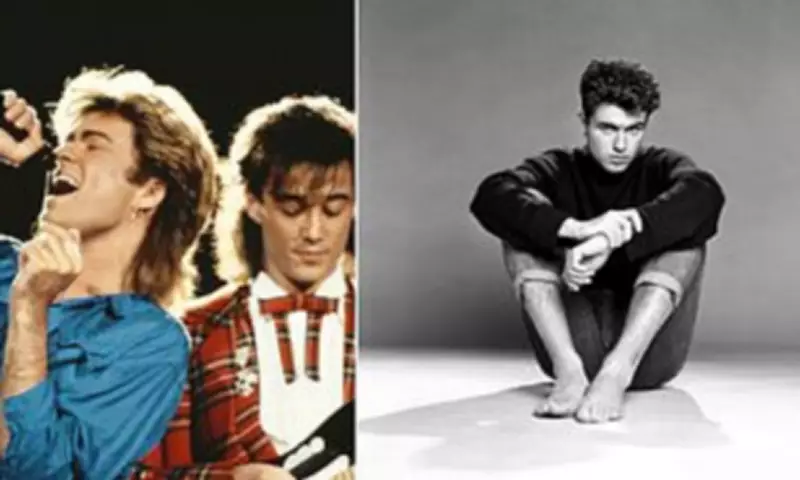
Reading Tonight The Music Seems So Loud in a restaurant in Greece, I ask the waiter if he has heard of George Michael. He confesses, apologetically, that he hasn’t. Admittedly he’s young, but I’m taken aback. After all, the person I’ve just asked him about was a pop star of Greek Cypriot roots who, in his day, could be mentioned in the same breath as Michael Jackson and Madonna. He was that big.
His haunting torch song, Careless Whisper, which he wrote on a bus when he was 17, made No 1 in 26 countries. His album, Faith, was the biggest-selling of the year in America in 1988 and eventually notched up a whopping 25 million sales worldwide. From 1984 to 2004 – which is to say, two-fifths of my time on this planet – he was the most-played artist on British radio.
How has his stock declined?
This is the question journalist and historian Sathnam Sanghera tackles in this thoughtful and thought-provoking, if slightly lugubrious, biographical study – or as he puts it, why doesn’t Michael receive ‘the acknowledgement that he deserves’? At least part of Sanghera’s answer is that the man was ‘deeply contradictory’, which makes it hard to know what to make of him.

Michael could be staggeringly arrogant. At 21, he declared in an interview that he had ‘achieved more as a performer, writer and producer, than anyone else ever has by the same age’. Yet he was also cripplingly insecure. When a girlfriend once told him at a party that he had ‘beautiful eyes’, he assumed she was mocking him and stormed off in a huff.
He was pathologically private about his sex life, yet after he had been ‘outed’ as gay in 1998 – the accidental result of being arrested for propositioning an undercover police officer in an LA lavatory – he seemed quite happy to talk about it. He appeared on Parkinson soon afterwards, and recalled how he had loved watching the TV chat show with his mum as a kid. Then he added wryly, ‘She probably wouldn’t have been quite as thrilled that I had to take my willy out to get on here.’ That confession had old Parkie chortling away.
The star took himself incredibly seriously, yet often seemed happy to send himself up. The invitations to his 35th birthday read, ‘Go to the bathroom before you come, as all conveniences will be locked to protect the host.’ As Sanghera points out, the title of his best-of album was another wry reference to that lavatory incident. It was called Ladies & Gentlemen.
The influence of his immigrant background
As the author of a book about the British empire, and the son of Sikh parents, Sanghera is precisely attuned to the influence of Michael’s immigrant background. Michael’s dad, Kyriacos Panayiotou, came over from British-controlled Cyprus in the 1950s. His can-do attitude inspired his son. Yet he also detested homosexuals, which cannot have been easy for young Michael.
In his strongest chapter, the author describes how shockingly homophobic Britain was when Michael burst on to the scene as one member (beside the straight and less obviously talented Andrew Ridgeley) of the pop duo Wham!. These changes in attitude happen in fits and starts, with sudden reactive reversals. After the advances of the preceding decades (with homosexuality being decriminalised in England and Wales in 1967), the 1980s saw a fierce surge in anti-gay feeling. In 1983, 50 per cent of people in this country believed that homosexuality was wrong. By 1987, that figure had risen to 63 per cent.
Where the book is less confident
Where Tonight The Music Seems So Loud is less confident – awkwardly enough – is in assessing the music. Sanghera never claims it as his strong suit, but his reference points don’t seem to extend much further than Taylor Swift. Nor does his tone fit the topic. At its best, Michael’s music – from Wham!’s Wake Me Up Before You Go-Go, to the title track of Faith, with its infectious Bo Diddley beat, to the codedly confessional but dancey Freedom! ’90 – is an expression of pure joy. Yet Sanghera is apologetic, even Eeyorish, as he traipses off to where Michael once worked as a waiter, or watches a Michael impersonator strut his stuff. There is nothing shameful about the love of perfect pop.

Between the lines, a story emerges with the shape of a Greek tragedy, which helps to explain the falling-off in Michael’s popularity. It’s the story of a man getting everything he ever wanted, then finding that it wasn’t what he wanted. Podgy and curly-haired as a kid, and put down by his dad, Michael burned to be famous. Through raw talent and perfectionism bordering on mania, he succeeded beyond his wildest dreams – then discovered that the last thing he desired was to have everybody staring at him. What he wanted now was to disappear.
As early as the Faith album, his exceedingly handsome face, with its smouldering stubble and blow-dried smile, began to feature less often on the sleeves of his singles. For the video for Freedom! ’90, he didn’t deign to appear at all, deputising a bevy of supermodels, from Naomi Campbell to Cindy Crawford, to stand in for him.
Acts of self-sabotage
Viewed in this light, many aspects of his later life come to seem like acts of self-sabotage. His naturally controlling streak ran rampant. After contributing to a concert for World Aids Day, he insisted on spending ages re-editing the footage, because he was concerned that some of the camera angles made his bum look big. It was around that time that it became a mantra in the industry that you should never work with ‘children, animals or George Michael’. Then there was the long court case against his record company, Sony, which he lost. Not to mention his dependence on drugs and alcohol, which led to a string of minor convictions, and finally his death from related causes in 2016.
The author has a lovely couple of pages in which he quotes celebrities slagging off fame. Hugh Grant once remarked that fame is ‘people forever telling you that you remind them of someone famous.’ Daniel Craig has said it is ‘only having 30 minutes in the pub to have a drink before you are mobbed.’ Yet for my money, Sanghera himself comes up with one of the best observations when he says, ‘Fame is like the ring in The Lord Of The Rings. We all think we’d be fine with it, but the moment we have it, or are near it, it disorientates and consumes.’
If it’s true that, notwithstanding the title of this book, tonight the music doesn’t seem quite as loud as it used to, that’s probably because George Michael spent decades dialling it down.