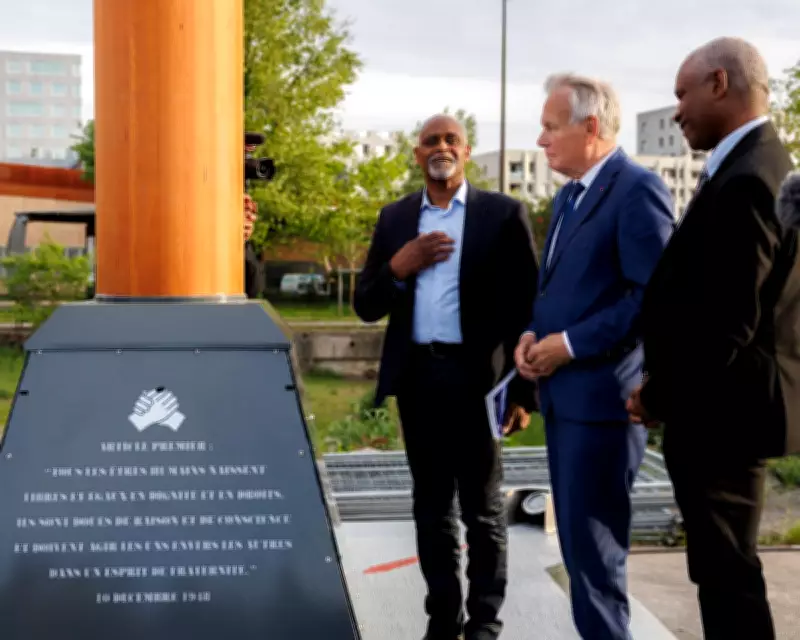
In the French port city of Nantes, once France's largest departure point for ships that trafficked enslaved Africans across the Atlantic, a new wooden mast rises 18 metres into the sky from the waterside. The Mast of Fraternity and Memory, inaugurated this month, marks a turning point in France's complicated relationship with the legacy of its history of enslavement, just as President Emmanuel Macron faces pressure to make key announcements on reparatory justice.
Grassroots Initiative Breaks Taboos
Dieudonné Boutrin, a 61-year-old descendant of enslaved Africans trafficked from Benin to Martinique, created the mast. He heads the grassroots organisation La Coque Nomade Fraternité, dedicated to breaking the silence around slavery and fostering discussion on reparatory justice. The mast, a permanent standalone structure, was conceived by descendants of enslaved people and built by local vocational college students. Inaugurated alongside a new International Federation of Descendants of the History of Slavery, it is expected to be replicated in other cities, with the next likely in Bristol, England.
Boutrin said: 'We're not responsible for the past, but we are responsible for the present and future.' He grew up in Martinique, where his father was a cabinet maker, and faced poverty after his mother died. He noted a taboo around discussing slavery heritage, which he only confronted after moving to Nantes. 'It wasn't spoken about. There was an aspect of shame around it, because enslavement had left such huge consequences.'

Political Pressure Mounts
The mast's inauguration highlights growing pressure on France to announce a framework for reparatory justice discussions. Macron is entering his final months as president amid a political row over racism and as the far right polls high ahead of the 2027 presidential race. Anger has surged after France abstained from a March UN vote describing the transatlantic slave trade as the 'gravest crime against humanity' and calling for reparations. Senator Victorin Lurel wrote to Macron that France had committed a 'moral, historic, diplomatic and political mistake.'
From the 16th to 19th centuries, France was the third largest European nation in the transatlantic slave trade, responsible for about 13% of the estimated 13 to 17 million Africans trafficked. In 2001, France became the first country to recognise slavery as a crime against humanity, but campaigners say it must now go further. Paris is crucial to global reparations discussions because several overseas departments and regions remain part of France, where structural inequalities are seen as a direct legacy of enslavement and colonialism.
Haiti Reparations Demand
France also faces demands for potentially billions of dollars in reparations to Haiti, after imposing a harsh financial penalty in 1825 to compensate slave owners following the Haitian revolution. That debt was only fully repaid in 1947. In 2025, Macron announced a joint commission with Haiti to examine the issue, with conclusions due by year-end.
Family Apology and Dialogue
Pierre Guillon de Princé, a descendant of 18th-century Nantes slave shipowners, made what is thought to be the first formal apology in France for a family's role in transatlantic slavery. His ancestors conducted 18 expeditions transporting about 4,500 enslaved Africans. Guillon de Princé said: 'Faced with the rise of racism in our society, I felt a responsibility not to let this past be erased.' He pushed for dialogue on reparation, adding: 'If we don't speak about this, we can't tackle the real problems of today.'
Jean-Marc Ayrault, former Socialist prime minister, said France must not be seen as 'sleeping through' this key moment and must galvanise other European countries. Until now, France has focused on restituting looted artefacts, but organisations now want a focus on people and communities. Legal recourse has not proved viable; in 2023, France's highest court rejected a demand for state reparation for descendants of enslaved people in Martinique.

International and Local Voices
Marie-Annick Gournet, born in Guadeloupe and an associate pro vice-chancellor at Bristol University, said: 'In 2001, France recognised this as a crime against humanity, but if there are no actions to redress that issue then it's just a void law.' She noted that inequality in Martinique and Guadeloupe 'does feel that there's a continuation of colonisation on these islands.'
Aïssata Seck, director of the Foundation for the Remembrance of Slavery, said reparations remain a taboo subject but hoped France is ready to open discussions. She stressed that France is the European country with the most people of African descent, linked to colonial enslavement, and 'the means allocated to this must be substantial.'
Asher Craig, former deputy mayor of Bristol, said work like Boutrin's 'led by Black communities is still not supported at the level it should be. That's not accidental. It's systemic.'