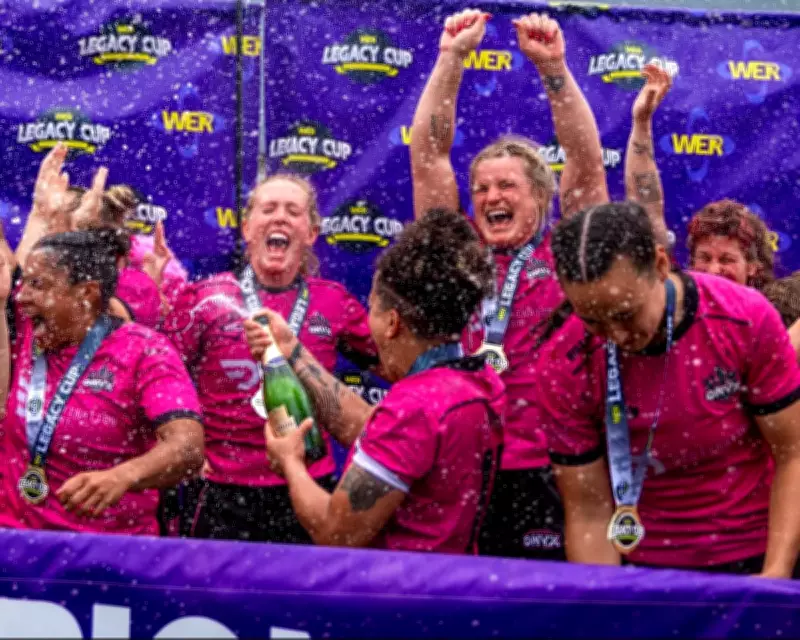
Women's Elite Rugby (WER), the semi-professional women's rugby union competition in the United States, kicks off its second season this Saturday with matches in Massachusetts and Illinois. The league aims to build on its inaugural year, having learned valuable lessons and secured new investors, including Grammy-winning pop star Meghan Trainor.
A League Born from Passion and Necessity
Dr Jessica Hammond-Graf, president and chief sporting officer of WER, reflects on the league's origins. A former fly-half who discovered rugby by chance at the University of Connecticut in the early 1990s, she now leads the charge to professionalize the sport. "We needed to evolve from the grassroots," she says. "The leadership at the time was great, but it's really hard to be a player-led organization. We wanted to elevate that for the players and for rugby in general."
The league was launched from the foundation of the amateur Women's Premier League (WPL) in 2022, spurred by the awarding of the 2033 Women's Rugby World Cup to the United States. Hammond-Graf, who had stepped away from rugby, was part of the first external board that transitioned the WPL into WER. "My background in college athletics could help guide the direction of the league," she explains.

Season One: Lessons Learned
Season one saw six teams compete: Denver Onyx, New York Exiles, Bay Breakers, Chicago, Twin Cities, and Boston. Denver emerged as champions, winning nine of ten regular-season games before defeating New York 53-13 in the Legacy Cup final. However, the season was not without challenges. "Securing venues has probably been the hardest thing," Hammond-Graf admits. "We don't need 20,000-seat stadiums to capture an audience. Finding the right-sized venues has been key."
For season two, the league has pivoted to new venues: the Bay Breakers will play at Heart Health Park in Sacramento, and Chicago moves to Benedictine University, offering better training facilities.
New Investors and Controversies
Meghan Trainor's investment marks a significant boost for the league, announced this week with fanfare. However, the season also brings challenges, including a controversial change to USA Rugby rules regarding transgender players in women's rugby, driven by Olympic status and federal pressure. WER has stated it "does not agree" with the change and will "actively work to ensure inclusion both on and off the pitch."
Building a Pathway to the World Cup
With the 2028 Olympics in Los Angeles and the 2031 Men's and 2033 Women's Rugby World Cups on US soil, WER aims to build a fanbase and create a clear pathway for players. Five WER players were selected for the US Eagles squad in the recent Pacific Four series, which included a historic win over Australia. Hammond-Graf notes that many top American players still earn a living in England's Premiership Women's Rugby, but WER provides a domestic platform.
The league is also scouting college talent, with coaches visiting campuses to identify prospects. "We want to eliminate barriers to try out for WER," Hammond-Graf says. "We know there's a lot of people with rugby skills who can relocate, so we're casting a wide net."
Looking Ahead: Expansion and Parity
Season two features continuity in coaching, with five of six teams retaining their head coaches. Chicago, winless in season one, hopes to improve under Kristin Zdanczewicz, who took over mid-season. Hammond-Graf seeks greater parity to keep fans engaged. "We know fans will stick around for exciting matches. Tight games keep people involved."
Expansion is on the horizon, targeting regions like Washington DC, North Carolina, San Diego, and Los Angeles. "There's a lot of talent that for whatever reason can't play in WER right now," Hammond-Graf notes. "We know there'll be good movement coming."
The league's ultimate goal is to elevate women's rugby in the US, inspiring the next generation. Hammond-Graf recalls attending Senior Day at Dartmouth College, where a graduating player announced plans to play professional rugby. "It just made my heart swell," she says. "That recognition that this is possible now—young players can see a pathway forward."