Derek Chisora's Final Chapter: From Chaos to Clarity at 42
At 42 years old, with countless miles on the clock and visible scars to prove it, Derek Chisora continues to navigate his boxing career entirely on his own terms. On a grey London afternoon inside his training camp, music thumps in the background, laughter echoes down the corridors, and Chisora—shirt damp with sweat, eyes vividly alive—holds court as only he can. This comes just days before his highly anticipated showdown with Deontay Wilder at the O2 Arena this weekend.
The chaos, the charisma, and the theatrical flair that have defined his career remain unmistakably present. However, spending extended time with him reveals deeper layers: reflection, raw honesty, and a man acutely aware that the final chapter of his fighting life is rapidly approaching.
The Battle Outside the Ring
To truly understand Derek Chisora, one must comprehend the intense struggle he has faced outside the ring, particularly his battle with alcohol. He addresses this with unflinching candor, refusing to dress it up or dodge the issue.

'My mum told me I would ruin my legacy if I kept drinking. I used to drink a lot, but I stopped,' he says, leaning forward and lowering his voice slightly. 'I would still drink now and then, but when I would go into camp I would stop drinking enough to be able to get through it.'
'I was drinking before each camp though, and what you have to understand—when you've been drinking for three or four months and then you stop for two months while training, those first two months are about getting the alcohol out of your system. So I had to stop. I could notice the impact it was having on me.'
Chisora has openly revealed all about his alcohol battle during his career, and now, at 42, he prepares to fight rival Deontay Wilder on Saturday. His nephew, Jermaine Dhliwayo, 24, will also feature on the undercard, adding a family dimension to the event.
A Turning Point in Monaco
There wasn't a single moment that changed everything immediately, but the Monaco fight against Agit Kabayel proved pivotal. That European title fight defeat still clearly frustrates him, yet in his own words, it also saved him.
'I lost that fight in Monaco and that was a blessing from above, from Jesus Christ. That fight was eight years ago but it changed everything. I lost that fight, even though I feel like I should have won it. I came back and said to myself, something has to give. Before that, I'd even had a fight with someone in a nightclub, and I thought, no—something has to change.'
'That was it. I was born again. I sold all my alcohol—I used to collect wine—so I sold all my wines, my spirits, everything. I stopped drinking. I was born again, and that was it. From then on, you have to understand, everything is a process. When God shows you something, you have to follow it through.'
He pauses, nodding to himself as if replaying the moment. For a fighter who built a career on chaos, it's striking how much of his turning point is rooted in stillness—in faith and clarity.
An Unlikely Alliance with David Haye
Even after his spiritual rebirth, something felt incomplete. The next step came to him almost like a vision.
'I was born again then, but something was still missing. Something wasn't complete. For some reason, I kept feeling like I needed a good manager. I kept praying, and I had a vision of David Haye. I went to see him in a hotel.'
'I told him straight: we hadn't seen each other since the fight, but every time we did, there was that energy between us, like we wanted to fight. I called him, we sat down in the hotel, and I asked him about management. He looked at me in shock—I'm telling you, real shock. Then he said, 'I'll let you know.' And that was it.'
This alliance is particularly remarkable given their history. This is the same David Haye he once clashed with so violently at a press conference that it cost him his licence—a rivalry built on genuine animosity. For it to come full circle, from chaos to trust, encapsulates his journey perfectly.

The Philosophy of Choice and Gimmicks
'You have to understand—God shows you the way all the time. The question is whether you choose to follow it. It's like that film The Matrix, you know? Which pill do you take? Do you take the pill of going out tonight with your friends and having the best night of your life, or the pill of staying home so you can train properly tomorrow and progress in your career? Most people choose one pill and that's the going out pill. I couldn't keep taking the pill anymore or I would have never amounted to anything.'
This sense of choice—chaos versus control—has defined Chisora's career, including his approach to self-promotion in a brutally competitive boxing landscape. Long before social media dominated, he understood the value of spectacle.
'It was actually Dean Powell and one of the Daily Mail journalists that suggested it,' he says of the now-iconic Union Jack bandana. 'We were all sat in a restaurant together and we came up with the idea of me wearing the Union Jack. Because, if I'm being honest, I would've been hard to sell. Before that, I was difficult to sell in boxing.'
'Remember, there was Eddie Hearn, Barry Hearn, Frank Warren, Kellie Maloney, and Mick Hennessy—all these different promoters with their stars and big names and that's all they cared about. There were so many fights happening every week, and you had to sell tickets to make money.'
'Sky Sports was putting on five shows every month, so it was tough to get a look in. Because of that, we had to come up with a gimmick. That's what I'm trying to say to you—gimmicks work. You have to come up with something and wearing the Union Jack and acting the way I did was my gimmick.'
It evolved beyond a mere gimmick into his identity—wrapped in the flag, loud, unpredictable, and impossible to ignore. He became the 'bad boy' of British boxing, flipping tables at press conferences, brawling with opponents before the bell, and thriving on chaos as much as the fighting itself.
No Regrets and Personal Evolution
'Would I change what I've done throughout my career, the bad boy stuff? No, I wouldn't change it. I'm still a bad boy, but now I'm a grown-up bad boy, a bad man. I'm not a bad boy anymore; I'm a bad man now. So I've changed, you know, from a bad boy to a bad man.'
'But it's important to say that everything I've done in my career over the last 10–15 years has never been staged. I don't have any regrets at all. Yeah, I spat in someone's face. Yeah, I fought David Haye. Do I regret it? No. Did I apologise? Yes, I did apologise. You know, it is what it is, we move on.'
For a long time, many didn't like him—even those closest to him. That, too, has shifted.
'I was hated, then I was loved. You can't beat that. At the beginning of my career, everybody hated me, even my friends. They were saying, 'That's not boxing.' I was just doing what I needed to do to make money. Then suddenly they liked it. Became fans. It's been a real journey and I am happy with how it has played out.'
There's a grin as he says it—part pride, part disbelief. The man who once thrived on confrontation now spends his downtime in a very different arena.
'I'm a father of girls now, girls soften you up,' he says, laughing. 'Instead of going out to buy boxing gloves, you're buying teacups. 'Hey, Daddy, do you want to have tea?' So you go and get the tea. Now you're sitting there drinking pretend tea, and you have to play along. 'Oh wow, this is nice, careful, it's too hot.' It's not easy, you have to really get into that game. It's just what it is. It makes you softer that for sure.'
It's a striking image—the same man who once flipped tables now carefully pretending tea is too hot. But back in camp, reality reasserts itself. The body, he admits, doesn't lie anymore.
Confronting Retirement and Legacy
'Shut the f*** up man. Older, what you talking about older? Get the f*** out of here. I am a f***ing stallion what are you talking about,' he jokes, before breaking into laughter.
'Only joking, my body is f***ing killing me. F*** man, my body is f***ing killing me. Let me tell you something: being in your 40s is no joke. You can't just get up and go anymore, I'm feeling it, and I'm not surprised.'
'Even with running, you have to start by walking, then walking fast, and only then start jogging. You can't just jump straight into it. You've got to get up, sit on the side of the bed for about 20 minutes, wait, then stand up and sometimes sit back down again. I'm getting old… but come next week, I'll fight like I'm 21 years old.'
That defiance—part bravado, part necessity—underpins everything about this final run. Chisora knows what's coming, even if he doesn't quite know how to face it.
'I see a therapist about retirement. And when I talk about it, it's scary. Retirement is very scary,' he admits, the mood shifting again. 'You have to understand, from amateurs your life is already mapped out.'
'You go to school, come back, get your bag, go to the gym, come back, do your homework, go to bed. Then you turn pro and it's the same thing, just on a bigger scale. People tell you what to eat, what to do, what to be. That's your whole life.'
'And then one day you get a knock. 'It's retirement. You need to retire tomorrow.' And that's it. The door shuts. You don't know anything else. Yes, you've got money, but money doesn't make you happy. What made you happy was the suffering—the running, the sparring, being in the boxing gym. That's where your purpose was.'
'That's the scary part. Very, very scary and not just for me, for everybody. That's why a lot of athletes, when they retire, they don't have anything else. So what do they do? They pick up a bottle and start drinking. They're trying to run away from something they can't run away from.'
'I cried walking to the ring during my last fight in Manchester. I was crying. It's very emotional. It's scary. You don't know if that's the last time.'
Political Alliances and Final Contradictions
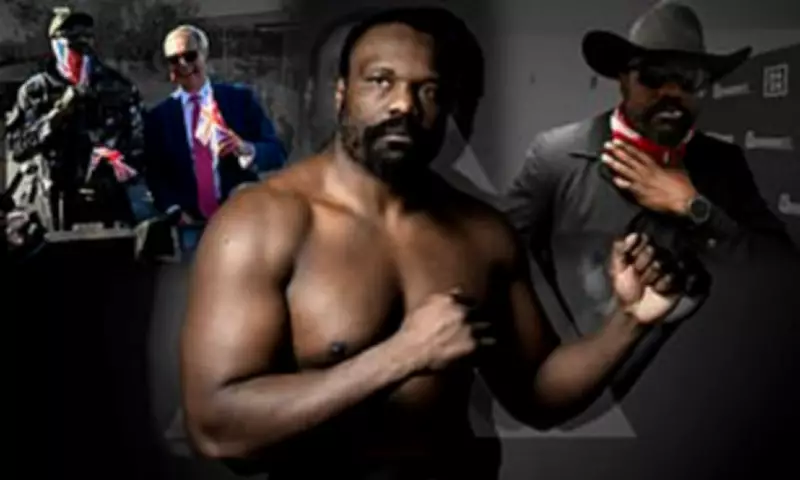
Outside the ropes, Chisora remains as headline-grabbing as ever. Just this week, he rolled into a central London press conference in a tank alongside Nigel Farage, the leader of Reform UK. Their friendship has grown in recent years, rooted in shared views on Brexit and 'British identity,' with Chisora unapologetic in his support and comfortable using the Union Jack as both symbol and sales tool.
This represents the ultimate extension of the gimmick he once needed—now transformed into something more personal, political, and unmistakably his own. As fight night looms, the contradictions remain: the bad man who plays tea parties, the showman who found religion, the veteran who still insists he's a stallion.
One last fight. One last walk. One last roar.