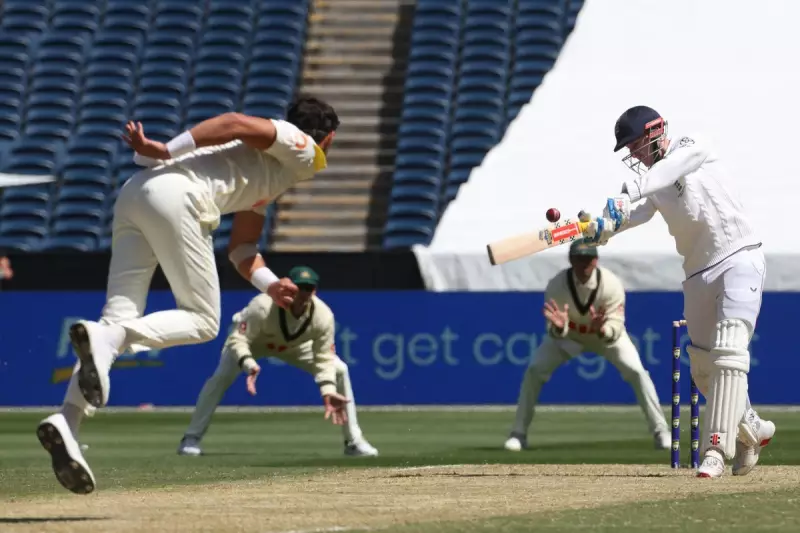
On a dramatic opening day of the Boxing Day Test at the Melbourne Cricket Ground, where a staggering 20 wickets tumbled, one innings stood out as a symbol of England's internal conflict. Harry Brook, walking in at a perilous 8 for 3, charged at Mitchell Starc first ball, missed, and smiled. His subsequent, counter-attacking 41 from 34 balls was the day's highest score, but it laid bare a team seemingly caught between its revolutionary identity and the pressure of an Ashes series in Australia.
The Innings That Defined a Day of Carnage
Friday, 26 December 2025, at the MCG will be remembered for bowler dominance. Australia were dismissed for 152, but England's reply swiftly found itself in tatters at 16 for 4. While Joe Root laboured for 15 balls for a duck and others nicked off defending, Brook alone embraced the philosophy England have championed. He "ran towards the danger," as the team's rhetoric often goes, striking two sixes in his brief but blistering knock. By the time he was out, he had scored 62% of England's total of 66 and almost a third of Australia's first innings score.
A Stark Departure from 'Bazball' Principles
The broader context of the tour makes Brook's lone assault even more telling. Under captain Ben Stokes and coach Brendon McCullum, England's run-rate in Australia is their lowest in 16 series. After an initial defeat in Brisbane, Stokes urged his team to "fight" and called the dressing room "no place for weak men." The result, notably on a flat Adelaide pitch, was uncharacteristic caution. Australian skipper Pat Cummins labelled their batting there "surprising" and was "pretty happy" they shut up shop.

This shift represents a fundamental tension. The 'Bazball' approach, often analysed as a response to mental health pressures in elite sport, was built on unwavering self-belief. Yet in the Ashes crucible, that conviction has wavered. As former England bowler Stuart Broad noted on SEN radio regarding the MCG pitch, "Test match bowlers don't need this amount of movement to look threatening." On such a surface, only Brook played with the advertised freedom.
Sticking to the Guns or Bending to Pressure?
England's selection for Melbourne hinted at a desire for aggression, with explosive hitter Will Jacks positioned at number eight. Yet, when the situation demanded their trademark positive cricket, the majority retreated. Brook's history supports his method: his scores when arriving with England three down for less than 30 are 186, 26, 123 and 158.
The team now faces a familiar critique. Had they attacked relentlessly and collapsed, they would be accused of stubbornness. By tempering their approach, they stand accused of losing their identity. They closed the day trailing by only 46 runs with four wickets in hand, still in the contest but philosophically adrift. As the political analogy in the stands suggested, they may have chosen to hurt themselves by straying from the values that defined them, a conscious bend of their own free will in the face of Ashes carnage.