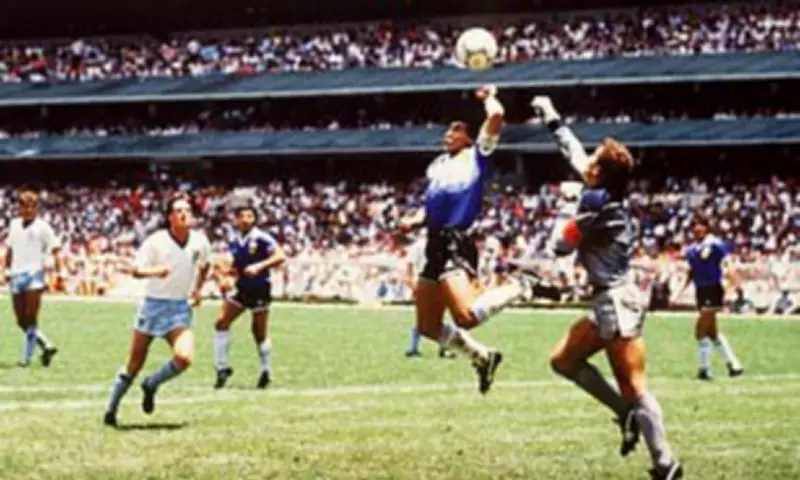
Those of us who were not present will never forget it: Diego Maradona's blatant handball followed three minutes later by his sublime second goal, met with reluctant admiration from Barry Davies in the BBC commentary box. 'Oh, you have to say that's magnificent,' he exclaimed.
For English fans whose memory spans 40 years, the two goals Argentina scored in the quarter-final of the 1986 World Cup are among football's 'JFK' moments. We all recall where we were. I was watching in my girlfriend's sister's cramped South London bedsit, on a small black-and-white TV. Not even monochrome could drain an extraordinary game of its colour.
In Argentina, that quarter-final at the Azteca Stadium in Mexico City looms even larger in the collective memory, so much so that an Argentine-made documentary about it, which premiered at the Cannes Film Festival on Wednesday, is simply called El Partido, or The Match.

One might think that one of their three victorious World Cup finals would claim the definite article. The first, in 1978, was on home soil, for heaven's sake. But no. It appears that for them, this will forever be the match. The film, adapted by writer-directors Juan Cabral and Santiago Franco from a non-fiction book of the same title, explores the reasons why. Unsurprisingly, one of them concerns a scraggy archipelago in the South Atlantic.
Here in Britain, Margaret Thatcher's decision to go to war following Argentina's invasion of the Falkland Islands in 1982 remains a matter of faith. Most of us are less certain about how they were first claimed for the Crown in 1765, but for the film's purposes, that is where the thunderous significance of 'the match' begins, 221 years earlier.
Smartly, Cabral and Franco have enlisted several of the 1986 England players as contributors to The Match, perhaps to avoid appearing as an exercise in shameless jingoism (though it still does, at times). Gary Lineker, Peter Shilton, and John Barnes share their memories, along with some of their Argentine counterparts, including Julio Olarticoechea, whose remarkable goal-line clearance with the back of his head, on 86 minutes with the score at 2-1, prevented Lineker from equalising. In Argentina, that moment is considered the game's second miracle, after Maradona's solo extravaganza. Olarticoechea himself, tongue in cheek, refers to it as 'the Nape of God'.
And so to the game's wildly controversial first goal, which, for all the flaws of VAR, could never happen today. The film reveals that it was not Maradona himself, but a reporter with an Italian news agency, who coined the infamous expression 'the Hand of God'. Some of us have always preferred the verdict of England manager Bobby Robson. It was not the hand of God, he said, but the 'hand of a rascal'.
Cabral and Franco do not exactly try to defend Maradona's act of cheating. But they trace its lineage back to the knockabout street football games in which he honed his spellbinding talent. He admitted to using his hands then too, on occasion, asserting that it did not matter if nobody noticed. Bluntly, he had form, hence the sly and well-rehearsed flick of his head as he outjumped Shilton to fist the ball into the England net. That is what fooled the hapless Tunisian referee.
Outrageously from an English perspective, the film invokes the 1966 World Cup final as moral justification for Maradona's Hand of God swindle. It shows only one goal from that game, and you can guess which. Moreover, it carefully shows Geoff Hurst's extra-time strike, the one that put England 3-2 ahead against West Germany, from an angle suggesting the ball did not cross the line after hitting the bar. For a Tunisian referee, read an Azerbaijani linesman. The clear message to us is: you win some, you lose some.
In that same tournament, England and Argentina clashed in more ways than one, meeting in a notorious quarter-final at Wembley in which Argentine captain Antonio Rattin was sent off after a series of shocking fouls. After the game, when England right-back George Cohen tried to swap shirts with an opponent, manager Alf Ramsey intervened, saying 'we do not exchange shirts with animals'. In England, Ramsey's 'animals' crack has always been a minor footnote in the triumphant story of 1966. In Argentina, it rankled for 20 years, until they had the sweetest revenge.

The filmmakers acknowledge England's place as the cradle of football, the country that invented and codified 'the beautiful game', which was introduced to South America by British railway workers in the late 19th century. But for every homage, there is a mischievous slight. The snapshot on June 22, 1986, which established beyond doubt that Maradona scored with his hand, was taken, we are told, by a Mexican photographer. But even that ended up in the hands of the rapacious English, the film alleges, as an agency whisked the rights from under the nose of the poor uncredited fellow.
Worse still, an Englishman also claimed the 'holiest relic' in Argentine football history, the number 10 shirt that Maradona swapped after the final whistle with England substitute Steve Hodge, and which festered in Hodge's attic for years until he sold it at auction four years ago for a staggering £7.1 million.
If we can set aside our indignation at the anti-English bias, which is tackled with a pretty light touch (unlike one of Rattin's tackles), this is a worthwhile documentary. There is some great material about the eccentric Argentina manager Carlos Bilardo and his bizarre array of superstitions and rituals. But more than anything, it is a film about a nation's veneration of one man, who unveiled the very best and the very worst extremes of his footballing personality barely three minutes apart, 40 years ago next month. Yet that is not how his adoring countryfolk see it. Not at all.