There is a striking commonality whenever stars of yesteryear reflect on their time in the game. It is never the goals and the glory which are foremost in their thoughts. It is the ones that got away. The bigger the miss, the bigger the sense of regret. Does Gary McAllister know it?
A First Division title winner with Motherwell, the midfielder won the English championship with Leeds before claiming an extraordinary cup treble with Liverpool in his mid-30s. In his mind, though, it always comes back to that scorching day at Wembley.
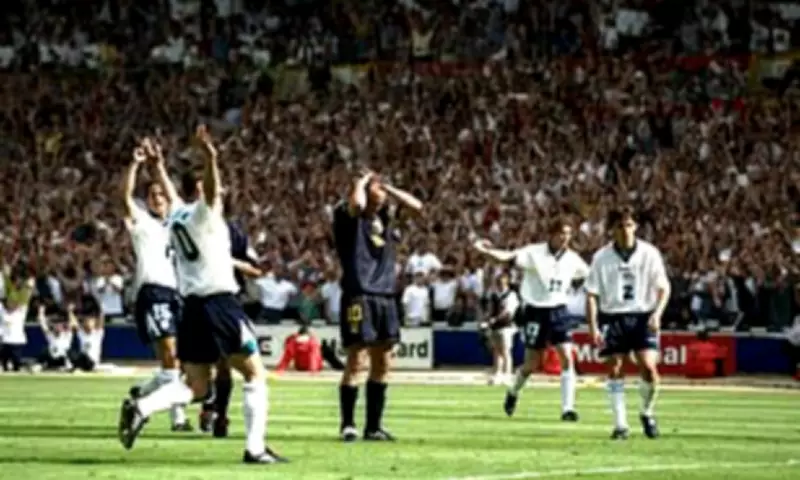
June 15, 1996: Stuart McCall’s cross, Gordon Durie’s smart thinking, David Seaman standing between the posts, a moving ball, Uri Geller, the genius of Gazza, and almost 30 years of hurt. Gary McAllister has his hands in his head after missing that penalty against England in 1996. McAllister battles with England's Paul Ince in Scotland's 2-0 defeat at Euro 1996.

‘You think the world has ended,’ McAllister reflects. ‘I still dream about it now. Every time I see a penalty, it never goes away.’
A few years ago, he watched the game back in its entirety for the first time. If he was seeking solace from the final score reflecting the balance of play, then he would not have found it. Almost lost among the fallout was how well Craig Brown’s side played. They were unfortunate when Alan Shearer put England ahead early in the second half. Had McAllister converted from the spot, all the momentum was with them. We know what happened next. In the blink of an eye, a moment of brilliance from Paul Gascoigne took the game away from us. Even for long-suffering members of the Tartan Army, this was a whole new level of cruelty.
‘The build-up was special,’ McAllister recalls. ‘I have a lasting memory of walking out. Our fans were outnumbered, but the noise coming from the Scotland end was very powerful. In my eyes, it was one of the biggest honours you can have: being the captain of your country, leading your team against the old enemy at Wembley. I do not know if it gets any better than that. It was only during Covid that I watched the game back. I did not realise how well we had played. I knew exactly where I was going to put the penalty. If I score it, I think we win the game. This is not an excuse, but my stock penalty was always up to the keeper’s left. That is where I wanted to go. As I am shaping to lean over the ball, it shuffled. Half a ball. Seaman makes the save, it goes to the left wing and Gazza scores. And the rest is history...’
McAllister’s painful recollections form the centrepiece of Icons of Football, one of six episodes in the third series from the BBC. Perhaps long forgotten is how stoically he dealt with such a crushing moment. Gary McAllister and Stuart McCall are dejected as Scotland exited Euro 1996 at the group stage. The same broadcaster submitted a request for him to come to their studio to reflect on the match, fully expecting to be told he was lying low. It says much about McAllister’s class that he did what he felt was his duty.
‘I was adamant that I had to go and speak because I just always felt that was the responsibility of the penalty kick-taker and being captain as well,’ he explains. Abdicating responsibility did not even enter his head when Scotland were next awarded a penalty against Belarus in a World Cup qualifier. McAllister scored that one. Scotland made it to France, although he missed out with a knee injury. That contribution seemed forgotten when elements of the support booed him in what proved to be his final cap against the Czech Republic.
The programme is another compelling watch which contextualises what was one aberration in an otherwise sparkling career. Born in Bellshill, he grew up a Motherwell supporter and started playing for the Fir Park team’s boys’ club. Sir Matt Busby’s connections with the town of his birth gave him a soft spot for Manchester United. He spent school holidays training at Old Trafford only for their interest to fade. When the ‘hammer blow’ arrived, he resolved to sign with Motherwell. ‘Looking back, that was probably a good move,’ he reflects.

He won the First Division in 1985. Gordon Milne, then Leicester manager, came up looking to sign Ally Mauchlen. He left having also snared McAllister for a combined £350,000. ‘I was very proud to play for my hometown club, but I needed to prove that I could go south of the border,’ he adds. ‘It was the opportunity to go and play at White Hart Lane, Highbury, Old Trafford and Anfield. That is what drove me.’
McAllister lived the dream for two years before the Foxes were relegated. Paradoxically, it was the best thing to happen to him. ‘David Pleat was exceptional,’ he notes. ‘He had worked with one of my favourite players, Glenn Hoddle, at Spurs.’ With his contract running down, there was talk of a move to Nottingham Forest and Leeds. ‘Being a Brian Clough fan, David pushed me towards Nottingham Forest,’ he recalls. ‘As soon as I mentioned Leeds to Clough, he kindly asked me to leave the building. Clough and Leeds, they did not get on.’
He felt the burden of history when he moved to Yorkshire to join the newly promoted club in 1990. ‘Billy Bremner would still be coming to Elland Road, so would the Grays, Eddie and Frank. On occasions, Gordon McQueen and Joe Jordan,’ he explains. ‘You always had that feeling, like, oh, how well did these guys do at this club?’
Pleat had improved his tactical acumen. At Leeds, Howard Wilkinson ensured he could demonstrate it more often. ‘He says, “listen, you should be finishing higher up on these running stats,”’ McAllister says. ‘That goes in. My game definitely jumped.’ Wilkinson’s side were not just among the fittest in the country. With David Batty and Gary Speed joining McAllister and Gordon Strachan, they had the perfect midfield blend. They finished fourth in 1991 and looked on course to finish second behind Manchester United the following year before the wind changed direction.
‘United were playing away at West Ham,’ McAllister says. ‘That evening, I was judging a karaoke in a place called Gipton, a big Leeds stronghold. There was a mad roar that went up when West Ham scored. That was the moment I thought, “we can win this”. I will never forget the fact that it was Meatloaf that won the karaoke with “Bat out of Hell”.’ Leeds beat Sheffield United before the squad gathered at Lee Chapman’s house the next day to watch United hand them the title by losing at Liverpool. It remains the last time they were champions of England.
‘I still like going to watch games at Elland Road,’ McAllister adds. ‘If there is a Scotsman playing for Leeds, they might look up and go: he was a winner here.’
He moved to Coventry in 1996, playing with and then for Strachan. Strachan thought he was ‘playing a game’ when his compatriot, then 35, dropped Liverpool’s interest into contract talks in 2000. Not so. ‘We were a gang of toerags,’ admits Steven Gerrard. ‘I was one of them, Jamie Carragher, Michael Owen, Danny Murphy. He brought experience, a lot of wisdom. Gary was vital for me.’
On the role Gerard Houllier envisioned for him, McAllister says: ‘I was more how to navigate Monday through Friday, setting an example of what it takes to play well on a Saturday. Sitting with the players after a couple of days, I am having a look around and going, well, surely this group of players can win something?’
That suspicion was confirmed in February when they clinched the League Cup by defeating Birmingham on penalties in Cardiff. McAllister took and converted the first. Three months later came the FA Cup. A 2-1 win over Arsenal was sealed thanks to Owen’s double in a classic game of rope-a-dope in which McAllister made a telling contribution from the bench.
Having beaten Barcelona in the semi-final of the UEFA Cup through another penalty from the Scot, Houllier’s men faced Alaves in the final. An astonishing game in Dortmund saw McAllister start the match and score another penalty to help the Reds establish a three-one lead. The Spaniards somehow pulled themselves level, went behind, then made it 4-4. With penalties beckoning, McAllister’s free kick saw Delfi Geli inadvertently score the golden goal which finished the game.
‘He put that delivery in at such a key time,’ Gerrard recalls. ‘I think that is where the best players know what to do. He ran the game.’ Having scored one goal and had a hand in three others, there was no other candidate for the man of the match award, which was presented by Johan Cruyff. Not a bad swan song for a 36-year-old. More goals and glory. A fitting summary of a career which knew plenty of them.