England Rugby's Historic Defeat to Italy Sparks Crisis and Questions Over Borthwick's Future
The contingency planning must begin in earnest. Empires have been built and demolished in Rome, and English rugby suffered a seismic defeat that leaves big questions hanging over Steve Borthwick's future as head coach. The Rugby Football Union will not make any changes after one disastrous campaign, but if things do not turn around by the summer, then the coach's substantial salary will be increasingly hard to justify.
A Record Shattered in Rome
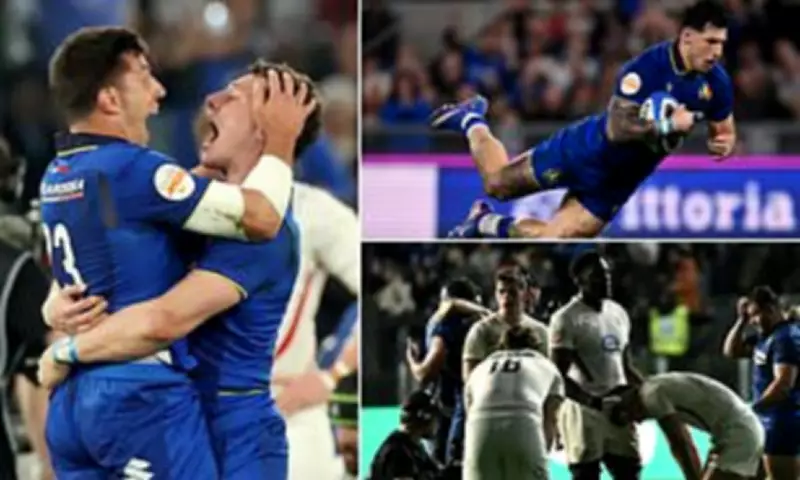
England had never lost to Italy in their entire history, but their proud 34-year unbeaten record is now decisively over. England's broken players gathered in a despondent huddle on the pitch after the final whistle, with Maro Itoje delivering some brow-beaten words of consolation. Yet what on earth could he say to his team, whose next two Tests are daunting away fixtures against France and South Africa?
Borthwick threw on Marcus Smith, Henry Pollock, and Chandler Cunningham-South in the desperate final throes of the match, but nothing could rescue their team from this alarming and historic collapse. Their discipline was shocking throughout. Borthwick has spent the past fortnight emphatically talking about the critical need to keep 15 players on the pitch, yet two of their most experienced forwards, Itoje and Sam Underhill, sat side-by-side in the sin-bin during the second half. The coach's messages have clearly not penetrated the squad.

Public Patience Wears Thin
Recent weeks have shown that Borthwick has little credit left with the rugby public. There is scant sympathy for his scientific methods and data-driven approach when results go south. Fans do not care for complex projections or analytics. The only statistic that truly matters to them is the one on the scoreboard. England are now in full crisis mode, and the players looked utterly shell-shocked after full-time in Rome.
England's profound pain was starkly contrasted by the utter jubilation from the victorious Italian players. Star centre Tommaso Menoncello scored a crucial try for the hosts after cutting a great line through a porous English defence, symbolising the shift in momentum.
Succession Plans and Parallels to Past Failures
You hear little about succession plans from the RFU these days. During the Eddie Jones era, the Twickenham executives trumpeted for years about having a war room full of viable candidates. A huge upset in Paris or Johannesburg could potentially drag England out of the pits, but if things do not improve markedly in the July Tests, then the damage to the team's reputation and morale could be unrepairable.
There are clear parallels here with England's defeat by Fiji just before the World Cup. England crashed to a new low on that occasion, yet they somehow emerged from the wreckage to reach the semi-finals. The crucial difference now is that Borthwick has had three full years in the job, and he must now justify that his methods have legs and can produce sustained success.
On-Field Failures and a Disjointed Performance
England's management often points towards 22 entries and final margins to validate the way they play. They talk incessantly about fast starts, yet they have now failed to score in the first quarter since their opening game against Wales. They talk about keeping 15 players on the pitch, and they failed catastrophically with that objective too.
Outside the Stadio Olimpico, fans gathered around the big screens trying to make sense of Scotland's early victory over France. They wore pizza hats and Henry Pollock headbands and pondered the grim fact that England could finish bottom of the Six Nations if they lost in Rome. They watched a Scottish team who looked unshackled and creative, and wondered why England make the game look so agonisingly difficult.
A Match of Errors and Missed Opportunities
England's day could not have got off to a worse start. Tom Curry limped off the pitch during the warm-up and was replaced by Sam Underhill. They made their way into Italy’s 22 three times in the first 10 minutes. They had 74 percent of the possession and 96% of the territory, but Ben Spencer kicked the ball into touch, Alex Coles lost the ball at the back of a lineout, and Seb Atkinson was turned over. It was cagey and error-strewn.

Fin Smith was charged down in his own half and Spencer was picked off at the breakdown. So much for a fast start; Italy were 3-0 ahead after 21 minutes. Jamie George and Maro Itoje both required treatment, and Ellis Genge had blood pouring down his face as the scrum barely bailed out Borthwick’s team.
With 26 minutes on the clock, England finally scored. Ben Earl carried hard off a lineout and finally there was a glimpse of speed in the attack. Smith, Alex Coles, and Tommy Freeman combined to score a try with distinct Northampton fingerprints. But discipline remained poor. Earl was penalised for obstruction at a maul. There were gaping holes in their defensive line, and Tommaso Menoncello ran straight between Joe Heyes and Sam Underhill to score. The defensive effort was as soft as a classic Roman tiramisu.
There was an impending sense of doom as the pack closed the gap at the lineout, Simone Ferrari won a turnover, and Murley knocked on a contestable kick. However, in the final play of the half, Smith delivered England's standout moment. As attackers flooded down the blindside, Smith switched direction brilliantly and launched a perfect crossfield kick for Tom Roebuck to score.
The Second Half Collapse
Smith kicked two penalties in the second half before Underhill was sin-binned for a high shot on Danilo Fischetti. Paolo Garbisi kicked two penalties of his own before Itoje was sin-binned for foolishly batting the ball out of the scrum-half’s hands at a maul.
With 72 minutes on the clock, the unthinkable happened. Garbisi launched an audacious kick-pass from around the halfway line and Italy flooded forwards. Monty Ioane and Menoncello charged down the wing, leaving Elliot Daly and Tom Roebuck in their wake. Leonardo Marin scored, and suddenly England were on the wrong side of history.
Staring into the Abyss
If England lose in Paris next week, they could finish bottom of the Six Nations, a position that does not reflect the talent Borthwick has at his disposal. Their 12-match winning run is now a distant memory. They are staring at their worst ever Six Nations campaign, and the RFU must be asking serious questions as a matter of utmost urgency. The empire of English rugby has been shaken, and the rebuilding must start now.