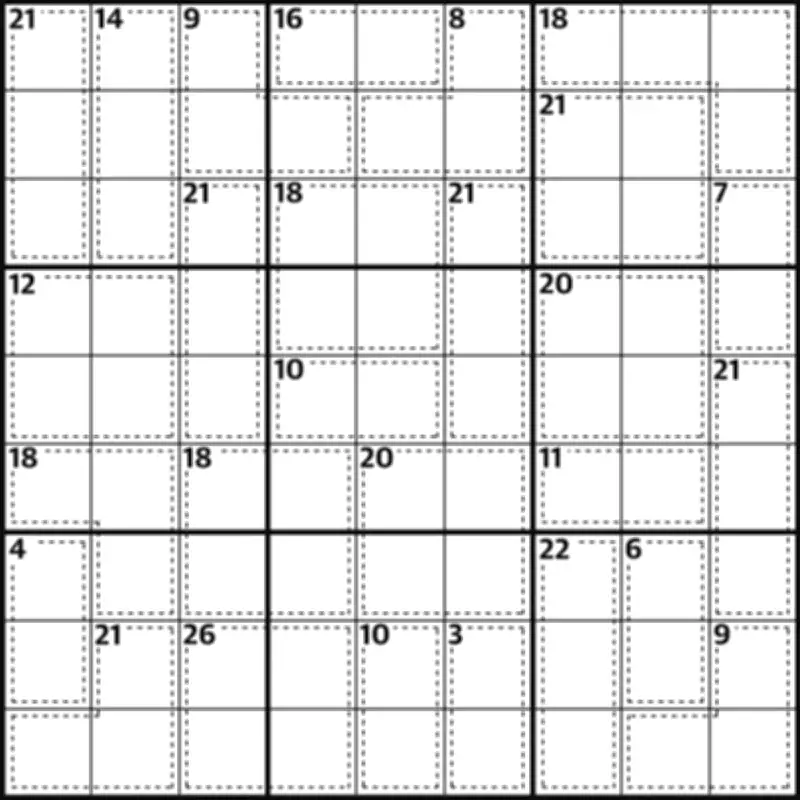
Killer Sudoku puzzle 1017 presents a formidable challenge for enthusiasts of this popular logic game, blending the classic rules of Sudoku with the added complexity of cage sums. This variant requires players to fill a 9x9 grid with numbers from 1 to 9, ensuring no repetition in rows, columns, or 3x3 boxes, while also adhering to the sums indicated in outlined cages.
Understanding the Basics of Killer Sudoku
At its core, Killer Sudoku retains the fundamental principles of traditional Sudoku. Each row, column, and 3x3 subgrid must contain all digits from 1 to 9 exactly once. However, the twist lies in the cages—groups of cells outlined with a dashed line—each marked with a small number representing the total sum of the digits within that cage. This additional constraint introduces a layer of mathematical reasoning, making the puzzle both engaging and mentally stimulating.
Key Strategies for Solving Puzzle 1017
To conquer Killer Sudoku 1017, solvers must employ a mix of logical deduction and arithmetic skills. Start by identifying cages with unique sums that limit possible number combinations. For instance, a cage with a sum of 3 can only contain the digits 1 and 2, as they are the smallest available numbers. Similarly, high-sum cages might involve larger digits, but careful analysis is needed to avoid conflicts with other rows or columns.

Another effective technique is to look for overlaps between cages and standard Sudoku constraints. If a cage spans multiple rows or columns, use the known sums to deduce potential placements, gradually narrowing down options. Patience and systematic elimination are crucial, as rushing can lead to errors that complicate the solving process.
Advanced Tips for Mastering Complex Puzzles
For those tackling more difficult versions like puzzle 1017, consider using advanced methods such as "hidden pairs" or "X-wing" strategies adapted for Killer Sudoku. These involve spotting patterns where certain digits must occupy specific positions based on cage interactions. Additionally, keeping a mental or written note of possible numbers for each cell can help visualize the puzzle's structure and identify breakthroughs.
Practice is key to improving your skills. Regularly solving Killer Sudoku puzzles of varying difficulty levels can enhance your ability to quickly recognize patterns and apply logical reasoning. Online resources and puzzle books often provide step-by-step solutions that can offer insights into effective approaches.
The Benefits of Engaging with Logic Puzzles
Beyond entertainment, Killer Sudoku offers numerous cognitive benefits. It sharpens critical thinking, improves concentration, and boosts memory by requiring players to hold multiple possibilities in mind simultaneously. Engaging with puzzles like 1017 can also reduce stress by providing a focused mental activity that distracts from daily worries.
Moreover, the social aspect of puzzle-solving should not be overlooked. Many enthusiasts share strategies and compete in online forums, fostering a sense of community. Whether you're a beginner or an expert, Killer Sudoku 1017 serves as an excellent tool for mental exercise and personal growth.
In summary, Killer Sudoku puzzle 1017 is a challenging yet rewarding endeavor that tests both mathematical and logical abilities. By mastering the techniques outlined here, solvers can enhance their problem-solving prowess and enjoy the satisfaction of completing a complex puzzle. Remember to approach each step methodically and enjoy the journey of discovery.