Inside Trump's AI 'Fake Army': Selfie Troops and a Digital Ministry of 'Truth'
Emotional videos depicting 'US soldiers' are spreading rapidly across social media platforms, only to be exposed as sophisticated AI-generated fakes. As Donald Trump prepares for potential military action against Iran, a shadowy digital army has emerged online, featuring troops that exist solely within smartphone screens and computer monitors.
The Digital Boots on the Ground
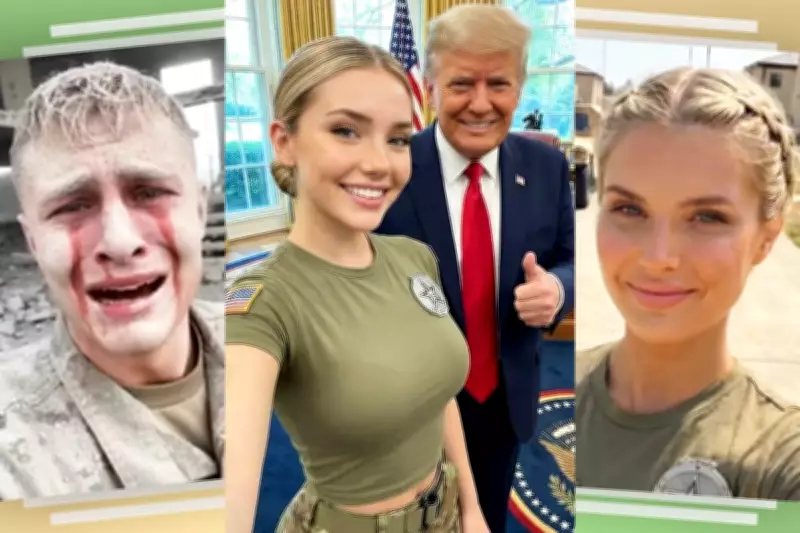
In Dubai, where influencers typically maintain carefully curated personas, 'Private Cole' appears in users' feeds with tears streaming down his face. The soldier stands before gleaming skyscrapers, his voice trembling as he declares: "I need you to listen. I'm standing here in Dubai and I'm honestly terrified right now." Despite his apparent distress, he shows no signs of immediate danger.
Another video features 'Private Amelia,' covered in dust within an ambiguous war-torn landscape. "I almost didn't make it out of these ruins today," she claims. "We take the hits so you live in peace."

These digital soldiers represent various emotional states and situations. Some appear cheerful, smiling alongside comrades while requesting followers. Others stand ready for deployment on aircraft carriers. Tragic scenes show coffins being unloaded from military planes as grieving relatives weep on the tarmac.
The Star Recruit Who Disappeared
The unit's most prominent member was Jessica Foster, a young private pictured alongside Donald Trump, Vladimir Putin, and even football star Lionel Messi. When not ostensibly fighting for the United States, she reportedly earned money selling pictures of her feet to admirers who appreciated both her MAGA-aligned politics and her toes. Her Instagram account has since been deleted, leaving her status as 'missing in action.'
This entire military unit exists only within digital spaces, demonstrating a disturbing reality: while traditional war propaganda has long been problematic, today's automated, incidental disinformation might prove even more dangerous.
The Proliferation of AI-Generated Content
The short-form video ecosystem, which a media.net poll indicates 75 percent of Americans engage with multiple times daily, is becoming inundated with increasingly realistic AI-generated videos. The competition in generative technology has intensified dramatically, with OpenAI recently discontinuing its Sora app due to pressure from competitors like Google and Kling.
Platforms now offer continuously improving software capable of creating convincing videos from simple text prompts. However, these videos gain traction primarily when they connect with current events. The chaotic conflict between Donald Trump, Benjamin Netanyahu, and Iran has destabilized the global economy while drawing worldwide attention. As billions scroll through their phones, already desensitized to daily updates about suffering in Gaza, Iran war videos have proliferated exponentially.
Official Versus Unofficial Narratives
The Trump administration's official output has largely avoided AI, instead favoring shock-and-awe "war porn" videos showcasing rockets hitting targets and advanced weaponry. One caption boasts: "The world's strongest military." Some official content has even spliced strike footage with Grand Theft Auto gameplay in a desperate attempt to engage viewers and reinforce perceptions of military supremacy.
Conversely, Iranian output employs meme characteristics like humor and irony, often accompanied by AI-generated rap songs mocking Trump. Recent AI-generated Lego-style videos reference both the horrific girls' school bombing that marked the beginning of the US-Israel campaign and Trump's connections to Jeffrey Epstein.
Expert Analysis: Memetic Warfare
Dr. Tine Munk, a senior lecturer in Criminology at Nottingham Trent University, has observed similar patterns before. In 2022, she investigated "memetic warfare" emerging online during the Ukraine-Russia conflict, where both sides exchanged memes in digital spaces. "I could suddenly see a pattern emerge in terms of information and communication online," she explains. "I went from researching hackers to more public methods of infiltration."

Munk notes that this phenomenon originates from the highest levels: "We have a president sharing memes and then you have the counter memes from Iran." The US-Iran meme war fundamentally concerns posturing and persuasion.
Persuasion has become particularly crucial given that Pew Research Center findings indicate six out of ten Americans disapprove of Trump's handling of the war, with similar numbers opposing the use of force. Enter the army of selfie troops: "These AI videos rely more on emotion: grief, fear, empathy, and success," Munk observes.
Emotional Manipulation Through AI
The first two emotions—grief and fear—dominate countless accounts that have emerged over the past year. "I miss home. I miss feeling safe. I miss who I used to be," declare Privates Waters and McCoy as they embrace for support. Particularly disturbing is a video featuring 'Private Harper,' who appears to stand on barracks grounds with tanks visible in the background. Through tears, she pleads: "Can someone come here? I don't know what's going on. I can't figure this out," sounding like someone experiencing a dissociative mental break.
Munk has witnessed similar content elsewhere. In late December, a video of a crying Ukrainian soldier went viral before being exposed as AI-generated. It was traced to a TikTok account posting numerous videos of Ukrainian "conscripts" weeping about being sent to front lines. In that instance, the intention seemed clear. With the crying US army corps, the purpose remains more ambiguous.
Alternative Soldier Personas
Another category of soldier within this digital unit avoids fear and sadness entirely. These figures are flirtatious, fun, and serve up candid selfies alongside clickbait questions wrapped in patriotism. This content entered mainstream news recently with the rise and fall of Jessica Foster, an Instagram account documenting an AI-generated 19-year-old woman. Reports suggested links to OnlyFans where fans could purchase pictures of her AI-generated feet.
"I found this disturbing, but I can see what they are trying to do," Munk comments. "War is ugly. They've created a woman who is good-looking, blonde hair, blue eyes. Who says the right thing, who looks the right way."
Building Narratives Through Digital Personalities
Kaia Nube, an Instagram account with 246,000 followers, represents a similar phenomenon. Fans can subscribe to communicate with "her." One caption reads: "I'm a Public Affairs Specialist. If you ever see me dirty from mechanical work or doing different tasks in crazy places, it's because my job is to document moments across all departments and tell the story behind them."
Videos featuring cheerful units declaring "God bless America" appear to bolster narratives of the US as a Christian imperialist savior, building solidarity around specific storylines—something Munk identifies as crucial to memetic warfare. While Jessica Foster-type videos engage certain viewers for obvious reasons, other generative content contradicts the Trump administration's "strongman" narrative by appealing to empathy and sadness.
The Mystery Behind the Accounts
One page called "Britsih [sic] times" shares dozens of crying soldiers, some accumulating millions of views. Direct messages to these social media accounts sometimes elicit responses, though many remain silent, possibly because their pages operate largely automated. Respondents typically avoid revealing their identities, offering only brief messages. Scrolling back through one page reveals comments and posts written in Vietnamese.
Most described pages and videos originate on Facebook, suggesting Meta's monetization scheme for content—which allows users with sufficient followers to earn from view counts—may contribute to this phenomenon. Those who do respond provide particularly strange explanations.
Questionable Motivations
"I created this content to share meaningful moments, aiming to engage viewers and inspire reflection," the owner of the "Britsih Times" page claims. While plausible in a general sense, this explanation appears stripped of ideological intention or genuine drive to persuade viewers about the legitimacy of US bombing campaigns in Iran.
The administrator of "Sky Army" offers more disturbing insight: "We provide military updates from around the world ... we use AI technology to bring everyone a more up-to-date and realistic news context than ever before."
While Munk references her study showing people worldwide creating memes to counter Russian propaganda due to sympathy for Ukraine's plight, the current situation feels different. "It's very difficult when you don't know the actual affiliation that they have," she acknowledges.
Entertainment Versus Propaganda
Could creators genuinely believe that automating hundreds of soldier videos achieves a more engaging "reality" than traditional news? Might this alternate reality fill gaps left by heavily censored reporting from Iran, Israel, and even Dubai—where people have been arrested for filming drone strikes?
Munk remains skeptical, offering a straightforward assessment: "It's entertainment." Often, the propaganda element appears secondary. Yet army AI influencers like Kaia and Jessica readily toe whatever line their prompts dictate. The sobbing privates will likely continue crying indefinitely as memetic warfare persists. Who ultimately emerges victorious remains uncertain, but the battle for digital narrative control shows no signs of abating.