A South Korean startup is capturing the techniques of skilled workers to develop artificial intelligence brains for robots, aiming to deploy humanoid machines in industrial sites and homes within the next few years.
Capturing Human Expertise
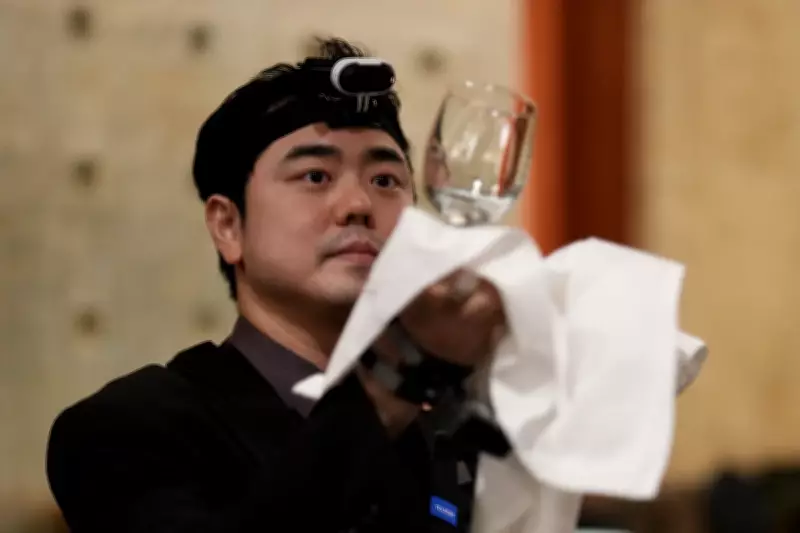
RLWRLD (pronounced “real world”) is working with companies such as Lotte Hotel Seoul, logistics firm CJ, and Japanese convenience store chain Lawson to build an extensive library of human expertise. Workers wear body cameras on their heads, chests, and hands to record every motion, which is then fed into a database to train robots. David Park, a nine-year veteran at Lotte Hotel, participates monthly in these sessions, folding napkins and wiping silverware while being recorded.
Focus on Physical AI
South Korea is investing heavily in “physical AI” — machines equipped with AI and sensors that can perceive, decide, and act autonomously. This goes beyond traditional factory robots designed for repetitive tasks. The government recently announced a $33 million project to capture the know-how of master technicians for AI-powered manufacturing, aiming to boost productivity and address an aging workforce.

RLWRLD expects industrial AI robots to be deployed at scale around 2028, a timeline shared by major companies like Hyundai Motor and Samsung Electronics. Hyundai plans to introduce humanoids built by its robotics unit, Boston Dynamics, at its global factories starting in 2028, while Samsung aims to convert all manufacturing sites into AI-driven factories by 2030.
Challenges and Concerns
Labor groups have expressed concerns that robots could take jobs and hollow out the skilled workforce. After Hyundai’s union warned of an “employment shock,” President Lee Jae Myung described AI as an unstoppable force and urged adaptation. Kim Seok, policy director at the Korean Confederation of Trade Unions, warned that widespread robot deployments could sever the pipeline for skilled labor and called for worker engagement over AI.
Developing Dexterous Hands
RLWRLD’s engineers prioritize replicating the dexterity of human hands, believing that humanoid machines will drive the field. While most robots use task-specific grippers, RLWRLD is among a smaller group developing AI for five-fingered hands that mimic human touch. This could prove crucial as robots move into homes, where closer human interaction is required.
The company captures motion data in real-world settings, then engineers repeat tasks wearing cameras, VR headsets, and motion-tracking gloves to add another layer of data. This process records fine details such as joint angles and force applied. In a recent demonstration, a robot guided by engineers lifted and placed cups, though it knocked over a dish. More advanced footage shows a humanoid carefully opening a box and placing a mouse inside.
Future in Hospitality
Lotte Hotel hopes robots will be ready for cleaning and behind-the-scenes tasks by 2029. Although current humanoids take several hours to clean a room that human workers finish in 40 minutes, the hotel believes robots could handle about 30-40% of event preparation workload. Park noted that the remaining 50-70% involves human-to-human interaction that will be difficult to replace.