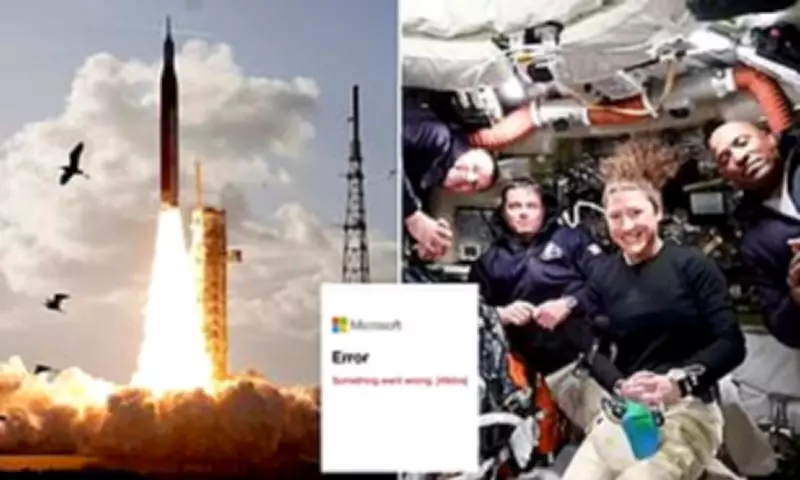
NASA's Artemis II Mission Confronts Dual Technical Challenges in Space
Astronauts aboard NASA's ambitious Artemis II mission have encountered a series of unexpected technical difficulties, including problems with Microsoft Outlook email services and issues with the spacecraft's waste management system. These glitches emerged during the early stages of the mission, underscoring the complex challenges of operating technology in the harsh environment of space.
Email System Failure in Orbit
Approximately seven hours into the flight, mission commander Reid Wiseman reported significant problems with the Microsoft Outlook email system. During a livestream communication with Mission Control in Houston on Thursday, Wiseman stated, 'I also see that I have two Microsoft Outlooks and neither one of those are working.' The commander was using a Microsoft Surface Pro tablet as his personal computing device, which astronauts rely on for accessing emails and critical mission data.
Wiseman requested remote assistance from ground control, saying, 'If you want to remote in and check those two Outlooks … that would be awesome.' NASA's team in Houston promptly confirmed they would access his device remotely and provide updates once the issue was resolved.

NASA's Response to Technical Difficulties
Judd Frieling, the Artemis II flight director, addressed the Outlook problems during a press conference on Thursday, explaining that such issues were not unusual for space missions. 'This is not uncommon,' Frieling stated. 'We have this on station all the time. Sometimes, Outlook has issues getting configured, especially when you don't have a network that's directly connected.'
NASA technicians resolved the Outlook malfunction by reloading Wiseman's files to restore functionality. The space agency emphasized that they had anticipated potential technical challenges and were prepared to address them efficiently.
Waste Management System Complications
In addition to the email problems, the Orion capsule's bathroom experienced significant issues shortly after launch. Sensors in the waste management system began showing unexpected readings within hours of takeoff, according to flight controllers. Astronaut Christina Koch reported problems with the toilet just seconds after activating it, telling Mission Control, 'The toilet shut down on its own and I have a blinking amber fault light.'
The titanium toilet system uses air suction to remove waste, with liquids being vented into space and solid waste stored onboard for disposal after the return trip. After several hours of troubleshooting, Mission Control reported that the toilet was operational again, though they offered a specific recommendation to the crew: 'Happy to report that toilet is go for use. We do recommend letting the system get to operating speed before donating fluid.'
Ongoing Bathroom Challenges
Despite initial repairs, the waste management system continued to present problems as of Saturday, according to reports from the Associated Press. Engineers suspect that ice may be blocking the urine line, preventing complete flushing. While the toilet remains usable for bowel functions, issues with the urine system persist.
Astronauts have also reported an unusual smell emanating from the bathroom compartment, which is concealed in the floor of the capsule with a door and curtain for privacy. Debbie Korth, NASA's Orion program deputy manager, acknowledged that space toilets and bathrooms present persistent challenges for space missions.
John Honeycutt, chair of the mission management team, provided an update on the situation, stating that the bathroom remained 'in a good state right now,' though it was not fully operational. He added that the astronauts were prepared to manage through the difficulties, saying, 'They're okay. They trained to manage through the situation.'

Mission Context and Public Reaction
The Artemis II mission, which launched on April 1 from Kennedy Space Center's Launch Pad 39B, represents a significant step in NASA's lunar exploration program. According to NASA's Office of Inspector General, the mission is estimated to cost approximately $4.1 billion. The four astronauts are expected to swing around the moon in their Orion capsule before returning directly to Earth without stopping.
Public reaction to the technical problems was swift on social media platforms, with users humorously noting that Microsoft Outlook's glitches appear to be a universal experience. One user on X commented, 'Microsoft disappointing customers Earth and beyond,' while another quipped, 'They took Outlook. It didn't work properly. Is there a single person on Earth or in Space who was surprised?'
A third observer remarked that NASA was 'sending the whole human experience to space,' technological challenges included. Another user summarized the dual problems succinctly: 'Outlook down and bathroom trouble. Proof that you can leave Earth, but Earth won't leave you.'
As the Artemis II mission continues toward its lunar destination, NASA remains focused on addressing technical issues while maintaining mission safety and objectives. The space agency has demonstrated its capability to troubleshoot problems remotely, ensuring that astronauts can continue their critical work despite unexpected challenges.