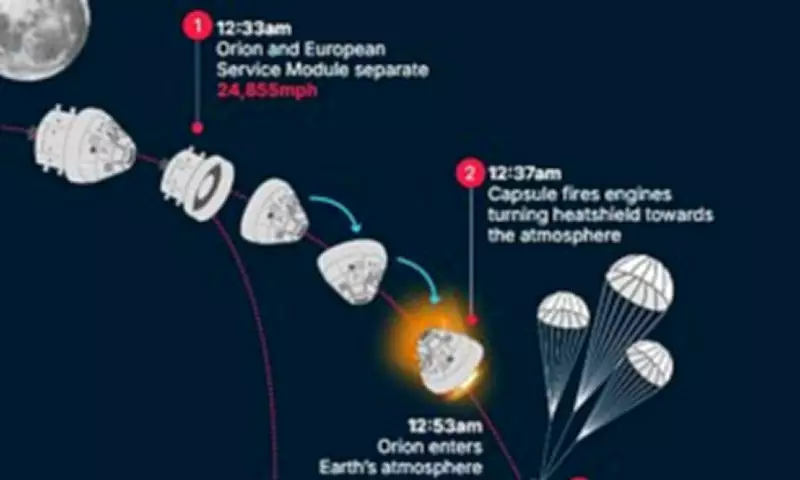
NASA's Artemis II mission is approaching the conclusion of its historic journey around the far side of the moon, but the most hazardous segment of the expedition still lies ahead. In the early hours of Saturday morning, the Orion module will initiate its final approach toward Earth, marking the end of an extensive 685,000-mile voyage.
The Critical Re-entry Sequence
At approximately 12:33am BST, when the spacecraft is merely 76 miles from home, the service module that provides power will detach from the crew capsule. The four astronauts aboard – Commander Reid Wiseman, Pilot Victor Glover, and Mission Specialists Christina Koch and Jeremy Hansen – will then confront a hypersonic re-entry into Earth's atmosphere at a staggering speed of 25,000mph.
Their sole protection against the searing 2,760°C heat, which approaches half the surface temperature of the sun, is a three-inch heat shield. During this intense phase, a layer of superheated plasma forms around the spacecraft, temporarily blocking radio communications and isolating the crew from mission control for several anxious minutes.

Parachute Deployment and Splashdown
After surviving the peak heat of re-entry, two drogue parachutes will deploy to decelerate Orion to about 300 miles per hour. Shortly thereafter, additional parachutes will activate to further reduce the capsule's speed to under 20 miles per hour before it splashes down in the Pacific Ocean at 1:07am BST.
No Margin for Error
NASA officials have emphasized there is effectively 'no plan B' if the heat shield fails during re-entry, widely regarded as the most perilous part of the mission. At a recent press conference, NASA administrator Jared Isaacman stated: 'In terms of what keeps me up at night, my blood pressure will be elevated until they're under parachutes in the water. There is no plan B there. That is the thermal protection system. The heat shield has to work.'
Compounding concerns, the uncrewed Orion spacecraft from the initial Artemis mission sustained significant damage to its heat shield. NASA's investigation revealed that Artemis I lost material in over 100 locations, with some large bolts melting due to extreme temperatures. Engineers identified that trapped gases within the material created cracks, causing portions of the heat shield to break away.
Engineering Adjustments
To mitigate this issue, NASA has planned a steeper re-entry trajectory, propelling Orion through the atmosphere more rapidly to reduce exposure time to high temperatures. Calculations indicate this approach should minimize cracking in the heat shield. The entire re-entry and landing process, from atmospheric entry to Pacific splashdown off San Diego, will last approximately 13 minutes.
Mission flight director Rick Henfling noted: 'It's going to happen pretty quick. It's very dynamic. Similarly to the launch environment, there's not a lot of time to react.' Weather conditions off the Southern California coast appear mostly favorable for splashdown, with the navy's USS John P Murtha en route to retrieve the capsule.
Mission Context and Achievements
This mission represents NASA's first crewed lunar journey since Apollo 17 in 1972. Thus far, Artemis II has been largely successful, with the primary issue being an intermittently functional on-board toilet, requiring reliance on a backup system. The astronauts have captured remarkable photographs, including an 'Earthset' image showing our planet setting over the lunar horizon.
As they approach Earth, the crew reflects on their extraordinary experience. Mission commander Reid Wiseman remarked: 'Human minds should not go through what these just went through. It is a true gift. And we have a lot that we just need to think about and journal and write, and then we'll get the full feeling of what we just went through.'
Pilot Victor Glover added: 'I haven't even begun to process what we've been through. We've still got two more days, and riding a fireball through the atmosphere is profound as well. I'm going to be thinking about and talking about all of these things for the rest of my life.'

Future Lunar Ambitions
NASA aims to return a crew to the moon by 2028, preceding China's anticipated lunar mission around 2030. The Artemis II mission, launched on April 1, involves a 10-day lunar flyby to test systems for future landings, covering 620,000 miles at an estimated total cost of $44 billion.
Key mission stages include:
- Launch from Kennedy Space Centre Launch Pad 39B
- Orbital manoeuvres using the Cryogenic Propulsion Stage
- Trans-lunar injection and four-day journey to the moon
- Lunar flyby at 5,523 miles above the surface
- Four-day return to Earth
- Crew module separation and Pacific Ocean splashdown