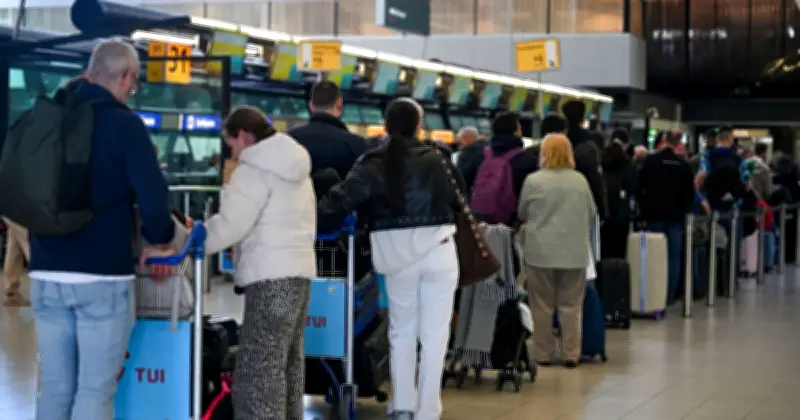
British travellers could see eased restrictions on the European Union's new Entry/Exit System (EES) during the summer holidays, but travel chaos is expected to persist for up to two years. The EES, fully rolled out on 10 April 2026, has caused major disruptions at European airports, with holidaymakers facing queues lasting up to four hours.
Temporary relief from biometric registration
Uku Särekanno, Deputy Executive Director of Frontex, the EU's border management agency, confirmed that member states have the option to temporarily suspend biometric registration—fingerprints and facial images—during peak hours this summer. This measure aims to alleviate long queues until September 2026.
Speaking at ABTA's Travel Matters conference, Särekanno stated: "We have until the end of the summer, the possibility during the tourism season to lift the biometric controls or the biometric registration temporarily. If there is a peak hour, you see that there are hundreds of people queuing, their queues are getting too long, then member states still have the possibility to lift biometric registration."

However, he emphasised that this is a temporary measure and will end in September. There are no plans for further relaxation of EES rules, as procedures are expected to be aligned by that time.
Long-term stabilisation expected within two years
Despite the temporary relief, full stabilisation of the EES could take one to two years. Särekanno explained that the most challenging part is the initial enrolment of biometric data. Once a significant number of travellers have completed their first enrolment, the system will become smoother.
"We expect that the situation will stabilise in one or two years, because the most challenging part is the first enrolment," he said. "Within the next two-year period, we will see that the first enrolment will be done. A significant number of visitors will not have to enrol by metrics anymore, so it will be a big relief for them."
Issues with biometric data resubmission
Some British holidaymakers have reported being asked to resubmit their biometric data even after initial registration. Särekanno acknowledged this problem, stating that it "needs to be corrected" by the border crossing point of the member state. He added: "We are on it and we are trying to ensure that there is a coherent approach to the border procedures."
The EES replaces manual passport stamping and requires all Brits travelling to the Schengen area to create a digital record with fingerprints and a photograph. The system aims to enhance border security but has faced criticism over its implementation.