The escalating conflict between Iran and the United States alongside its allies has triggered widespread airspace closures across the Middle East, causing major disruption to international flights and leaving numerous British nationals stranded. This unprecedented situation has forced airlines to cancel the majority of their scheduled departures from the region, with only a handful of flights managing to operate on Tuesday to repatriate passengers.
Limited Repatriation Flights Operate Amid Chaos
Emirates, the Dubai-based carrier, plans to operate a severely reduced schedule, with just two flights to Heathrow and one each to Gatwick and Manchester. Notably, at least some of these flights will utilize the airline's massive Airbus A380 jets, each capable of carrying up to 615 passengers depending on configuration. This is a stark reduction from Emirates' usual operation of 146 weekly flights to the UK, equivalent to approximately 21 services per day.
Etihad Airways has scheduled a single UK-bound flight on Tuesday, operating from Abu Dhabi to Heathrow using a Boeing 787-10 Dreamliner aircraft configured with 336 passenger seats. Meanwhile, Qatar Airways announced that its operations remain completely suspended due to the closure of Qatari airspace, affecting its usual services to Heathrow and Gatwick.

Major Airlines Cancel Services
British Airways has cancelled all its timetabled flights to Heathrow from key Middle Eastern destinations including Abu Dhabi, Amman, Bahrain, Doha, and Dubai. The airline issued a statement to affected passengers, emphasizing that safety remains their absolute priority. "We are closely monitoring the situation and have cancelled a number of our flights to the Middle East. Safety is always our top priority and we would never operate a flight unless it was safe to do so," the statement read.
In a gesture to impacted travelers, British Airways is allowing passengers with bookings on certain routes up to March 15 to amend their travel dates to fly on or before March 29. Virgin Atlantic has also axed its scheduled flight from Dubai to Heathrow, adding to the growing list of cancellations.
Passenger Backlog Could Take Weeks to Clear
The scale of the disruption is immense, with approximately half a million passengers per day typically using the major hub airports in Dubai, Doha, and Abu Dhabi. These airports serve as critical connection points for travel between Europe and the continents of Asia and Australia.
UK-based aviation consultant John Strickland warned that clearing the resulting backlog of stranded passengers could take weeks. "It's a bit uncertain when that will happen because of course it will depend on how long the airspace restrictions remain in place," Strickland told the Press Association. "But factoring in the high volumes of normal daily traffic and the high capacity of aircraft such as the A380 and the Boeing 777, plus the fact that other flights covering similar routes operate at high occupancy, then it will certainly be quite a period of time which would likely run into weeks."
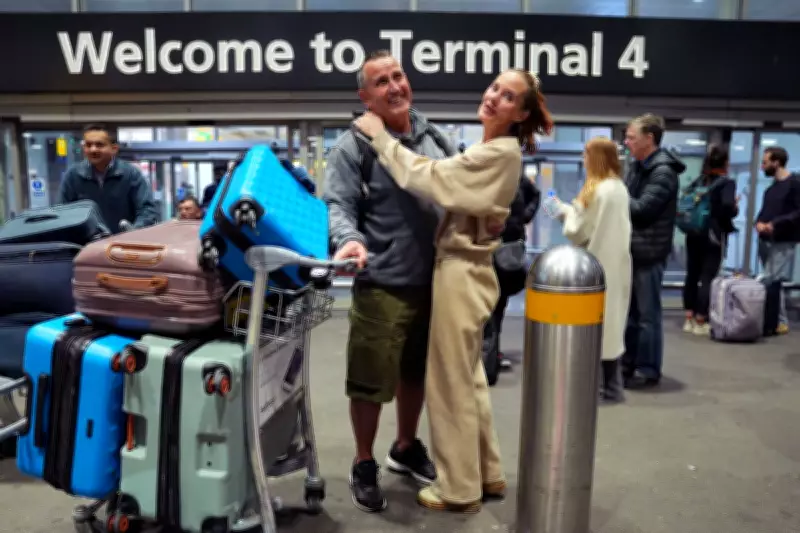
The human impact of this crisis was visible at Heathrow Terminal 4 on Monday, where passengers like Jeff and Rebecca Moses from Manchester, who had been staying in Abu Dhabi, arrived on one of the limited available flights. Their experience reflects the uncertainty and disruption facing thousands of British travelers caught in the Middle East during this geopolitical crisis.