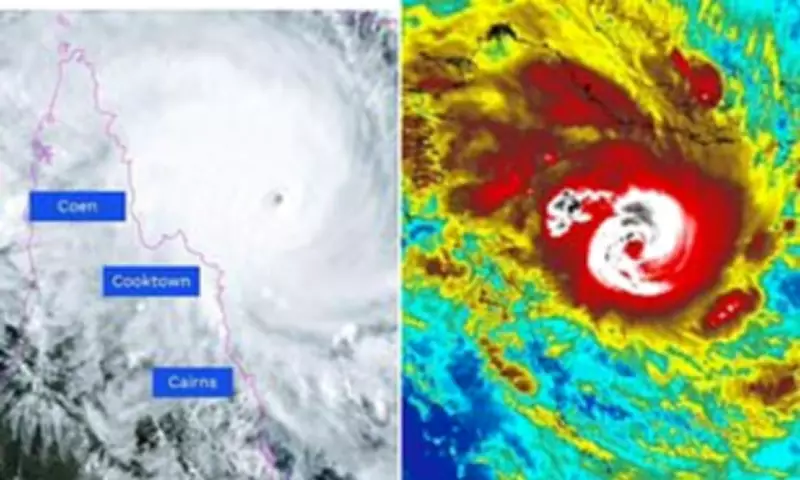
One of the most formidable cyclones in recent memory has experienced a slight reduction in intensity, yet the peril it presents remains undiminished as it advances towards Australia's coastline. Tropical Cyclone Narelle, which had previously intensified to a peak category five system in the Coral Sea on Thursday, has been downgraded to a category four early Friday, according to the Bureau of Meteorology. However, officials have issued urgent warnings that conditions are still exceptionally dangerous, with residents urged to take immediate shelter.
Imminent Landfall and Severe Weather Conditions
The monstrous storm is projected to make landfall around 7am AEST on Friday near the remote community of Coen, situated north of Cairns on Queensland's Cape York Peninsula. As it crosses the coast between Cape Melville and Lockhart River, Cyclone Narelle is expected to unleash very destructive wind gusts exceeding 250 km/h near its centre. These ferocious winds have the potential to 'blow apart sheds' and trigger significant downpours, exacerbating the hazardous situation.
Emergency Measures and Community Response
Emergency alerts have been activated for the remote communities of Lockhart River, Coen, and Port Stewart, with authorities instructing residents to 'take shelter now in the strongest part of the building you are in.' In preparation for the cyclone's impact, vulnerable residents have been evacuated, tourists have returned home, and schools have closed. More than 100 emergency services personnel have been deployed, with police conducting door-to-door checks to ensure locals are adequately prepared.

Meteorologist Angus Hines emphasised the system's power, stating on Thursday afternoon, 'They do not get more powerful than this.' Despite the slight weakening, the cyclone's conditions are just as dangerous, highlighting the unpredictable nature of such weather events.
Regional Impact and Evacuation Efforts
After crossing Cape York, Cyclone Narelle is forecast to lash the Northern Territory's Top End before moving towards Western Australia's Kimberley coast. In anticipation, about 500 people will be evacuated from the remote Gulf of Carpentaria community of Numbulwar in the coming days. Residents who choose to ride out the storm have been cautioned that emergency services will not respond if conditions become too perilous, underscoring the importance of heeding safety advisories.
Local Resilience and Unconventional Preparations
Despite the grave warnings, some far north Queensland residents are adopting a more relaxed approach, relying on community spirit and humour to cope. Tim Layton, from the family-run Greenhoose accommodation near Lockhart River, shared with AAP that many locals plan to have a 'cyclone party' with beer, reasoning, 'Everyone's line of thought is that you can't actually do anything during a cyclone, so let's have a beer. Let's make it a cyclone party because there's going to be one hell of a clean-up.'
Mr Layton, whose family is accustomed to seasonal storms that flood roads and limit access to plane or barge transport, reported that they are 'all battened down' with generators primed. He added, 'Fingers are crossed and hoping for the best - the calm before the storm, right?' This blend of preparedness and levity reflects the resilience of communities in cyclone-prone regions, even as they face one of the most powerful weather systems in recent history.