Cyclone Narelle's Fury: Queenslanders Take Cover in Shipping Containers
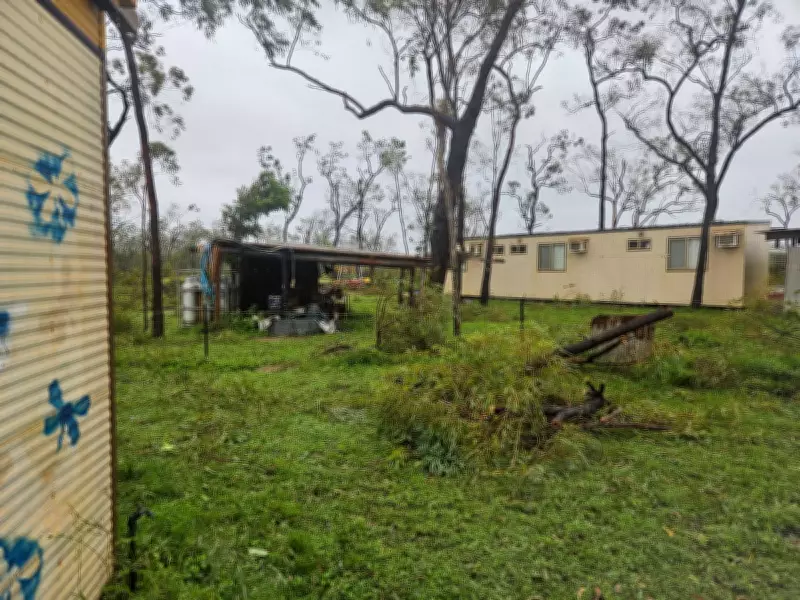
As Tropical Cyclone Narelle, the largest cyclone in a generation, barrelled towards remote Queensland, residents faced a terrifying night. Debbie Jackson, her husband Kevin, their family, and a friend sought safety in shipping containers, staying awake all night in anticipation of the storm's arrival. With wind gusts reaching up to 270km/h, the cyclone tore through Archer River, a small community approximately 650km north of Cairns, uprooting trees and causing severe damage to buildings and sheds.
Rising Flood Waters Add to the Chaos
Neighbour Debbie Cameron, manager of the Archer River roadhouse, expressed concerns about flooding from the Archer River. She planned to escape to a nearby hill and take cover under a vehicle, but this became a race against rising waters and dropping winds. "She's devastation here," Cameron stated. "We've got buildings crushed, sheds down. I don't think there's a leaf left on any tree." The storm made landfall in remote Cape York on Friday morning, just two days after forming in the Coral Sea, travelling at speeds up to 25km/h.
Record Ocean Temperatures Fuel the Storm
Record ocean temperatures contributed to Narelle's rapid intensification into a category 5 cyclone offshore, the highest possible level. It was forecast to cross the coast at this intensity, posing a significant threat. The Lockhart River Aboriginal community, with a population of 700 and located a three-hour drive north-east of Coen, sustained substantial damage after the cyclone landed there around 9am on Friday. Powerlines tumbled, large trees were ripped from the ground and landed on homes, and debris floated everywhere, with the local airstrip requiring repairs.

Resilience in the Face of Adversity
Despite the destruction, David Clarke, CEO of the shire council, noted that the community was "relatively unscathed" due to two days of preparation. "All of our folks are cyclone-hardened from birth, so they understand," he said. "Our preparation was pretty good. Our community is a very resilient one." Clarke, who has lived in the area since the 1980s, compared Narelle to previous cyclones like Tropical Cyclone Trevor, stating that while it was "bloody horrendous," it was not as bad as predicted, with winds reaching 130 to 140km/h instead of the forecasted 160km/h.
Official Warnings and Narrow Escape
Queensland Premier David Crisafulli spent three days urging residents to take the storm seriously, highlighting that a category 5 system crossing the coast in this location would be the first time in over 100 years. The storm produced sustained winds of 195km/h, just shy of category 5. Initially expected to hit Coen, a town of 320 people, it swung north, avoiding the town and Lockhart River. Crisafulli described it as having "threaded the needle between both." Fortunately, no injuries were reported, a stark contrast to the 1899 Tropical Cyclone Mahina, which claimed 307 lives.
Community Spirit and Relief
Residents like Koi Ngoreoge from Coen spent the night in their bathrooms, the most secure rooms, with mattresses and cooking equipment. "I'm making breakfast in the bathroom," she joked. Sarah Watkins, also from Coen, took shelter at the local brick pub, the Exchange Hotel, and noted that the town banded together to ensure everyone's safety. "We got off lightly," she said, expressing relief that the damage was less severe than expected. The storm weakened to category 3 and was forecast to drop to category 2 before crossing the central Cape York Peninsula, with plans to move west into the Gulf of Carpentaria and potentially strengthen again before a second landfall in the Northern Territory.