Mother and Daughter Killed in Tornado-Linked Car Crash as Severe Storms Sweep US Heartland
A mother and her teenage daughter have tragically died in what authorities believe was a tornado-related car crash in Oklahoma, as a powerful wave of severe thunderstorms and potential tornadoes sweeps across America's heartland, putting more than 7 million people at the highest risk of dangerous weather conditions.
Fatal Incident in Fairview, Oklahoma
The two victims were found deceased in their vehicle in Fairview, Oklahoma, on Thursday night. Sarah Stewart, a spokesperson for the Oklahoma Highway Patrol, confirmed the crash "appears to be tornado related." Oklahoma Governor Kevin Stitt expressed his condolences, stating, "I am praying for the family as they grieve this tragic loss, as well as all those impacted by the storms."
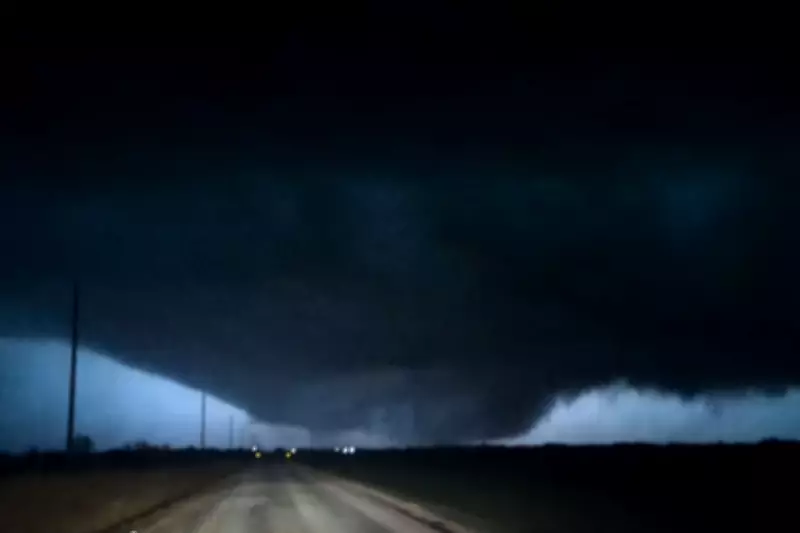
The incident occurred as thunderstorms tore across Oklahoma prairies, with one particularly intense storm near Fairview captured on video. Dashcam footage from a first responder showed flashes of lightning illuminating a giant funnel cloud that appeared to reach the ground.

Intensifying Severe Weather Threat
The severe weather threat is expected to intensify significantly on Friday, with more than 7 million Americans facing the highest risk of powerful storms. According to the national Storm Prediction Center, this high-risk area includes major metropolitan centers such as:
- Kansas City, Missouri
- Tulsa, Oklahoma
- Omaha, Nebraska
An additional 25 million people are at a slightly lesser risk in a zone encompassing Dallas, Oklahoma City, and Milwaukee, Wisconsin. Storms were already forming Friday afternoon from North Texas to Michigan, where a tornado warning was issued southwest of Kalamazoo, though no immediate reports of tornadoes on the ground were made.
Investigations and Meteorological Analysis
The National Weather Service in Norman, Oklahoma, is sending a damage survey crew to determine if Thursday night's storms were confirmed tornadoes. Meteorologist Ryan Bunker stated, "As of right now, we're still investigating that."
Severe, scattered thunderstorms are anticipated Friday afternoon and evening, stretching from the Plains states to the Ozarks and Midwest. The National Weather Service warned that "The greatest potential for a few strong tornadoes and very large hail should exist across eastern portions of Oklahoma/Kansas/Nebraska into western Arkansas/Missouri and southern Iowa."
Meteorologists with AccuWeather attribute the general setup for these strong storms to a clash between warm air streaming north from the Gulf Coast and cooler Canadian air behind cold fronts.
Spring Storm Season Begins
Melissa Mayes, deputy director of the Washington County Emergency Management Agency in Bartlesville, Oklahoma, noted, "This is probably our first real event this season where people are really starting to pay attention getting into the spring storm season." As the spring storm season begins, experts advise simple safety steps, including having a weather radio and a designated shelter plan.
Contrasting Weather Patterns Across the US
Meanwhile, other parts of the country are experiencing vastly different weather patterns. The Northeast was under winter weather advisories on Friday, with rain, snow, and slush creating hazardous morning commutes from Pennsylvania to Maine. Several vehicle slide-offs were reported on the Maine Turnpike, and schools in states like New Hampshire and Maine canceled or delayed classes.
While conditions eased in some areas by midmorning, advisories remained in effect for Maine, Massachusetts, Rhode Island, and Connecticut. In Ohio, flood warnings were issued for the southern region.
Conversely, the southern U.S. is bracing for unusually warm temperatures this weekend, with federal forecasters predicting "Temperatures will be 20-30 degrees above average, with 80s reaching as far north as parts of the Ohio Valley and Mid-Atlantic." They added that "Daily records could become widespread."