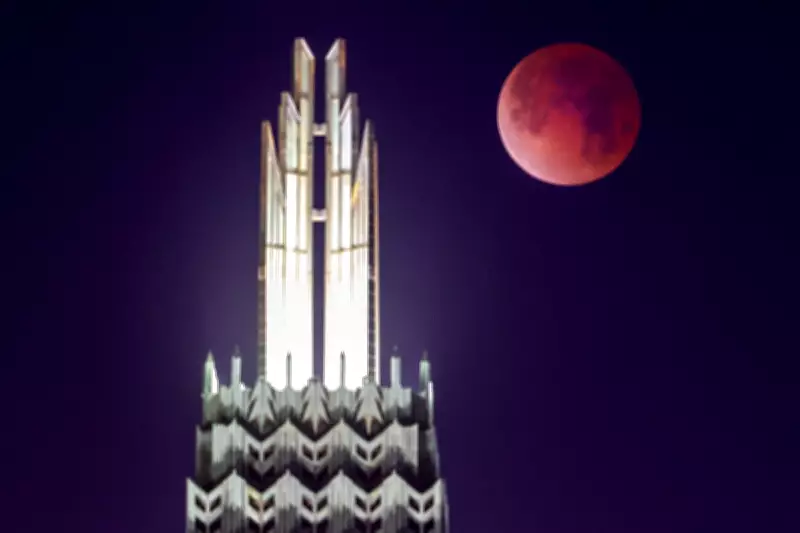
Spectacular images have emerged capturing Tuesday's total lunar eclipse, where the moon transformed into a striking blood-red orb against the night sky. This awe-inspiring astronomical phenomenon was witnessed across several continents, providing a vivid display of celestial mechanics in action.
Global Visibility of the Crimson Moon
The eclipse was observable during Tuesday morning from North America, Central America, and western regions of South America. Meanwhile, viewers in Australia and eastern Asia had the opportunity to witness the event during Tuesday evening hours. This widespread visibility allowed millions to experience the rare cosmic alignment firsthand.
The Science Behind the Blood Moon Phenomenon
During a total lunar eclipse, Earth positions itself directly between the sun and the full moon, casting its shadow completely over the lunar surface. The characteristic red hue, which gives rise to the term "blood moon," occurs because scattered fragments of sunlight filter through Earth's atmosphere before reaching the moon. This atmospheric filtering removes shorter wavelength colors, leaving primarily red and orange tones to illuminate the lunar surface.

Solar and lunar eclipses result from precise alignments of the sun, moon, and Earth. According to NASA data, between four and seven such eclipses typically occur each year. These celestial events often follow consecutive patterns, taking advantage of specific orbital alignments that create optimal viewing conditions.
A Relaxed Celestial Spectacle
The lunar eclipse unfolded gradually over several hours, with the period of totality—when the moon appeared completely red—lasting approximately one hour. Unlike solar eclipses that require protective viewing equipment, lunar eclipses can be safely observed with the naked eye, requiring only clear, cloudless skies for optimal viewing.
Catherine Miller from Middlebury College's Mittelman Observatory noted that "the lunar eclipse is a little more of a relaxed pace" compared to solar eclipses. Astronomer Bennett Maruca of the University of Delaware added practical advice for observers: "You don't have to be out there the whole time to see the shadows moving."
Planning Your Eclipse Viewing Experience
For those hoping to catch future lunar eclipses, experts recommend using forecasting applications or online celestial calendars to determine exact timing for specific locations. The gradual nature of the event allows viewers to venture outside multiple times to observe Earth's shadow progressively darkening the moon before revealing the distinctive reddish-orange orb.
Tuesday's total lunar eclipse followed just two weeks after a dramatic "ring of fire" solar eclipse that captivated observers—including penguins—in Antarctica. Looking ahead, astronomy enthusiasts can anticipate a partial lunar eclipse scheduled for August, which will be visible across the Americas, Europe, Africa, and western Asia.
From the moon setting behind Boston Avenue United Methodist Church in Tulsa, Oklahoma, to its appearance near traditional lanterns in Beijing and alongside the High Roller observation wheel in Las Vegas, photographers worldwide documented this extraordinary celestial event that bridged continents through shared astronomical wonder.