Cold War Nuclear Bunker Rediscovered Under Scarborough Castle After 57 Years
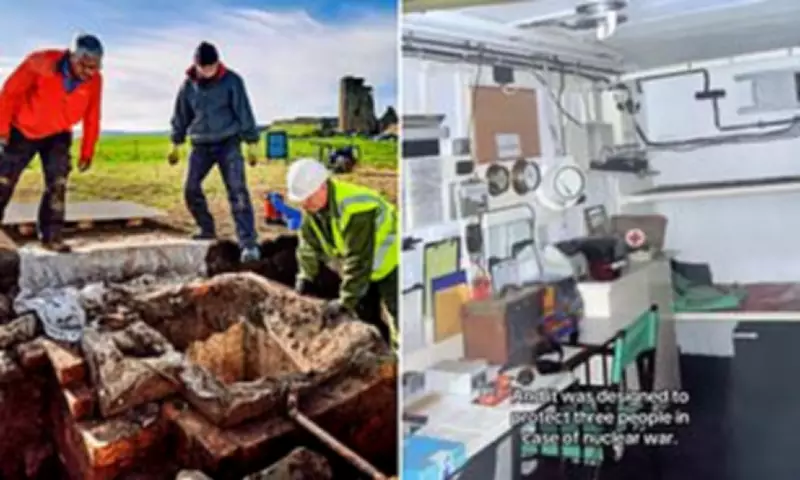
A Cold War nuclear bunker, lost and forgotten for over five decades, has been dramatically rediscovered beneath the historic grounds of Scarborough Castle in North Yorkshire. This secret underground observation post was decommissioned and sealed in 1968, remaining hidden until a recent archaeological excavation by English Heritage successfully pinpointed its exact location.
A Hidden Relic of Nuclear Preparedness
In the event of a nuclear conflict, the bunker would have been manned by volunteers from the Royal Observer Corps (ROC), tasked with a critical role in national defence. It formed part of a network of approximately 1,500 underground posts constructed across Britain during the Cold War. Each was designed to shelter three ROC volunteers, who would have mapped the locations of Soviet nuclear detonations using specialised equipment. The bunkers were stocked with essential rations intended to sustain occupants for around two weeks during a crisis.
The exact whereabouts of the Scarborough Castle ROC post had been a mystery since its closure, with historical records and websites only vaguely suggesting it was buried somewhere between the ancient castle and the North Sea. The structure itself is remarkably compact, measuring just 15 feet in length and 7 feet in width, with a ceiling height barely sufficient for standing.

Archaeological Discovery and Historical Context
Kevin Booth, a senior curator at English Heritage, emphasised the widespread yet obscure nature of these installations. "Wherever you lived in Britain you were probably no more than a few miles from an ROC post," he noted. "Yet few people knew they existed. It seems strange to have a Cold War bunker built inside Scarborough Castle, but in many ways, it is a perfect location."
Booth elaborated on the site's long history as an observation point, tracing it from a Bronze Age settlement and a Roman signal station to a medieval castle, a World War I gun battery, and finally this 1960s concrete bunker poised to watch for nuclear Armageddon. "We wanted to pinpoint it and see if we could reopen it and see what was inside," he explained. The team relied on old maps and ground-penetrating radar surveys to locate the "big black blob" of concrete hidden beneath the earth.
Inside the Forgotten Bunker
The bunker was equipped with a bomb indicator to measure pressure waves from explosions and a pinhole camera mounted on the roof to record blast flashes. However, the Scarborough post operated for only a few years before being decommissioned in 1968 as nuclear tensions eased. It was then capped with concrete and abandoned.
Recent inspections have revealed that the chamber has since filled with approximately six feet of water. Despite this, Booth expressed optimism about its preservation. "We're getting inklings of some interesting survival down there," he said, noting that a wooden door visible through a shaft remains solid despite decades of flooding. He hopes the bunker can eventually be drained and, once deemed safe, opened to the public for the first time in over half a century.
The find offers a tangible connection to the memories of ROC volunteers, who recalled the cold, cramped conditions and even preferring fish and chips over the supplied rations. For English Heritage, this discovery completes not only the story of Scarborough Castle but also a chapter of Cold War history, illustrating how Britain prepared for the existential threat of nuclear war.
Funding and Future Prospects
Helen Featherstone of The National Lottery Heritage Fund highlighted the significance of the discovery, linking it to a project marking the centenary of the Royal Observer Corps. "It's really exciting that this lost bunker has been uncovered by the team," she stated. "This find builds on our understanding of their story and shines a spotlight on their important work protecting the UK." The archaeological work was made possible through funding raised by National Lottery players, underscoring public support for preserving such unique historical sites.