Middle East Airspace Closures Strand Thousands as Iran Retaliates Against Gulf States
International travel faces yet another period of severe disruption, but this time the cause is far more serious than technological failures or natural phenomena. The escalating conflict in the Middle East has triggered unprecedented chaos across the region's aviation network, with the Foreign Office issuing urgent safety directives for British citizens.
Foreign Office Issues Immediate Shelter Directives
The British Foreign Office has instructed nationals currently in Bahrain, Qatar, Kuwait, and the United Arab Emirates to "immediately shelter in place" and remain indoors in secure locations. The advisory explicitly tells travelers to avoid all movement and strictly follow instructions from local authorities as regional tensions reach dangerous levels.
Major Airspace Closures Across Gulf Region
In response to Iran's retaliatory attacks against Gulf states, multiple countries have taken the extraordinary step of closing their airspace entirely. The United Arab Emirates, Bahrain, Iraq, and Qatar have all implemented complete aviation shutdowns, creating a domino effect of flight cancellations and diversions throughout the Middle East.

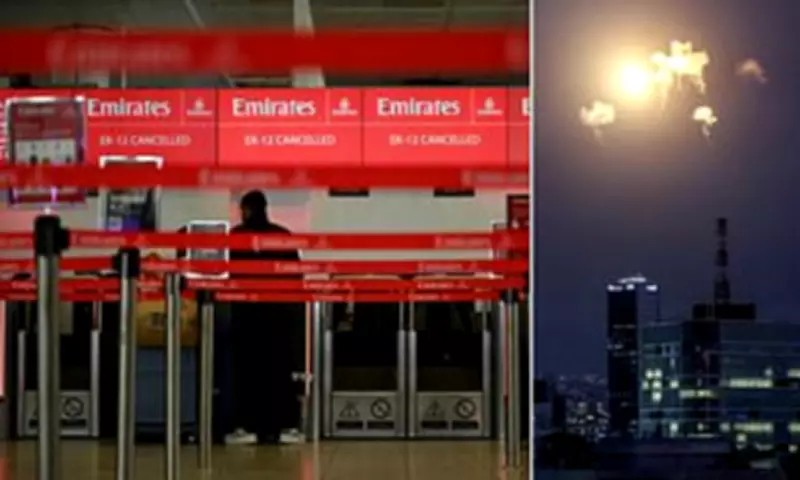
The resulting chaos has left thousands of passengers stranded at airports across the region, with major carriers scrambling to adjust their schedules and reroute aircraft away from conflict zones. This represents one of the most significant disruptions to global aviation since pandemic-era restrictions.
Critical Aviation Hubs Paralyzed
The airspace closures have particularly devastating consequences because they affect some of the world's busiest and most strategically important aviation hubs. Zayed International Airport in Abu Dhabi and Dubai International Airport together handled approximately 127 million passengers in 2025, serving as critical connection points for travel to Asia, Australia, and New Zealand.
When combined with Doha's Hamad International Airport in Qatar, these three facilities form the backbone of Middle Eastern aviation and crucial transit points for long-haul international travel. Their simultaneous paralysis creates ripple effects across global air travel networks.
British Travelers Particularly Affected
The United Arab Emirates remains exceptionally popular with British holidaymakers, with Dubai alone welcoming nearly 20 million international visitors last year, including substantial numbers from the United Kingdom. Additionally, thousands of British expatriates have relocated to Dubai in recent years, creating a significant population of potentially affected UK nationals.
Major airlines serving British travelers have implemented emergency measures in response to the crisis. British Airways has cancelled numerous Middle Eastern flights, emphasizing that "safety is always our top priority" while contacting affected customers about alternative arrangements.
Airline Responses and Passenger Uncertainty
Emirates, the region's flagship carrier, has temporarily suspended all operations to and from Dubai while monitoring the evolving situation. Wizz Air has taken more drastic action, suspending all flights to Israel, Dubai, Abu Dhabi, and Amman until at least March 7th. Virgin Atlantic has rerouted flights to avoid Iraqi airspace and cancelled its London-Dubai service entirely.
Passengers face significant uncertainty regarding refunds and compensation. While airlines must provide full refunds for cancelled flights and cover associated expenses like hotel accommodations, the situation becomes murkier for travelers who wish to cancel due to safety concerns. Since the Foreign Office has not officially advised against travel to the UAE, airlines may refuse refunds for voluntary cancellations.
Nigel Rawlence, a retired businessman from the Isle of Wight who recently returned from Abu Dhabi with his wife, expressed relief at their timing: "We managed to get out on Friday before the attacks started. You would never have known that something like this was about to happen. We consider ourselves fortunate and won't be going back in a hurry."

Travelers with upcoming flights to the region are advised to contact their airlines directly for the latest guidance and to monitor Foreign Office travel advisories closely as the volatile situation continues to develop.