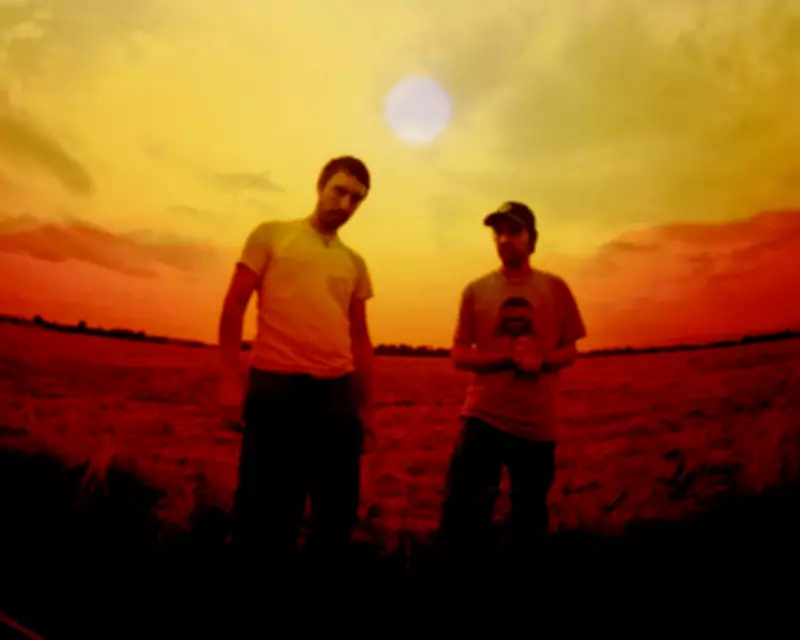
Boards of Canada's first album in 13 years, Inferno, opens with an analogue synth rising and falling like a sound effect from a forgotten 1960s radio play, immediately thrusting listeners into one of the most recognisable worlds in electronic music. From their 1995 debut EP Twoism onward, the Scottish duo—brothers Mike Sandison and Marcus Eoin—used heavy hip-hop beats to trudge through spectral ambient vistas, like spacemen sent through a time portal while tethered to the present. By sampling old public television and vintage sources, they looked back at the utopian promise of the mid-20th century while teasing out latent kitsch and creepiness.
Their music became hugely influential, from US cloud-rap to the hauntological sounds of the UK's Ghost Box label. You would not be surprised to find Boards of Canada albums on the shelves of filmmakers like Adam Curtis or Ben Wheatley. But on Inferno, the duo feels stuck in the past, overtaken by more nimble electronic contemporaries.
A Dubious Interrogation of Religion
The title suggests Dante's hell, and the duo seem to consider spiritual deliverance and damnation, though often in a callow way. On Father and Son, voices of people having crises of faith are jokily cut up into a light funky rhythm, recalling the Avalanches' Frontier Psychiatrist. Richard Dawkins might be amused; others will find it excruciatingly unfunny. The Word Becomes Flesh uses a sample from an old educational video about human embryo development, cut up into body-popping electro—perhaps a genuine celebration of transubstantiation, but it feels like another jibe, not to mention the sample being a total Boards of Canada cliche. The appearance of sampled Hare Krishna chanting on the ghastly Naraka makes it seem as if they are laughing at eastern religion, or deploying lazy orientalism (which reappears with the sitar twang of Deep Time). A better critique comes on All Reason Departs, with a Christian nationalist treatise pitched into a demonic whisper.

Dull Music and Pedestrian Beats
At least Boards of Canada engage with ideas, but the deeper problem with Inferno is how dull much of the music is. The brothers have expanded their range, particularly with guitars: lead single Prophecy at 1420 MHz recalls their countrymen Mogwai. Somewhere Right Now in the Future is drumless dream pop, while Into the Magic Land sounds like Tortoise (albeit lacking that band's swing). There are updates to core Boards of Canada sounds, such as the fat synthwave lines on Arena Americanada and Hydrogen Helium Lithium Leviathan. But the beats on those tracks, and many others, are wretchedly pedestrian, plodding in dreary, funkless steps. The nadir is You Retreat in Time and Space, which sounds like hold music for a broadband provider.
Boards of Canada were always at their best with light-touch trip-hop beats, as on Kid for Today, or a different rhythmic mode, as on proto-dubstep track Amo Bishop Roden (from the visionary 2000 EP In a Beautiful Place Out in the Country). The best tracks on Inferno are beatless. Age of Capricorn sets a priestly sermon against chiming ambient sound and hymnal melody. The Process has enjoyable babble from an AI-like female voice against watery instrumentation and bustling crowds. The 78-second interlude Acts of Magic is a scary throb of noise from the lip of hell's pit, complete with buzzing fly.
Dotted across 70 minutes, these highs are fleeting. Inferno is another epic Boards of Canada album statement, and diehard believers will bow to the duo's ability to conjure their signature corrupted nostalgia anew. The rest of us might regard them as we would a cult leader: impressive, even charismatic figures with a dubious amount of substance.