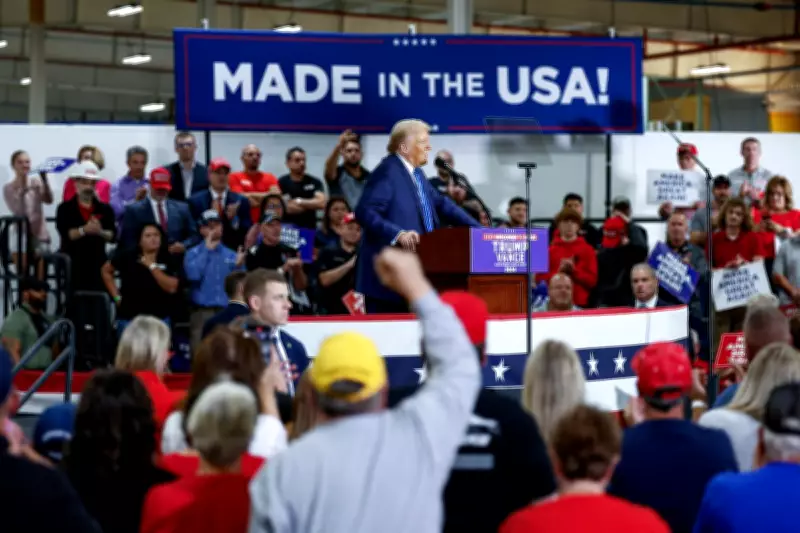
President Donald Trump repeatedly pledged to revive U.S. manufacturing jobs and usher in a “golden age” of American-made goods. However, 16 months into his second term, he has fallen far short of that goal, according to a new report.
Declining investment and employment
In April, private investment in manufacturing construction stood at $15.2 billion, a 16 percent decline from Trump’s inauguration. Over the same period, factory employment decreased by 77,000 jobs, The Financial Times reports.
This lackluster data emerges despite the Republican president's sweeping tariff regime — designed to bolster domestic manufacturers — and his jawboning of executives to invest in U.S. production. To date, 84 firms have announced nearly $1 trillion in investments.

“Announcements are what people say they’re going to do, but dollars spent is what’s actually happening,” said Didi Caldwell, chief executive of Global Location Strategies, a manufacturing site selection firm. “From where we’re standing, we are not seeing signs of a manufacturing renaissance in the US.”
White House response
The White House pushed back against the idea. “President Trump pledged to revive American industry, and the Trump administration is delivering with a proven economic agenda of targeted tariffs, rapid deregulation and investment-friendly tax cuts,” White House spokesperson Kush Desai told the Times.
Where progress has occurred, it has been modest. According to industry insiders, Trump's tariffs — which the Supreme Court struck down in February — have had a decidedly mixed effect.
Katie Farmer, head of BNSF Railway, said she has witnessed a resurgence in “certain commodity areas,” such as steel. But in other areas “we’ve really seen a plateau,” she noted. “Because of some of the other uncertainty that exists in the world, and some of the uncertainty that frankly exists with the tariffs, I do think it’s keeping some of that capital on the sidelines.”
Historical context
American factory jobs peaked in 1979, when nearly 20 million people were employed in manufacturing. That figure has been dropping ever since, in part due to automation and global competition. Since Trump took office, the U.S. has lost 77,000 manufacturing jobs.
Companies in Indiana, which boasts the largest proportion of manufacturing jobs in the U.S., said the industry is showing signs of recovery, but the process is patchy and will take years to take effect. It is a far cry from Trump’s claim last April that manufacturing would come “roaring” back and “supercharge” domestic production.
“We’ve built up the momentum and it’s continued, but it’s not this mushroom cloud of explosive growth,” said John Urbahns, chief executive of the Greater Fort Wayne Inc business group.
Experts previously told The Independent that the 79-year-old president’s vision of a manufacturing boom was more of a pipe dream. “It’s just fantasy,” said Dean Baker, a senior fellow and co-founder of the Center for Economic and Policy Research, in March. “There’s literally nothing that would support his claims of a renaissance.”
While Trump's tariffs have modestly boosted some domestic manufacturers, that improvement largely came at the expense of American consumers, who bore the bulk of the tariff costs, multiple studies have shown. The Independent has reached out to the White House for comment.