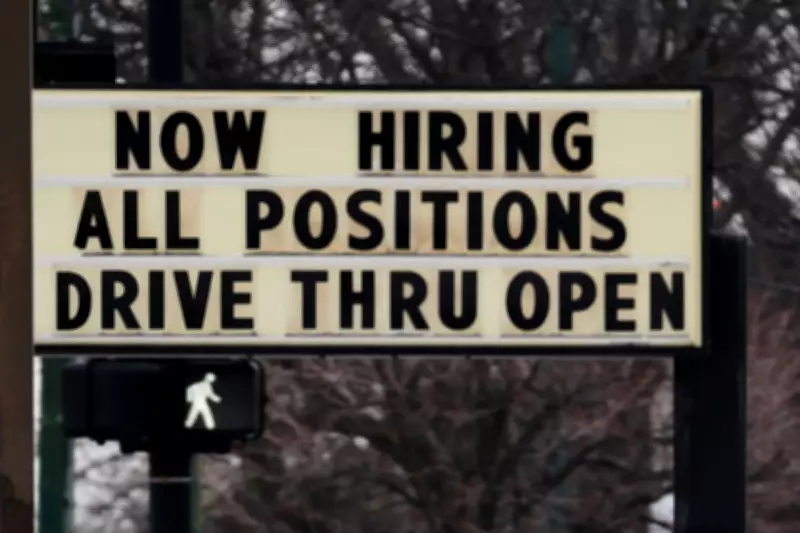
US Job Market Shows Modest Gains in February, Outpacing 2025's Weak Hiring
The American job market is displaying signs of improvement this year, contrasting sharply with the subdued performance observed throughout 2025. According to projections, US employers likely added approximately 60,000 jobs in February, a figure that, while modest, represents a marked enhancement over the previous year's hiring trends.
February Employment Figures and Context
The Labor Department is anticipated to report that US companies, nonprofits, and government agencies contributed to this job growth last month. This estimate of 60,000 new positions is down from an unexpectedly robust 130,000 jobs added in January. However, it signifies considerable progress when compared to the monthly average of just 15,000 new jobs recorded in 2025, which was the weakest hiring period since the COVID-19 recession year of 2020.
Concurrently, the unemployment rate is forecast to have remained at a low 4.3% in February, as indicated by a survey of forecasters conducted by the data firm FactSet. This stability in unemployment underscores a resilient labor market despite the challenges faced.

Supporting Data and Economic Insights
Additional reports corroborate this positive trajectory. The Bank of America Institute revealed on Wednesday that its data, derived from anonymized customer accounts, demonstrated solid hiring in February for the second consecutive month, with a 1.3% expansion following a 0.8% gain in January. David Tinsley, a senior economist at the Bank of America Institute, emphasized, "Job market growth is gaining traction. February's numbers show real forward momentum."
Similarly, a private report released on Wednesday by payroll processor ADP indicated that companies added 63,000 jobs in February, marking the highest increase since last July. These figures collectively suggest a gradual strengthening in employment opportunities.
Factors Influencing February's Hiring
The Labor Department report is likely to highlight that February hiring was impeded by several factors, including frigid winter weather and a four-week strike by nurses and other front-line workers at Kaiser Permanente in California and Hawaii. This industrial action probably reduced last month's payrolls by more than 30,000 jobs. Moreover, some economists suspect that the solid January jobs figures were overstated and may be revised downward in Friday's official report.
Broader Economic and Political Context
The outlook for the job market, and the broader economy, remains clouded by ongoing geopolitical tensions, such as the war with Iran. In 2025, employers were hesitant to hire due to uncertainty surrounding President Donald Trump's tariffs and their unpredictable implementation. High interest rates, engineered by the Federal Reserve to combat post-pandemic inflation, also weighed heavily on the job market last year.
However, the impact of Trump's aggressive trade policies may diminish in 2025. His import taxes became smaller and less erratic after he reached a trade truce with China and secured deals with key US trade partners like Japan and the European Union. Many businesses have adapted by incorporating these costs into their models, often passing them on to consumers through higher prices.
Andy Decker, CEO of Atlanta-based Goodwin Recruiting, noted, "Businesses needed a year to bake some of those costs into their business model, and now it's time to get back to growth mode." The Supreme Court has also struck down the most significant of Trump's tariffs, though plans for replacements are underway.
Current Hiring Trends and Future Projections
Despite these improvements, hiring continues to lag far behind the boom of 2021-2023, when the economy rebounded from pandemic lockdowns and the US added nearly 400,000 jobs monthly. Many economists describe today's job market as "no-hire, no-fire," where companies are reluctant to add workers but equally hesitant to let go of existing staff.

Fortunately, achieving adequate job growth has become easier in recent times. Until a year or two ago, employers needed to hire well over 100,000 people monthly to prevent the unemployment rate from rising. However, factors such as Baby Boomer retirements and President Trump's deportations have reduced the pool of job seekers, lowering the break-even point to between zero and 50,000 jobs per month.
Joe Brusuelas, chief economist at the tax and consulting firm RSM, explained, "Under the current conditions, 70,000 should be considered solid." He added that companies may be delaying hiring as they invest in and integrate new technologies, including artificial intelligence, which could reduce the need for workers, particularly in entry-level positions.
Brusuelas further elaborated, "They are thinking, 'we've invested an awful lot of money in capital expenditures, and we need to see how much we can produce with our current labor force... The last thing you want to do is hire a lot of young people and then let them go.'"
This cautious approach reflects a broader trend of technological adaptation and economic prudence shaping the modern labor landscape.