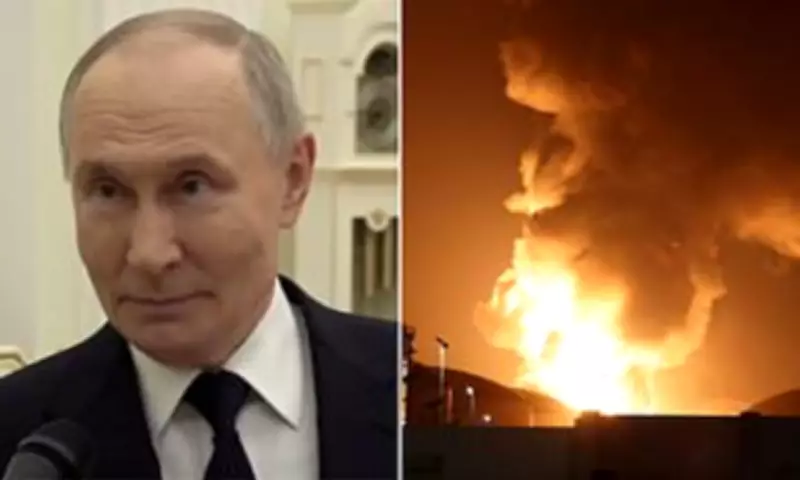
Russian President Vladimir Putin has issued a stark threat to immediately halt gas supplies to Europe and Britain, delivering the warning with a characteristic smirk during a televised interview. This comes as global energy markets reel from soaring oil and gas prices triggered by escalating conflict in the Middle East.
Energy Markets in Turmoil
The recent US and Israeli military actions against Iran, coupled with Tehran's retaliatory strikes on Gulf Arab neighbours, have created perfect storm conditions for energy disruption. The conflict has paralysed critical shipping lanes through the Strait of Hormuz while forcing the shutdown of Qatar's substantial LNG production facilities and Saudi Arabia's largest oil refinery.
Putin's Calculated Threat
When questioned by top Kremlin correspondent Pavel Zarubin about European plans to impose a complete ban on Russian pipeline gas imports by late 2027 and prohibit new short-term LNG contracts from April 2026, Putin suggested Russia might benefit from preemptive action.

'Now other markets are opening up. And perhaps it would be more profitable for us to stop supplying the European market right now,' Putin stated, according to official Kremlin transcripts. 'To move into those markets that are opening up and establish ourselves there.'
The Russian leader clarified this wasn't a formal decision but rather 'thinking out loud,' though he pledged to instruct his government to seriously explore the option. He directly linked this potential move to what he termed Europe's 'misguided policies' regarding energy sanctions.
Market Dynamics and Russian Strategy
Putin argued that oil prices were rising due to both 'aggression against Iran' and Western restrictions on Russian oil exports. Regarding European gas prices, he claimed customers were now willing to pay premium prices due to Middle East instability and the Strait of Hormuz closure.
'If they're going to shut us down in a month or two anyway, wouldn't it be better to stop now and go to those countries that are reliable partners, and gain a foothold there?' Putin questioned rhetorically.
The Russian president maintained a business-focused narrative, stating: 'Customers have emerged who are willing to buy the same natural gas at higher prices... This is natural; there's nothing here, there's no political agenda — it is just business.'
European Energy Security at Risk
Russia holds the world's largest natural gas reserves and ranks as the second-largest global oil exporter. However, Moscow lost most of its lucrative European market following Europe's strategic shift to reduce dependency on Russian energy after the 2022 invasion of Ukraine.
The European Union had already committed to phasing out Russian liquefied natural gas and pipeline supplies before the current Gulf crisis, aiming for complete cessation by the end of next year as punishment for Putin's war in Ukraine.
Despite this planned phase-out, Russia still accounted for approximately 13 percent of EU gas imports in 2025. This remaining share means any sudden disruption to Russian supply could create significant price volatility across European markets, with indirect consequences for Britain through interconnected energy systems and competition for global LNG shipments.
Global Energy Realignment
As Europe has turned away from Russian energy, Moscow has increasingly pivoted toward China, the world's leading energy consumer and importer, for sales of oil, pipeline gas, and LNG. Putin emphasized Russia's reliability as an energy supplier while suggesting traditional suppliers like American companies might abandon European markets for higher-paying alternatives.
'Russia has always been and remains a reliable energy supplier to all our partners, including, incidentally, European ones,' Putin asserted, specifically mentioning continued cooperation with Eastern European partners like Slovakia and Hungary.

Regional Complications and Economic Fallout
Separately, EU and NATO member Slovakia is increasing pressure to restart controversial Russian oil supplies to both Slovakia and Hungary. Slovak Prime Minister Robert Fico claims to have satellite evidence contradicting Ukrainian assertions about pipeline damage from Russian strikes.
The broader concern is that precipitate Russian action could exacerbate already soaring energy bills across Britain and Europe, potentially derailing fragile economic recoveries and severely impacting consumers. While most British gas originates from domestic production and Norwegian fields, UK wholesale prices remain tightly linked to European markets through interconnectors and global LNG competition.
This latest development represents a significant escalation in energy geopolitics, with Putin leveraging Middle East instability to pressure European energy policies while positioning Russia for alternative market opportunities in a rapidly changing global energy landscape.