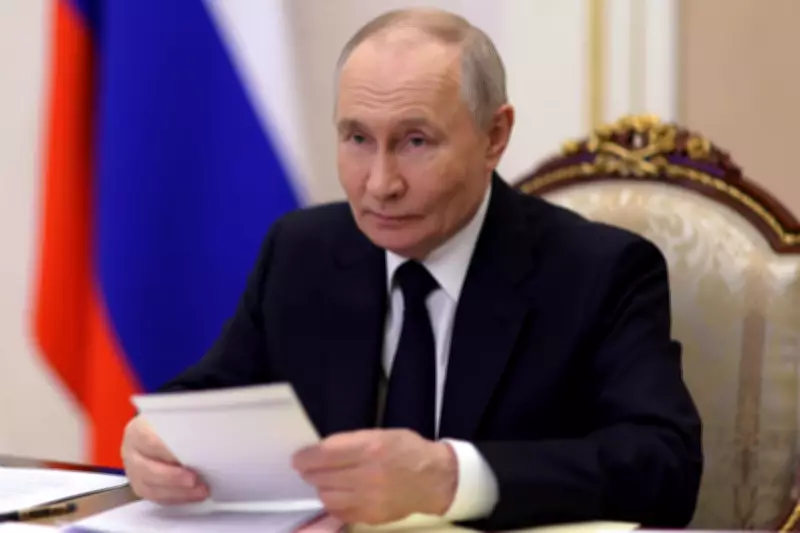
Russian President Vladimir Putin has issued a stark warning that Moscow could cease gas supplies to European markets, shifting instead to more "promising" global buyers. This provocative statement comes as the European Commission prepares to table a legal proposal on 15 April to permanently ban Russian oil imports, a move strategically timed three days after Hungary's parliamentary election, according to EU officials and a Reuters document.
Putin's "Thinking Out Loud" on Gas Supplies
In an interview with Russian state TV reporter Pavel Zarubin, Mr Putin declared: "And now other markets are opening up. And perhaps it would be more profitable for us to stop supplying the European market right now. To move into those markets that are opening up and establish ourselves there." He quickly clarified that this was "not a decision, it is, in this case, what is called thinking out loud. I will definitely instruct the government to work on this issue together with our companies."
Despite this threat, Mr Putin reiterated Russia's long-standing reliability as an energy supplier, vowing to maintain this approach with dependable partners such as Slovakia and Hungary. This dual messaging underscores the geopolitical tensions surrounding Europe's energy security.

European Gas Prices Skyrocket Amid Global Turmoil
European gas prices have surged dramatically, jumping 75 per cent this week to hit multi-year highs. This spike is driven by hostilities in and around Iran, which have severely impacted gas exports from the Gulf region. Benchmark Dutch and British gas prices extended their gains for the second consecutive day, rising more than 40 per cent on Tuesday morning alone.
Supply fears have mounted following escalated attacks between Iran and Israel in the Middle East, coupled with Qatar's decision to halt production at its Ras Laffan liquefied natural gas plant, the world's largest export facility. The conflict has effectively closed the Strait of Hormuz, a critical chokepoint through which nearly 20 per cent of global LNG transits, pushing prices up internationally.
Market Reactions and Data Insights
The Dutch front-month contract at the TTF hub, a key benchmark for Europe, was up 18.384 euros at 62.755 euros per megawatt hour (MWh), equivalent to approximately $21.33/mmBtu, according to ICE data. This level marks the highest since January 2023, having peaked at 63.490 euros/MWh. Similarly, the British April contract increased by 44.36 pence to 158.15 pence per therm, as per ICE data.
Europe's Energy Strategy in Flux
In response to Russia's invasion of Ukraine, Europe has aggressively increased imports of liquefied natural gas (LNG) over recent years, aiming to phase out dependency on Russian gas. However, the continent now faces the urgent challenge of importing more LNG to replenish its fast-depleting storage reserves. This situation is exacerbated by the current Middle East conflicts, which threaten to disrupt global energy flows further.
The EU's proposed oil ban, set for mid-April, represents a significant escalation in economic sanctions against Russia. If implemented, it could reshape energy markets and intensify the search for alternative suppliers, potentially accelerating Europe's transition to renewable sources and other non-Russian energy imports.
As tensions simmer, the interplay between Putin's gas threats and the EU's oil ban plans highlights the fragile state of global energy diplomacy, with consumers and markets bracing for continued volatility in the weeks ahead.