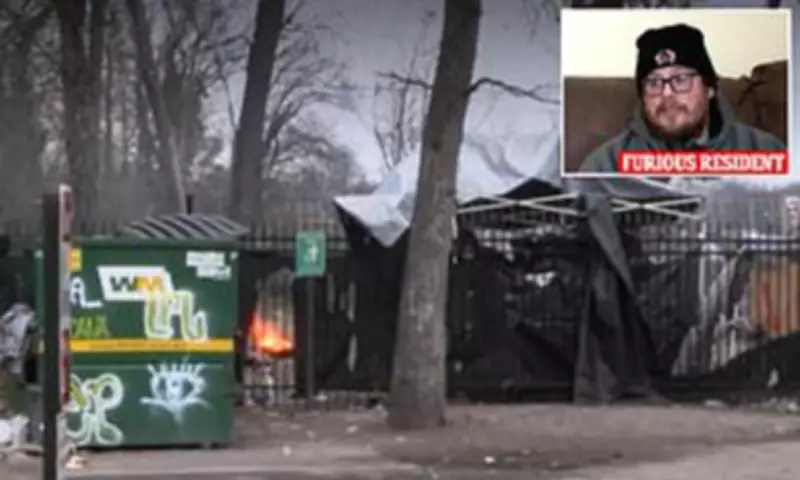
Maryland Condominium Residents Plead for Help Amid Homeless Encampment Crisis
Residents of the Marylander Condominiums in Prince George's County, Maryland, are expressing growing desperation as they contend with a severe homeless encampment crisis that has brought vandalism, power outages, and violent incidents to their doorstep. Their appeals for assistance have largely been ignored, with building management and local officials engaging in a blame game rather than offering concrete solutions.
A Community in Distress
The problems began in 2023 when a homeless encampment emerged in the backyard of the condominium complex. Since then, residents have reported a litany of issues, including break-ins, assaults, vandalism, and even individuals urinating in hallways. The situation escalated dramatically after Thanksgiving when a homeless person allegedly damaged pipes, leaving half the buildings without heating. This led county officials to issue notices to vacate, pushing many residents toward homelessness themselves as they struggle to sell their now-undesirable units.
At a town hall meeting on January 22, police officials Melvin Powell and Thomas Boone advised residents to "have compassion" for the homeless and stated that the department would not be "criminalizing the unhoused." This response sparked outrage among long-suffering residents like Scott Barber, who has lived at the Marylander for years with his mother Linda and brother Chris. Barber noted that the encampment has worsened due to insecure buildings, calling it "a crime of opportunity." Despite the installation of a $27,000 fence, security remains inadequate, with broken locks exacerbating the problem.

Daily Fears and Financial Strain
For residents like Jason Van Horne and his 73-year-old mother Lynette, daily life is fraught with fear. Lynette described being unable to do laundry without feeling unsafe, citing incidents where homeless individuals have torn up the laundry room, slept in buildings, and engaged in sexual activity. "You have to get up in the morning and look through the peephole before you can leave," she lamented. Financially, residents are burdened by condo fees of up to $1,000 per month on top of mortgage payments, yet many cannot afford to relocate due to high hotel costs and the unsellable nature of their properties.
Following the town hall, Prince George's County Executive Aisha Braveboy vowed to hold the property management company, Quasar, accountable. A county judge later gave Quasar two weeks to evacuate residents and repair the heating system. However, Phil Dawit, Quasar's managing director, criticized the county for its lax approach to the encampment, arguing that hardworking residents are being pushed toward homelessness while the encampment faces no consequences. Dawit blamed the county for the community's decline, stating, "The dilapidation of this community was caused directly by the county."
Conflicting Responses and Political Context
County officials, in turn, have pointed fingers at building management and even residents. Police Captain Nicolas Collins warned against providing food to the homeless, claiming it would incentivize their return. Meanwhile, the Department of Social Services runs a program aimed at building trust with the homeless population, and county official Danielle Coates threatened "further escalation" if repairs and safety measures were not addressed. The county has reportedly considered suing the Marylander for nearly $5 million in property damage.
This crisis unfolds in Prince George's County, which boasts an 86 percent Democratic vote share, making it one of the nation's strongest Democratic strongholds. As residents remain trapped in a cycle of blame and inaction, their plight highlights broader challenges in addressing homelessness and public safety in urban communities.