The Phillips Mansion: A Lone Survivor from a Lost Frontier Town
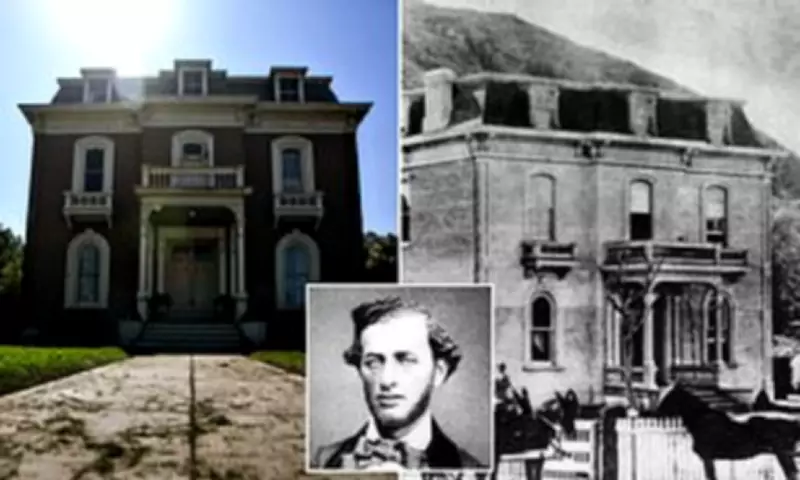
Nestled in the industrial sector of Pomona, on the eastern fringe of Los Angeles County, the Phillips Mansion stands as a poignant relic of a bygone era. This architectural gem, constructed in 1875, is one of the last surviving remnants of Spadra, a 19th-century frontier town that has largely faded from public memory. At the time of its construction, the area was far less developed, forming part of Spadra, a settlement that no longer exists today.
A Testament to Resilience and Historical Significance
Built in the distinctive Second-Empire style, the Phillips Mansion has endured for over 150 years, surviving earthquakes, narrowly escaping demolition, and undergoing numerous renovations. Its survival marks it as a designated historical landmark, a tangible link to California's pioneering past.
The Visionary Behind the Mansion: Louis Phillips
The mansion was commissioned by Louis Phillips, a Jewish immigrant from Poland who arrived in the United States in 1848 and settled in California by 1850. Phillips transformed himself into a remarkably successful rancher. In 1862, he purchased 12,000 acres of land outside Los Angeles, expanding his holdings to 20,000 acres by 1874, along with 6,000 sheep and 300 head of cattle. This vast estate encompassed most of what would evolve into modern-day Pomona, then known as Spadra.

Phillips played a pivotal role in Spadra's development. He sold land parcels to newcomers, facilitating the establishment of shops, hotels, a school, and a post office. His influence even extended to convincing the Southern Pacific Railroad to establish a stop in Spadra, which significantly spurred growth. By 1870, the town's population had swelled to approximately 500 residents.
Architectural Innovation and Opulent Design
Constructed at an estimated cost of $20,000 in 1875—equivalent to about $600,000 today—the Phillips Mansion was a marvel of its time. It was among the first brick residences in the region and the inaugural home to feature gas lighting. The opulent design includes eight rooms, soaring 16-foot-high ceilings, six fireplaces, and exquisite cherry and maple woodwork.
Wealth, Investment, and Lasting Legacy
Phillips's prosperity stemmed from astute real estate investments in Los Angeles, where he bought entire downtown blocks that yielded substantial returns, combined with his sprawling ranches producing wool, honey, hay, and wheat. By 1892, the Pomona Progress hailed him as the "richest man in Los Angeles County," with an estimated fortune of at least $3 million, comparable to over $100 million in today's currency.
Despite Spadra's decline after the Southern Pacific Railroad relocated its stop to Colton in 1883, Phillips's legacy endured. He was a founding figure of Pomona College, which commenced classes in 1888 and remains operational, and served as a trustee for years. Phillips passed away in 1900, with his wife Esther residing in the mansion until her death in 1918.
Preservation and Modern-Day Access
After the couple's descendants sold the home in the 1940s, it was converted into apartments, remaining in use until the 1960s before falling into vacancy. In 1974, the mansion faced imminent demolition, but the Historical Society of Pomona Valley intervened, purchasing it for $45,000. The society restored the building and secured its listing on the National Registry of Historic Places.
Today, the Historical Society of Pomona Valley offers occasional tours of the Phillips Mansion. Visitors can also explore the nearby Spadra Cemetery, the only other surviving fragment of the old frontier town, where Phillips is interred beneath a grand tombstone adorned with carved Corinthian columns.