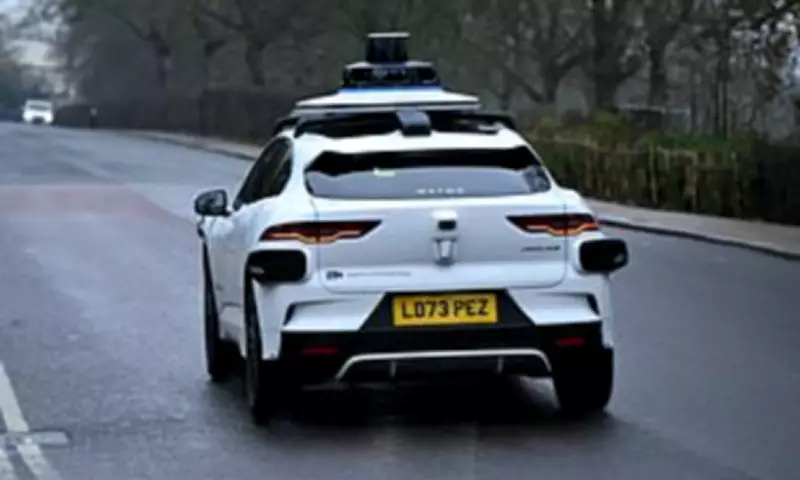
Autonomous vehicles have been found to slam on their brakes after confusing large advertisements with actual human beings, raising significant safety questions as the United Kingdom prepares for widespread trials of self-driving technology. This alarming revelation comes just weeks before a major test of driverless taxis is scheduled to commence in London this April, following preliminary assessments conducted in British cities including York.
Artificial Intelligence Fails to Distinguish Reality from Imagery
Despite the rapid deployment of computer-controlled vehicles across various regions, persistent worries regarding their operational safety protocols remain intensely elevated. Professor John McDermid, a government advisor on self-driving vehicles and a software specialist based at York University, addressed journalists at London's Science Media Centre, confirming that these autonomous systems continue to be easily misled by everyday scenarios.
In one particularly concerning incident detailed by Professor McDermid, a driverless car erroneously identified a life-size promotional poster for the 2015 cinematic release The Man from U.N.C.L.E., displayed on the side of a bus and depicting several actors, as a group of genuine pedestrians obstructing the roadway. Consequently, the vehicle's artificial intelligence compelled it to execute an abrupt emergency halt, a manoeuvre that could have posed a serious collision risk to following traffic.

Professor McDermid's Expert Testimony
Speaking to the Daily Telegraph, Professor McDermid elaborated: 'One of the automated vehicle companies I collaborate with encountered a situation where their vehicle initiated a sudden emergency stop because it perceived pedestrians in the road, except they were not actually there. It was a life-size advert on the side of a bus, but to an AI system, it represented human beings. That distinction seems very obvious to us, but actually, to the artificial intelligence, it is not.'
He further noted that during experimental runs in his academic home of York, autonomous cars have also been baffled by the unpredictable behaviours of pedestrians, such as individuals crossing streets after traffic signals have turned green and the red 'no crossing' figure is illuminated. In the United States, where self-driving technology is more advanced, jaywalking constitutes a legal offence with potentially severe penalties, encouraging stricter adherence to crossing instructions. However, in Britain, pedestrians traditionally maintain priority, a cultural nuance that these innovative robotic vehicles appear to struggle to comprehend.
Additional Challenges in Urban Environments
Professor McDermid explained the crossing confusion observed in York: 'The system detects a traffic light, thus identifying a potential hazard because the light is red. When it changes to green, the vehicle prepares to proceed. But this is York, so tourists—despite the lights changing to green—continue to walk across the road. Computer vision technology does not understand elements for which it lacks pre-programmed models. It does not inherently know what a roundabout is, for instance.'
American autonomous vehicle firm Waymo is set to initiate its driverless taxi trials in London from the Easter period, with subsequent plans for Uber to adopt the scheme and eventually offer robotaxis to fare-paying customers. However, previous experiences with Waymo's autonomous cars in San Francisco two years ago documented multiple near-miss incidents involving school crossing guards, casting further doubt on reliability.
Safety Incidents and Public Apprehension
A survey of thirty crossing attendants in San Francisco indicated that approximately a quarter had experienced a 'close call' with an autonomous vehicle, with some forced to leap out of the path to avoid impact. Veteran lollipop lady Theresa Dorn endured three such near-misses within a single year, recounting one episode where a parent had to swiftly intervene: 'The parent grabbed the child, looked at the car—and there was nobody driving it. Why do they have these driverless cars? I think somebody should be driving them.'

In Britain, official government guidance stipulates that self-driving vehicles must be held to the same high behavioural standards expected of human drivers. Nevertheless, a majority of respondents in recent surveys believe these standards should be even more stringent, expressing trepidation about a potential increase in the annual toll of approximately 1,600 road fatalities in the UK.
Professor McDermid has issued a stark warning, urging that pedestrians must not become a 'moral crumple zone' for robotic cars, emphasising the imperative for continuous refinement of artificial intelligence to ensure public safety remains paramount as autonomous technology advances.