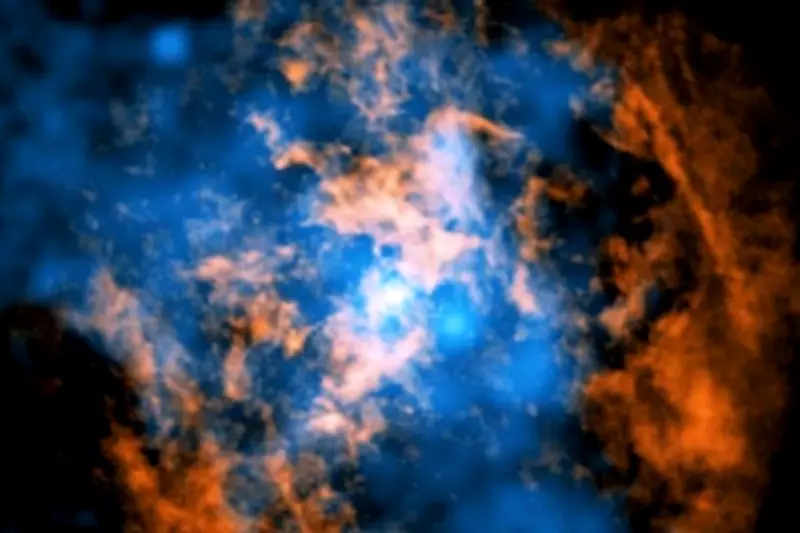
Astronomers have finally solved a decades-old mystery about the supermassive black hole at the center of our Milky Way galaxy. Using the most detailed observations yet, they have identified a 20,000-year-old wind emanating from Sagittarius A*, the black hole that governs our galaxy's growth and evolution.
Breakthrough Observation
Most black holes produce winds or jets as they consume surrounding material. However, until now, no one could detect the wind from Sagittarius A*. The new study, co-led by Mark Gorski of Northwestern University and Elena Murchikova, provides the first clear evidence of this wind.
"Unless a black hole exists in a perfect vacuum, it must blow a wind somehow," Gorski explained. "And there is no perfect vacuum in the universe." He added, "With new observations, this is the first time we've had a clean enough view to see the wind's imprint. We looked at the data and said, 'There it is. There is the thing that everybody's been looking for for 50 years.'"

Advanced Imaging Techniques
The team used five years of data from the Atacama Large Millimeter/Submillimeter Array (ALMA) radio telescopes in Chile. By peering through gas and dust that previously obscured Sagittarius A*, they captured an image of the gas near the black hole. They then corrected the image to reduce the black hole's radio signals, resulting in a view that is 100 times deeper and 80 times sharper than previous maps of the region.
This unprecedented clarity allowed scientists to see areas that were invisible in earlier photos. They discovered a massive, cone-shaped cavity devoid of gas, which could only have been created by a hot wind. Winds produced by surrounding stars are not powerful enough to carve out such a large region.
"If you blow hot material from the black hole, it's not going to want to exist with the cold material," Gorski said. "It's either going to push the cold material out or heat it up. And, if it's too hot, you will no longer see the cold gas."
Implications for Black Hole Understanding
Murchikova noted, "The wind is not powerful, and its direction probably wanders with time. It shows that our black hole is not unique, and our place in the universe is not unique." The observations indicate that Sagittarius A* is currently in a quieter phase, although past disruptions have been evidenced. NASA's Chandra X-ray Observatory had previously detected X-ray emissions in the same region as the cone-shaped hole, corroborating the findings.
Sagittarius A* was first discovered in 1974. Gorski emphasized the need for rigorous validation: "Exceptional claims require exceptional evidence. We wanted to make sure that we weren't just looking at some sort of imaging artifact. Then, the X-ray image from Chandra just slotted in perfectly. The molecular features lined up."
Murchikova reflected on the discovery process: "When you find something that no one has seen before, the first thought that runs through your mind is not 'Oh my God, we made a discovery.' It's 'Oh my God, what's wrong with my analysis?' But when we overlaid our image with the X-ray image, it started to make sense."