Petra's Deserted Splendor: A UNESCO Wonder Empty Amid Regional Conflict
Standing at the entrance to one of the world's most incredible destinations, I found myself in an almost surreal silence. This UNESCO World Heritage site, which would normally be swarming with up to 10,000 visitors daily, was remarkably quiet. The ancient wonder of Petra, Jordan's crowning glory and one of the new Seven Wonders of the World, stood practically deserted before me.
The Awe-Inspiring Treasury in Unprecedented Solitude
Our guide, Zuhair Zuriqat, built suspense as we approached through the Siq, the narrow gorge that serves as Petra's dramatic entrance. "After I count to three, I need you to look up my friends," he instructed. As I lifted my gaze at his signal, I was met with the breathtaking sight of the Treasury (Al-Khazneh), the most intricate rock-carved tomb in Petra. A relic of the Nabataeans, an industrious Arab civilization that settled in southern Jordan over 2,000 years ago, this architectural masterpiece normally draws visitors from every corner of the globe.
"At this time of year, it should be the peak," mourned Zuhair. "Two years ago, there were certain days when we had over 10,000 visitors." Petra typically hosts nearly one million tourists annually, but today only a smattering of visitors wandered through the ancient city.

The Regional Conflict's Devastating Impact on Tourism
Zuhair tactfully explained that since the outbreak of the conflict between Hamas and Israel in October 2023, tourism has taken a severe hit. Given Jordan's border with Israel, the ongoing strife has wreaked havoc on its tourism industry. Many potential travellers, influenced by regional news coverage, erroneously perceive the entire Middle East as one perilous zone.
Tourism Consultant Malia Asfour, formerly Managing Director of Jordan Tourism Board North America, elaborated: "With the current political situation in the region, we're victims of misperception, and so there's less tourism coming in." She emphasized that Jordan has consistently maintained neutrality in military conflicts and remains fully functional and open to visitors.
A Stark Contrast to Over-Tourism Challenges
The irony is striking. Not long ago, Jordan was grappling with over-tourism at its most popular sites. Now it faces the opposite challenge: persuading the world that it's safe, tranquil and completely ready to receive tourists again. From my vantage point, the contrast was most striking. I've seen countless social media images of Petra packed with selfie-taking visitors jostling for the perfect shot, making it feel remarkable to have the famous 'Rose City' virtually to myself.
Exploring Petra's Ancient Wonders
Thought to be more than 2,300 years old, Petra's exact date of construction remains unknown. By the first century BC, it had become the capital of the Nabataean Empire, whose wealth came from trading frankincense, myrrh, and spices. Today, it operates as an Archaeological Park covering 264,000 square metres across Wadi Musa.
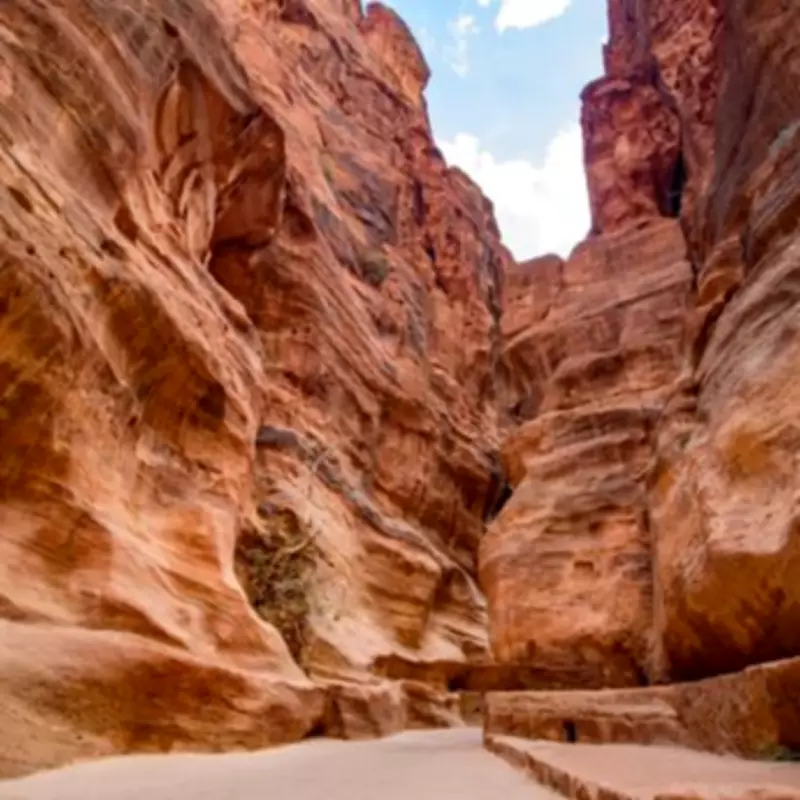
Entry costs 50 JOD (approximately £51). Your experience begins in the Siq, where walls tower above, sometimes just metres apart, marked with pinks, rusts and buttery golds where centuries of weathering and flash floods have polished and shaped the stone into wave-like patterns. The ambience becomes cool and echoing in parts, with tour guides often pointing out remnants of ancient water channels expertly etched into the rock face.
Petra's Rich History and Rediscovery
Our guide informed us that Petra was the capital of the Nabataean Kingdom from around the 4th century BC. These Arab traders amassed enormous wealth by controlling caravan routes for incense, spices, and other valuable goods travelling between Arabia, Egypt, and the Mediterranean. They transformed this desert stronghold into a thriving city, complete with temples, tombs, and a hillside theatre carved from rock with room for thousands of spectators.
Later, Rome incorporated the city, and it continued to prosper until a devastating earthquake in AD 363 caused extensive damage. This destruction, along with shifting trade routes, accelerated Petra's decline. It ultimately fell into disuse and was remembered only by local Bedouin tribes.

Petra was reintroduced to the Western world on August 22, 1812, thanks to Swiss explorer Johann Ludwig Burckhardt. Under the pseudonym Ibrahim Ibn Abdallah and posing as an Arab scholar, he persuaded his Bedouin guides to lead him to a mythical hidden city within Jordan's Wadi Musa. His discovery unveiled a 12th-century marvel that had seemingly remained largely unknown beyond the local vicinity.
Cinematic Fame and Beyond the Treasury
Since then, Petra has gained worldwide fame, particularly after featuring as a film location in the 1989 blockbuster Indiana Jones and the Last Crusade, which significantly boosted visitor numbers to the site. As a fervent cinephile, I was thrilled to be tracing Indy's steps, though our guide emphasized that Petra offers much more than just the Treasury.
Venture further, and you'll discover a theatre possibly dating back to the early first century AD, the Petra Church Complex, the Pharaoh's Column, and Qasr Bint Far'un (Palace of the Pharaoh's Daughter). More importantly, as you wander past the Treasury, you'll start spotting numerous cafés and shops run by Bedouins, where you can try Arabic eyeliner, buy souvenirs, and sip pomegranate juice.
The Human Impact of Tourism Decline
Although the government relocated the Bedouins to nearby Wadi Musa, they've kept their businesses running within Petra and in the 2,000-year-old caves they've called home for centuries. The doors stay open. The shelves remain filled. What's missing are the visitors.
"Today is good because we see tourists," said Rosa, who sells sand art bottles, jewellery, trinkets and bright woven textiles. "Normally, there is no one." As she spoke, she steadied my face and traced a line of dark kohl around my eyes, a Bedouin tradition used for centuries for both beauty and protection.
Now is the moment to buy your souvenirs, not simply because the scarves are beautiful, but because tourism continues to be painfully slow, and these families truly rely on tourism income. Every souvenir, every glass of juice or coffee, every small purchase isn't just a keepsake for you; it's a practical way of helping local communities.
A Rare Opportunity for Tranquil Exploration
After savouring samples of fresh pomegranate juice and purchasing last-minute souvenirs, our time in Petra was coming to an end. The visit felt all too brief. I'd jump at the chance to return to this awe-inspiring wonder, bustling with tourists once again, even if it means giving up my boastful Instagram snaps of a near-empty Treasury.
Until the crowds return, this presents a rare golden opportunity to visit Jordan. The tranquillity of Petra, the ruby-red sands of Wadi Rum, and even the Jordanian coast of the Dead Sea is something to behold. It's a unique chance to explore these sites without having to navigate through hordes of selfie-stick-brandishing holidaymakers.
If you're nervous about venturing out on your own, group tours offer a simple and enjoyable solution. Tour operators such as G Adventures, Explore Worldwide, and Wild Frontiers offer a range of itineraries across Jordan, allowing you to discover these wonders accompanied by well-informed local guides.
Honestly, I reckon it's worth spending your hard-earned money in places where visitors are genuinely appreciated. I'm highly likely to revisit this warm and friendly country. On my next trip, I might even manage to snap a decent selfie with others in the frame. I look forward to seeing you there.