Chicago's Ambitious Roundabout Expansion Meets Driver Resistance
Chicago has been quietly constructing roundabouts and traffic circles in a strategic bid to improve road safety across the metropolitan area. However, this infrastructure initiative has encountered a significant hurdle: many motorists remain unfamiliar with how to properly navigate these circular intersections.
The Scale of Implementation
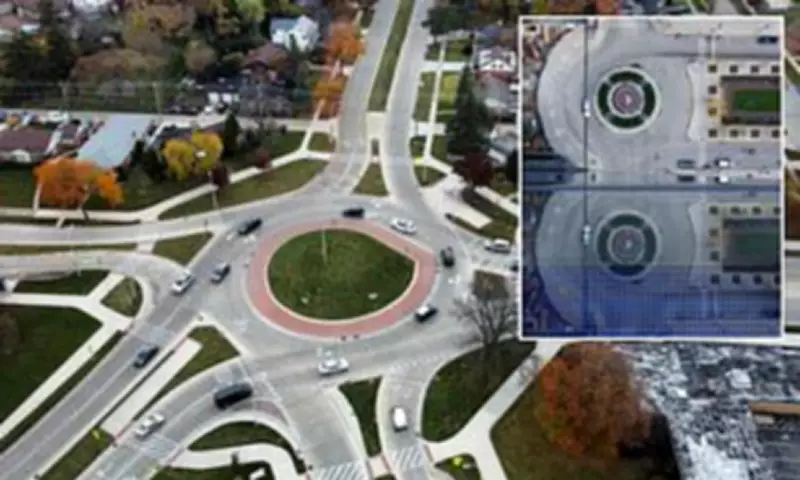
Currently, eight roundabouts have already been completed in Chicago's suburban districts. An additional eleven are actively under construction, with completion expected within the next three to five years. Furthermore, discussions are underway regarding twelve more potential roundabout locations.
The city maintains less precise records for traffic circles, but according to the Chicago Department of Transportation, approximately 250 appear on official landscaping lists. The actual total is substantially higher, as many traffic circles do not require formal landscaping documentation.

Safety Benefits Versus Driver Confusion
Wen Hu, senior research transportation engineer at the Insurance Institute for Highway Safety, explained to the Daily Mail that roundabouts effectively eliminate "very severe, dangerous conflicts at traditional intersections, such as right-angle crashes." Extensive research demonstrates that compared to conventional intersections, roundabouts enhance safety while improving traffic flow efficiency.
Despite these documented advantages, roundabouts remain uncommon in many American regions. Drivers who haven't traveled to Europe often lack prior experience with them, leading to frequent navigation errors and widespread complaints about their implementation.
Local Experiences and Anecdotal Evidence
Chicago's Reddit community reveals numerous accounts of driver confusion. One resident observed, "Not a soul in my neighborhood has the slightest idea how to use these now that they put them in. I've seen every possible scenario. Almost none of them involve turning signals."
Another resident described problematic behavior at a local traffic circle: "There's an intersection of two side streets near me that has a circle. Nearly all drivers short cut through the circle when making left turns." This same individual reported seeing "a destroyed muffler" left on the street after a motorist drove over the raised cement center of a traffic circle.
Understanding Roundabout Mechanics
Hu clarified the fundamental differences between roundabouts and traditional intersections. "Roundabouts are just one way to control traffic at intersections. At traditional intersections, traffic is controlled by either stop signs, yield signs, or traffic signals," she explained.
At roundabouts, entering vehicles must yield to circulating traffic. Cars then proceed counter-clockwise around a central island before exiting at their desired street. Traffic circles represent a slightly different design, often placed at traditional four-way intersections to force left-turning vehicles to slow down and navigate counter-clockwise around a center circle.
Comparative Advantages and Global Context
Traffic circles prove particularly valuable in residential areas where children might be present, as they naturally encourage speed reduction. They are also smaller and more cost-effective to implement than multi-lane roundabouts, which require more land and pavement.
Globally, roundabouts have achieved widespread adoption in countries like the United Kingdom, Australia, and France, where motorists navigate thousands without complaint. Within the United States, Carmel, Indiana has earned the title "Roundabout Capital of the United States" with over 150 installations.
The Learning Curve and Transition Period
Hu acknowledged that unfamiliarity breeds apprehension. "They get scared of driving through a roundabout," she noted, adding that lane selection confusion can complicate exit decisions. Initially, roundabout implementation sometimes correlates with increased crash frequency, but these incidents typically involve low-severity impacts due to enforced speed reduction and redesigned traffic angles that virtually eliminate dangerous T-bone collisions.

Research from the Insurance Institute for Highway Safety indicates that "over time, the number of crashes declines as drivers get familiar with these roundabouts." This pattern finds support in anecdotal Chicago experiences. One Reddit user commented, "I grew up with traffic circles rather than four-way stops and in my experience they work far better, but yeah, only if everyone understands they work."
Improving Driver Adaptation
Hu emphasized that proper signage and pavement markings can significantly ease the transition for inexperienced drivers. "There should be clear signs or pavement markings to let the driver know clearly on which lane the driver should stay, should pick, when they enter the roundabouts," she advised. Entrance signs reminding drivers that entering traffic must yield to circulating traffic would further improve navigation.
Survey data reveals that as drivers gain roundabout experience, their approval increases substantially. "We did several surveys in communities with roundabouts, and we did see that as drivers gained some experience navigating these roundabouts, they were more likely to favor them," Hu reported. "Generally speaking, no matter where drivers are, as they gain experience, as they know how these roundabouts work, they tend to like it."
Measurable Safety Improvements
Despite ongoing adaptation challenges, some Chicago residents already report noticeable safety enhancements. A Reddit user shared, "They literally just added one on my street this summer. Drivers would fly down blowing the stop signs before it... so a huge improvement!!" This feedback underscores the potential long-term benefits of Chicago's roundabout initiative, even as the city works to educate its driving population about proper circular intersection navigation.