

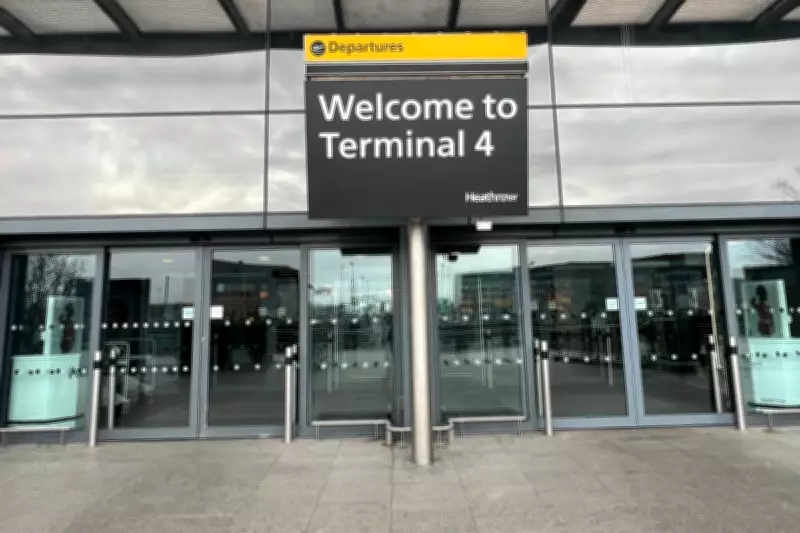
Heathrow Terminal 4 Sees Passenger Numbers Drop by a Third Following Gulf Airline Cancellations
Exclusive analysis by The Independent has uncovered a dramatic decline in passenger traffic at London Heathrow Airport's Terminal 4, with figures indicating a loss of one in three travellers since late February. The downturn is directly linked to a cascade of flight cancellations by major Gulf and Middle Eastern carriers, creating an eerily quiet atmosphere in the terminal.
Daily Impact of Widespread Flight Cancellations
The cancellations by Qatar Airways, Etihad, Gulf Air, Kuwait Airways, and El Al are now affecting approximately 9,000 passengers arriving or departing daily from Terminal 4. This represents a significant portion of the terminal's normal traffic, though Heathrow Airport authorities maintain the reduction is less severe than independent calculations suggest.
During a recent Monday morning visit, the terminal presented a ghostly appearance with rows of empty check-in desks and minimal activity. One catering server described current business levels as "ten" compared to a normal day's "one hundred," highlighting the stark contrast in passenger volumes.

Terminal 4's Unique Position and Specialization
Terminal 4 occupies a geographically isolated position south of Heathrow's southern runway, separated from the more centrally located Terminals 2, 3, and 5. This location, combined with challenging onward connections, has shaped T4 into primarily a point-to-point terminal specializing in flights to key Middle Eastern hubs.
Normally, passengers could choose from seven daily Qatar Airways flights to Doha, including service on the massive Airbus A380. Etihad typically offered four daily nonstop flights to Abu Dhabi, half utilizing the "SuperJumbo" A380 aircraft. Additionally, Gulf Air of Bahrain and Kuwait Airways each operated two daily wide-bodied aircraft flights between their respective hubs and Terminal 4.
El Al's service to Tel Aviv from T4 has become intermittent with a skeleton schedule, further contributing to the terminal's reduced activity.
Operational Challenges and Historical Context
The departure screens at Terminal 4 now reveal a yawning 90-minute gap in the middle of the day with no scheduled departures—a situation unthinkable at Heathrow's other terminals. This operational lull underscores the terminal's current struggles.
Terminal 4 originally opened in 1986 as a temporary facility during the prolonged planning inquiry for what would become Terminal 5. Its location has always presented challenges, requiring aircraft using the northern runway to taxi across an active runway during arrival or departure procedures.
Public transport access has historically been problematic, with the Piccadilly line serving T4 on a branch loop and the Heathrow Express train redirected to Terminal 5 upon its opening. Recent improvements include increased Elizabeth line frequency to four trains per hour connecting to central London.
Remaining Operations and Future Prospects
Despite the significant reductions, some airlines continue operations from Terminal 4. Air France and KLM serve their Paris Charles de Gaulle and Amsterdam Schiphol hubs respectively, while British Airways' budget sibling Vueling operates flights to Barcelona, Santiago de Compostela, Bilbao, and Paris Orly.
The terminal was designed with easy access to departure gates to facilitate fast turnarounds, making it a potential future home for easyJet should the budget airline ever launch Heathrow services. However, industry observers note such a move is unlikely until and unless Heathrow's controversial third runway is constructed.
Commercial Impact and Historical Parallels
The cafés and duty-free shops at Terminal 4 are experiencing severe commercial strain reminiscent of the COVID-19 pandemic, when the terminal was completely closed for two years. A protracted Middle East conflict could potentially force similar measures, though Heathrow management firmly states closure is not currently being considered as an option.
The current situation highlights Terminal 4's vulnerability to geopolitical disruptions affecting its core Middle Eastern route network, with the passenger decline creating a ghost airport atmosphere that contrasts sharply with Heathrow's typically bustling environment.






