Cockpit Recording Details Fatal Communication Failures in LaGuardia Airport Disaster
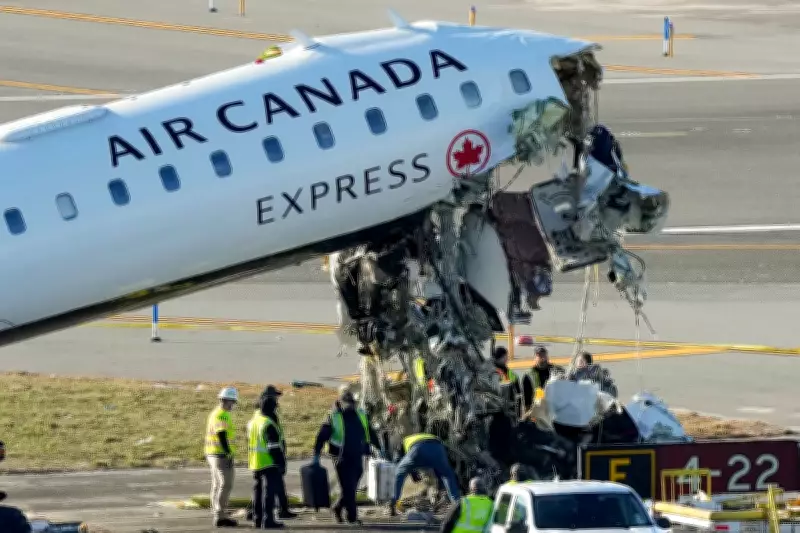
Critical cockpit audio recovered from the Air Canada Express passenger jet involved in a deadly collision at New York's LaGuardia Airport has exposed a series of communication breakdowns and operational errors that culminated in tragedy. The National Transportation Safety Board (NTSB) has released a detailed timeline revealing how confusion between air traffic controllers and a fire truck contributed to the crash that claimed two lives and injured forty-three people.
Fatal Collision and Immediate Aftermath
The disaster occurred late Sunday night when Jazz Aviation Flight 8646, operating as Air Canada Express from Montreal, collided with a Port Authority fire truck crossing Runway 4. Captain Antoine Forest and First Officer Mackenzie Gunther, the two pilots aboard the Bombardier CRJ-900, were killed instantly. Forty-one passengers sustained injuries, with most subsequently released from hospital treatment. The two fire truck occupants suffered broken limbs but are reported to be in stable condition following medical care.
NTSB investigators recovered the cockpit voice recorder by cutting through the aircraft's damaged roof on Monday, enabling Chair Jennifer Homendy to present a minute-by-minute account of the events leading to the collision during a Tuesday briefing.

Controller Confusion and Communication Breakdown
Homendy's investigation revealed that one controller in LaGuardia's tower authorized the fire truck to cross the runway while another controller simultaneously cleared the Canadian flight to land on the same tarmac. This critical coordination failure created the conditions for disaster.
The situation was compounded by radio communication problems at the crucial moment. According to Homendy, a transmission from the fire truck was lost because another unidentified user was communicating on the same frequency. "That would be significant because it could mean somebody might not hear the other part of the communication," Homendy explained during the briefing.
Real-time audio previously released by LiveATC.com captures controllers frantically shouting "stop, stop, stop" to the fire truck as the plane approached, but these warnings went unacknowledged. The truck involved was not equipped with a transponder that would have triggered an automatic alert within the airport's surveillance system, potentially contributing to the tragedy.
Fatigue Concerns and Investigation Findings
Homendy noted that the controllers involved were working a night shift from 10:30 p.m. to 6:30 a.m., during which staff have previously reported experiencing fatigue. However, she emphasized there was "no indication that was a factor here" in this specific incident.
The cockpit recorder contained approximately twenty-five hours of audio, which investigators planned to fully transcribe on Wednesday. The final moments captured the Air Canada flight liaising with control tower personnel, securing permission to use the runway, and completing standard landing checklist procedures.
Detailed Timeline of the Disaster
The NTSB released a comprehensive chronology showing how multiple factors converged to create the deadly situation:

- 10:12 p.m.: Air Canada Express Flight 8646 departs Montreal–Trudeau International Airport, already delayed by over two hours.
- 11:16 p.m.: A United Airlines flight aborts takeoff due to an anti-ice warning light, reporting a strange odor shortly afterward.
- 11:31 p.m.: The United flight declares an emergency as flight attendants report feeling ill from the odor.
- 11:34 p.m.: Air Canada Flight 8646 is instructed to contact LaGuardia's control tower for final approach guidance.
- 11:35 p.m.: The Air Canada flight receives clearance to land on Runway 4/22.
- 11:37 p.m.: A firefighter requests and receives permission to cross Runway 4 at Taxiway D with emergency vehicles responding to the United flight's odor emergency.
- 11:37:11 p.m.: Electronic callouts indicate Flight 8646 is just fifty feet above ground.
- 11:37:16 p.m.: Controllers frantically order the fire truck to stop as the plane approaches.
- 11:37:25 p.m.: The Air Canada jet collides with the fire truck, with the cockpit recording stopping abruptly.
In audio captured after the collision, one controller admitted, "I tried to reach out to 'em... We were dealing with an emergency earlier, and I messed up." A pilot responded with attempted reassurance: "Nah, man, you did the best you could."
Ongoing Investigation and Safety Implications
The NTSB continues its investigation into the precise causes of the communication failures and operational breakdowns. Homendy emphasized that while LaGuardia Airport has surveillance systems to track aircraft and vehicle movements, the fire truck involved lacked the transponder technology that might have prevented the tragedy.
This incident raises significant questions about air traffic control coordination during emergency responses, radio frequency management, and vehicle tracking protocols at major airports. The detailed cockpit audio provides crucial evidence as investigators work to determine exactly how permission was granted for both the landing aircraft and crossing vehicle to occupy the same runway simultaneously.
As the investigation progresses, aviation authorities will likely examine procedures for controller handoffs, emergency vehicle communications, and technology implementation to prevent similar tragedies in the future.