

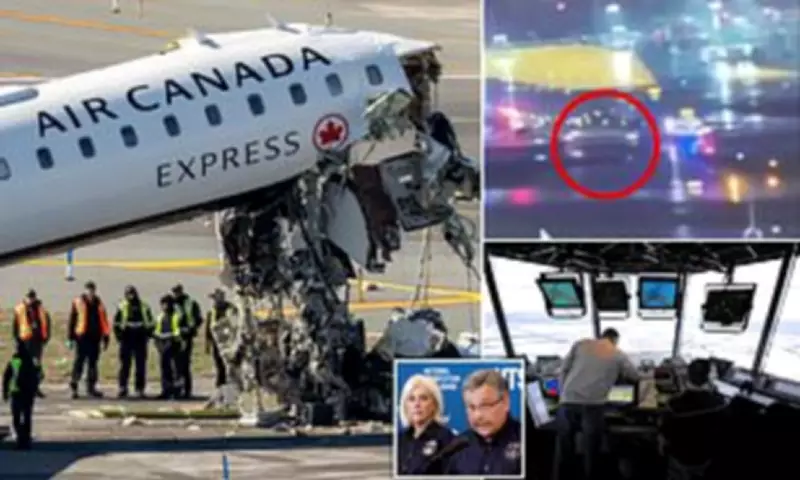
Air Canada Crash Audio Exposes Critical Failures at LaGuardia Airport
Heart-stopping cockpit audio recovered from Air Canada Flight 8646 has laid bare a cascade of overlapping errors at New York's LaGuardia International Airport in the minutes before the aircraft slammed into a firetruck on the runway. The recording reveals how one air traffic controller granted permission for the Montreal-bound flight to land on Runway 4, while another controller simultaneously cleared the emergency vehicle to travel down the same runway around 11:40 PM on Sunday.
Multiple System Failures in Aviation Safety Layers
In a devastating sequence, the firetruck's surface safety system failed to trigger any alerts for controllers, leaving them unaware of the imminent danger. It remains unclear why this critical device was not operational. National Transportation Safety Board investigators are now focusing on potential issues within both the air traffic control tower and the firetruck itself, which may have lacked a functioning transponder to alert controllers.
"We rarely, if ever, investigate a major accident where it was one failure," NTSB Chairwoman Jennifer Homendy told The Wall Street Journal. "Our aviation system is incredibly safe because there are multiple, multiple layers of defense built in to prevent an accident. So when something goes wrong, that means many, many things went wrong."

Timeline of a Tragic Descent
According to senior aviation investigator Doug Brazy, the flight's descent began normally. In the two minutes and four seconds before impact, pilots followed procedure and received clearance to land on Runway 4. About thirty seconds later, the crew lowered landing gear, set wing flaps for final descent, and confirmed the landing checklist was complete.
The two Port Authority firefighters, responding to reports of a foul odor on another aircraft, radioed the tower approximately one minute before impact. However, their transmission was "stepped on"—either by another microphone activation or communication on the same frequency—potentially obscuring critical information.
"That would be significant because it could mean somebody might not hear the other part of the communication," Homendy emphasized during a Tuesday news conference.
Final Moments Before Impact
As the Air Canada flight continued its stable approach, reporting 500 feet above ground level, the controller asked which vehicle needed to cross the runway. Someone in the firetruck responded, and the controller cleared the emergency vehicle to "cross Runway 4 at taxiway delta."
Simultaneously, inside the cockpit, an enhanced ground proximity warning system called out altitudes: 100, 50, 30, 20, and just 10 feet above ground. With only nine seconds remaining before impact, the air traffic controller seemed to recognize the error and urgently instructed the firetruck to stop.
One second later, the landing gear touched down. First Officer Mackenzie Gunther transferred control to Captain Antoine Forest as the aircraft raced down the runway at 150 mph. The tower could be heard repeatedly ordering the firetruck to stop before the recording ended abruptly.
Controller Procedures and Fatigue Concerns
It remains unclear whether the same controller authorized both the aircraft and firetruck. Two controllers were on duty—one managing active runways and airspace, while the "controller in charge" oversaw safety operations. One also functioned as ground controller, directing taxiway movement.
Homendy noted that combining positions during night shifts is standard practice at LaGuardia, one of the nation's largest airports. The controllers worked a shift from 10:30 PM to 6:30 AM, a period historically associated with fatigue concerns.
"The midnight shift, as a reminder, is one that we have many times at the NTSB raised concerns about with respect to fatigue," Homendy stated. "We have no indication that was a factor here, but it is a shift that we have been focused on in past investigations."
Remarkably, at least one controller continued working for several minutes after the crash, raising questions about relief availability.

Safety System Deficiencies and Ongoing Investigation
Investigators are examining whether the firetruck lacked a working transponder, which would have provided crucial alerts. The truck's ASDE-X surface safety system failed to trigger warnings, despite LaGuardia being one of 35 major U.S. airports with such advanced surveillance systems designed to prevent runway incursions.
Just last May, the FAA urged airports with these systems to equip vehicles with transponders. While the NTSB hasn't mandated this, Homendy asserted they should be standard equipment: "Air traffic controllers should know what's before them, whether it's on airport surface or in the airspace. They should have that information to ensure safety."
The Port Authority of New York and New Jersey, which operates the airport, declined to comment on the transponder issue due to the ongoing investigation.
Visible Aftermath and Passenger Reactions
As the investigation continues, passengers landing at LaGuardia have been shocked to see the wreckage still on the runway. Officials confirmed the scene won't be cleared until the NTSB probe concludes.
"At first I was just shocked at the proximity, it was right there. It's shocking, you land and it's the first thing you see when you're on the tarmac," said Sherrie Katanach, who flew in from Chicago.
Sherman Criner, returning from New Orleans, added: "I figured they would get that off the runway as quickly as possible, but from the plane you could see it still sitting there."
The collision killed both pilots and injured 41 others, with the investigation now meticulously reconstructing how multiple safety layers failed simultaneously.





