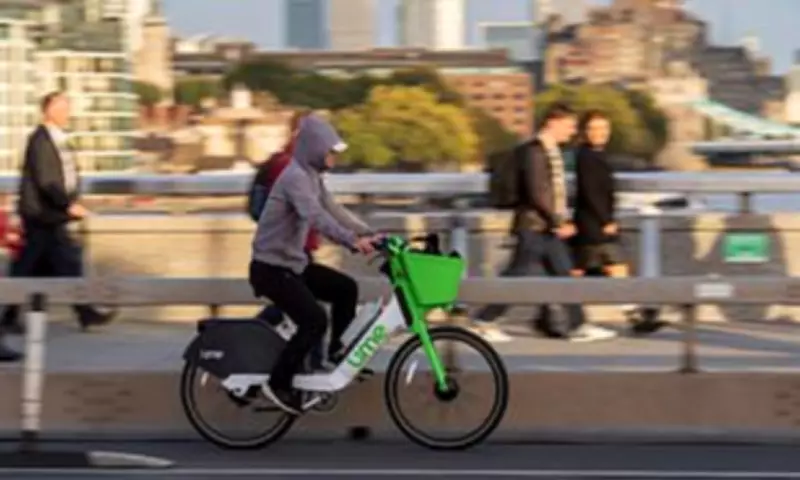
The perennial tension between motorists and cyclists on Britain's congested roads has been reignited by a controversial new proposal. Lime, the prominent bike hire company, has called for traffic lights in London to automatically turn green for cyclists, a measure they argue would enhance safety and efficiency for those on two wheels.
Cycling Advocacy Meets Resistance
Hal Stevenson, the policy director for Lime, has publicly advocated for this initiative, suggesting it could significantly reduce the number of cyclists who ignore red lights. "Cyclists shouldn't be left on red," Stevenson wrote in an article for the news website MyLondon. He pointed out that cycling now accounts for up to one in five trips in central London, with cycle traffic at peak times exceeding cars. Despite this growth, he argued, signal timings remain predominantly set around motor traffic speeds, leading to frequent stopping and less smooth journeys for cyclists.
Building on Existing Infrastructure
Stevenson welcomed Transport for London's (TfL) recent announcement to give buses priority at all 3,500 traffic lights they pass in London by 2030, but called for this measure to be extended to bikes. He highlighted that TfL has expanded London's cycling network from about 56 miles in 2016 to 267 miles last year, and rethinking traffic light timing could be a natural next step in building on that success.

"Other leading cycling cities like Copenhagen and Amsterdam show what's possible," Stevenson noted. He referenced "green wave" technology, which rewards cyclists travelling at a safe, consistent speed with a sequence of green lights. This approach has been shown to improve safety and rider behaviour while reducing journey times at relatively low cost, and could help address the issue of red-light running.
Opposition from Taxi Drivers
However, the proposal has faced sharp criticism from Steve McNamara, general secretary of the Licensed Taxi Drivers Association, who labelled the suggestion as "farcical." McNamara argued that London is "incredibly congested," with traffic "slower than it's ever been," making such a policy impractical.
He further claimed that people who hire bikes are "incentivised" to take "dangerous risks," such as ignoring red lights, because the companies' time-based pricing makes it cheaper if journeys are completed faster. McNamara also expressed frustration with what he described as the "white, middle-class cycling lobby," whose "whole obsession is removing vehicle traffic from the roads."
Context of London's Traffic Woes
The debate unfolds against a backdrop of severe congestion in the capital. A recent report by location technology firm TomTom found London was the world's slowest capital city to drive in last year. The analysis revealed it took an average of three minutes and 38 seconds to drive 0.6 miles in central London, a situation partly blamed on widespread 20mph speed limits.
As London grapples with these transport challenges, the call for cycling-friendly traffic lights highlights the ongoing struggle to balance the needs of different road users. While advocates see it as a progressive step towards safer and more efficient urban mobility, opponents view it as an unrealistic addition to an already strained system. The outcome could shape future transport policies in one of the world's busiest cities.