

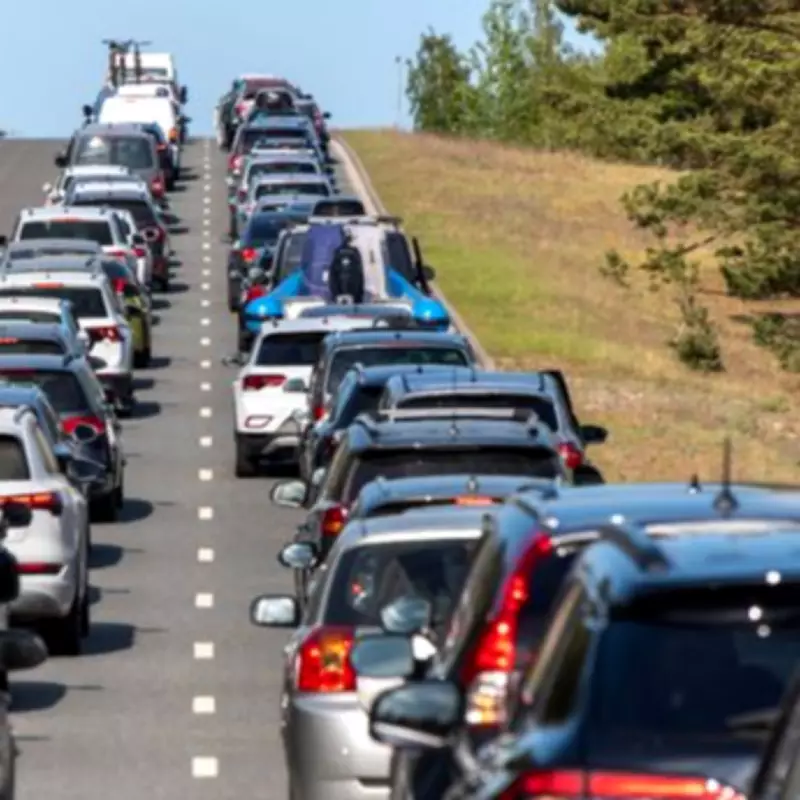
If you have ever been trapped in a traffic jam that appears to materialise out of thin air, with no visible cause such as an accident or road closure, you are not alone. This perplexing phenomenon, known as a phantom jam, has a scientific explanation rooted in mathematics and human behaviour.
The Enigma of Phantom Traffic Jams
Many drivers have experienced the frustration of cruising smoothly on a motorway, only to suddenly encounter a long queue of vehicles bringing them to an unexpected halt. Initially, thoughts turn to potential accidents or closures ahead, but as you slowly advance, it becomes clear there is no obvious reason for the standstill. Once you reach the front of the congestion, the road opens up, allowing you to continue unimpeded, leaving you baffled by the mysterious delay.
The Scientific Explanation Behind Phantom Jams
Whilst most people dismiss these incidents as mere quirks of daily life, a mathematician has shed light on the science behind phantom jams, revealing they are more common than many realise. Professor Hannah Fry, in a detailed YouTube video, explains that these inexplicable traffic jams are triggered by subtle changes in driving behaviour among vehicles ahead, causing a chain reaction of braking.

She elaborates: "When you are in that situation, you're not stuck behind a crash. Your day has just been ruined by a mathematical ghost." The official term for this is a phantom jam, a concept understood since the 1950s when mathematicians observed that overcrowded motorways cause cars to behave not as individual entities but according to the principles of fluid dynamics.
How Phantom Jams Form and Spread
Here is how the ghost is born: when traffic density increases, vehicles drive in close proximity. A minor event, such as a lane change or a slight over-braking, can force the following driver to brake. This action cascades backward through the line of cars, with each subsequent driver braking more sharply due to human reaction times.
Professor Fry notes: "That means the person behind them has to brake, the person behind them has to brake, and so on and so on. Because of human reaction times, the amount of braking increases as you go further back, until you get to about 20 cars, when the amplification is so big that the car has to come to a complete dead stop."
Phantom jams do not remain stationary; instead, they form a wave that travels backward along the motorway, meaning drivers are not heading toward the origin point but rather encountering the congestion as it moves in their direction.
Clearing Phantom Jams and Preventive Measures
The congestion typically dissipates only when it reaches a section of road where vehicles are spaced far enough apart that drivers no longer need to slow down to avoid collisions. However, Professor Fry emphasises there is a straightforward solution to prevent phantom traffic jams: avoiding tailgating.
Tailgating, or driving too closely to the vehicle ahead, is a dangerous practice that constitutes careless driving and can lead to fines and penalty points. Despite this, many motorists engage in tailgating, which forces sudden braking and can trigger phantom congestion on busy routes.
Professor Fry explains: "So how do you defeat this mathematical ghost? Two options, really. Either we can all get in driverless cars with much better reaction times, or we can all just agree to stop tailgating."
In the absence of widespread adoption of autonomous vehicles or a collective change in driving habits, there is little individual drivers can do to avoid phantom jams. If you find yourself stuck in such a situation on the motorway, with no sign of a crash, the best approach is to remain calm, take a deep breath, and allow the mathematical ghost to pass by.






