

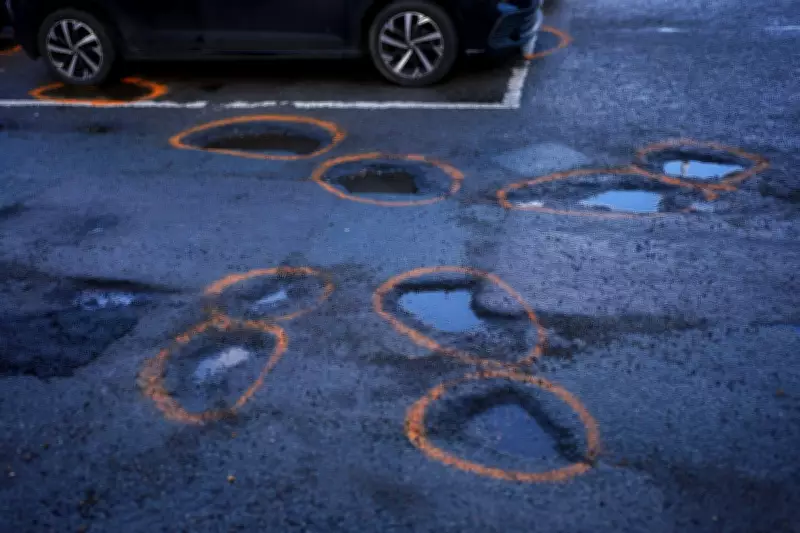
Pothole Crisis Branded a 'National Disgrace' as Repair Bill Hits £18.6 Billion
The pothole crisis engulfing England and Wales has been labelled a 'national disgrace' as the staggering cost of repairing the crumbling local road network has soared to a record £18.6 billion, according to a damning new report. The Asphalt Industry Alliance (AIA) has revealed that a mere 51 per cent of the local road network is currently in good condition, despite increased investment from the government.
Failed Efforts and a Century-Long Resurfacing Cycle
Efforts to tackle the pervasive issue of potholes have failed to deliver 'noticeable improvements', the report states, with roads being resurfaced, on average, only once every 97 years. Last year alone, a massive 1.9 million potholes were filled across the country, highlighting the sheer scale of the problem. David Giles, chair of the AIA, lamented that any significant improvements 'lie a long way off'.
'I think all road users would agree that the condition of our local roads has become a national disgrace,' Mr Giles stated emphatically. He acknowledged that local authority highway engineers are 'cautiously optimistic' that increased funding could stem further decline, but cautioned that it is 'not the silver bullet that will clear the backlog of repairs any time soon.'

Government Funding Increases and Long-Term Backlogs
Government funding for local road maintenance in England is set to reach nearly £1.6 billion in the 2025/26 financial year, marking a £500 million increase from the previous 12 months. A total of £7.3 billion has been allocated for the four years leading up to the 2029/30 financial year. However, Mr Giles suggested that 'the dial could be moved quicker' if the additional funding was front-loaded rather than 'ramping up in the years to 2030.'
The AIA’s annual Alarm (annual local authority road maintenance) report, based on a survey of local authorities, estimates that bringing roads up to an ideal standard would take 12 years to complete. Highway maintenance budgets for 2025/26 have reportedly increased by 17 per cent to an average of £30.5 million per authority, with 54 per cent allocated to road surface and structure.
Industry and Campaigner Warnings
AA president Edmund King warned that 'much more needs to be done to eradicate this plague of potholes.' He added: 'We have been seeing with our own eyes, and feeling with our wheels, how record wet weather linked to substandard roads has led to many local roads becoming patchwork obstacle courses.'
Tom Hunt, who chairs the Local Government Association’s inclusive growth committee, welcomed the funding increase as 'positive' but stressed that 'more action is needed for councils to bring roads up to scratch.'
Colin Brown, director of campaigns and political engagement at the Motorcycle Action Group, highlighted government figures indicating that poor road surface conditions contribute to twice the proportion of killed or seriously injured motorcyclists compared with car occupants and cyclists. He remarked starkly: 'Riders aren’t complaining about cracked roads because of the damage to their tyres – it’s the added risk of dying on them.'
Government Response and Claimed Progress
A Department for Transport spokesperson acknowledged that the report 'rightly highlights the need to improve our roads' and affirmed that the government has increased funding to help councils 'fix the pothole plague.' The spokesperson added: 'We’re already seeing progress, with 15% more pothole‑prevention works carried out in 2025 compared to 2024 and reversing a nearly decade-long decline in road repair works.'
Despite these claims, the overwhelming evidence from the AIA report and industry leaders paints a picture of a deep-seated crisis requiring sustained and substantial investment over many years to resolve the 'national disgrace' of Britain's pothole-ridden roads.






