

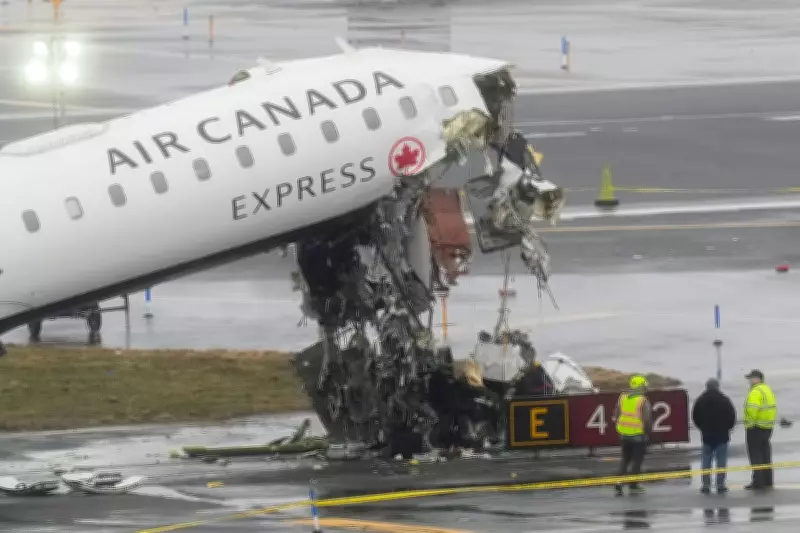
Survival Stories Emerge from Deadly LaGuardia Airport Collision as Investigation Intensifies
Investigators are continuing to delve into the cause of a high-speed crash between an Air Canada jet and a fire truck at New York's LaGuardia Airport, which resulted in fatalities and multiple injuries. The incident has sparked a thorough probe into airport safety protocols and air traffic management.
Heroic Passenger Actions Amid Chaos
Moments after the collision, passengers took swift action to escape the damaged aircraft. With the smell of fuel permeating the air and debris hanging from the obliterated cockpit, individuals tore open emergency exit doors and jumped from the plane's wings. They then turned back to assist others, including some with bleeding or head wounds.
Passenger Clément Lelièvre described the scene, stating, "Strangely enough, I wasn't scared or panicked. On the contrary, I think most of us were pretty aware of what happened. So we all went outside; we got other people out." He credited the pilots' "incredible reflexes" for saving lives, noting they braked extremely hard upon touchdown.

Casualties and Hospitalizations
Approximately 40 passengers and crew members from the regional jet, which originated in Montreal, along with two individuals from the fire truck, were transported to hospitals. While some sustained serious injuries, most had been released by Monday morning, and others walked away without requiring treatment. Notably, a flight attendant was found injured but alive outside the aircraft, adding to the survival narratives.
Investigation into the Catastrophic Wreck
Authorities are focusing on the coordination of air and ground traffic at the time of the crash. Mary Schiavo, a former Department of Transportation Inspector General, emphasized this as a key area for investigators. Transportation Secretary Sean Duffy acknowledged that LaGuardia, though "well-staffed," faces a controller shortage. The runway involved is expected to remain closed for "days" during the investigation, according to Jennifer Homendy, chair of the National Transportation Safety Board (NTSB).
Investigators have recovered the plane's cockpit and flight data recorders by cutting a hole in the aircraft's roof and transporting them to the NTSB lab in Washington for analysis. Homendy indicated that while it is too early to answer many questions, more information is anticipated to be released soon.
Context and Broader Implications
The crash occurred after the fire truck was granted permission to inspect another plane that had aborted its takeoff due to an onboard odor. Air traffic control audio captured a controller frantically instructing the fire truck to stop, and roughly 20 minutes later, the controller appeared to blame himself, saying, "We were dealing with an emergency earlier. I messed up."
This incident has highlighted ongoing issues in the aviation sector. The Federal Aviation Administration (FAA) has been chronically short on air traffic controllers for years, and LaGuardia is one of 35 major U.S. airports equipped with an advanced surface surveillance system designed to prevent such collisions. An alarm heard in the background of the control audio likely originated from this system, alerting the tower to the potential danger, as noted by former FAA air traffic control chief Mike McCormick.
The crash disrupted operations at LaGuardia, the New York region's third busiest hub, during a period already complicated by a partial government shutdown. Flights resumed on one runway with significant delays, causing ripple effects at other airports, particularly for Delta Air Lines, which has a major presence at LaGuardia.
Victims and Memorials
The pilots who died in this first fatal crash at LaGuardia in 34 years were both based in Canada. Jeannette Gagnier, the great aunt of one pilot, identified him as Antoine Forest, recalling his lifelong dream of becoming a pilot. The flight carried 72 passengers and four crew members, with Canada also sending a team of investigators to assist in the probe.

FAA statistics reveal there were 1,636 runway incursions last year, underscoring the persistent challenges in airport safety. As the investigation progresses, the focus remains on understanding the precise sequence of events and implementing measures to prevent future tragedies.





