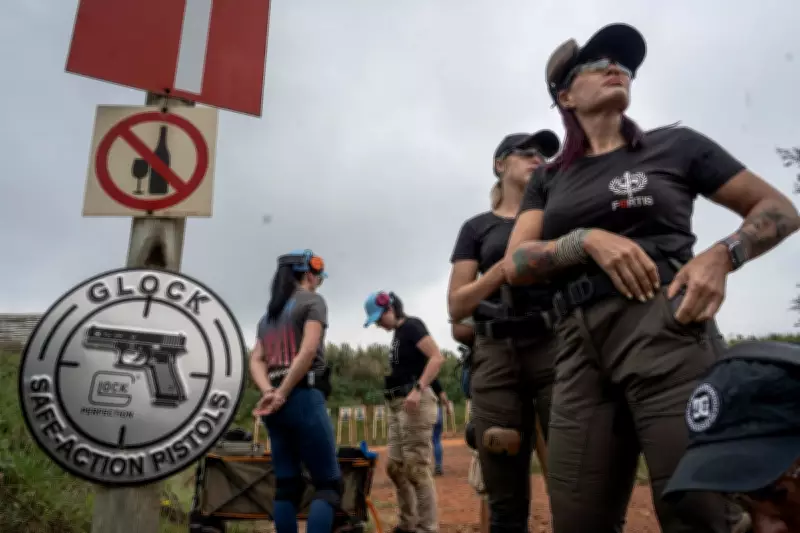
South African Women Embrace Firearms and Martial Arts Amid Gender Violence Crisis
In response to alarmingly high rates of gender-based violence, women in South Africa are increasingly turning to firearms and martial arts for self-protection. This trend reflects a desperate need for safety in a country where femicide rates are among the world's worst, prompting the government to declare violence against women a national disaster in November.
Firearm Training for Women Gains Momentum
At the Lone Operator shooting range in Bronkhorstspruit, near Pretoria, women and girls as young as 13 and as old as 65 are learning to handle 9 mm pistols under the guidance of female instructors. Claire van der Westhuizen, the lead instructor, coaches participants through real-world scenarios, such as firing while lying on their stomachs or backs, emphasizing proper grip and sight alignment.
Sunette du Toit, a 51-year-old grandmother, was motivated to join after surviving a home invasion by five men who tied her up and ransacked her house. "I was not in a position to defend myself at that point," du Toit told The Associated Press. She described the training group as "a family of support," helping her regain confidence to move freely in public and at home.

In South Africa, firearm ownership is heavily regulated, requiring individuals to be over 21 and pass proficiency tests and background checks for self-defense purposes. Despite these hurdles, women are enrolling in courses nationwide, seeking empowerment through skill development.
Martial Arts as a Defensive Tool
In Johannesburg, Tatiana Leyka, 33, has taken up jiujitsu to protect herself, aware of South Africa's notorious reputation for gender violence. Her classes focus on practical techniques like escaping chokeholds and avoiding being trapped against walls, aiming to help women flee attacks. "With the rise in numbers of gender-based violence, it’s good for you to be able to defend yourself, even if it’s just to be able to get away," Leyka said.
Stephanie Graham, a jiujitsu instructor, noted that while training boosts confidence, it doesn't guarantee safety. "We can only hope that it’ll give us more confidence and heightened awareness so that we can perceive a threat a little bit earlier than the average person would," Graham explained.
National Crisis and Systemic Failures
According to U.N. Women, South Africa's femicide rates are five to six times higher than the global average. Mpiwa Mangwiro-Tsanga of Sonke Gender Justice reported that around 15 women are killed daily due to gender-based violence, with one in three experiencing sexual abuse or harassment. "We are competing with conflict countries," she remarked, highlighting the severity of the issue.
President Cyril Ramaphosa's declaration of violence against women as a national disaster followed years of advocacy, citing factors like socio-economic inequality, patriarchal attitudes, and an under-resourced police force. However, activists point to a disconnect between policy and implementation, noting that a national strategic plan from six years ago has failed to curb the violence.
Mangwiro-Tsanga criticized the lack of women's shelters and safety resources, stating that policies are progressive on paper but poorly executed. She also highlighted the low conviction rate for rapes, with only about 8% of reported cases in 2021 resulting in convictions, according to Amnesty International.
Women Taking Safety into Their Own Hands
Despite government assurances, many women are pursuing self-defense training secretly, with some hiding it from partners or husbands. Michael Palin, a jiujitsu gym manager, observed that not all women's partners know about their training, with some claiming to visit a nearby shopping center instead.
Marguerite Hershensohn, 49, attends gun classes with her 21-year-old daughter, Nika, relieved that her daughter is learning to protect herself independently. "Yes, we have to respect those authorities," Hershensohn said, referring to the police. "But they’re not always around." She added that the women in training "don’t look like G.I. Jane. We just look like normal women."

However, Mangwiro-Tsanga warned that relying on guns or martial arts can be problematic, as it places additional burdens on women instead of addressing perpetrators. "It burdens women and girls who are already burdened," she said, urging for systemic solutions to the crisis.
As South African women navigate this dangerous landscape, their pursuit of self-defense skills underscores a broader call for effective action against gender-based violence, blending personal empowerment with a plea for societal change.