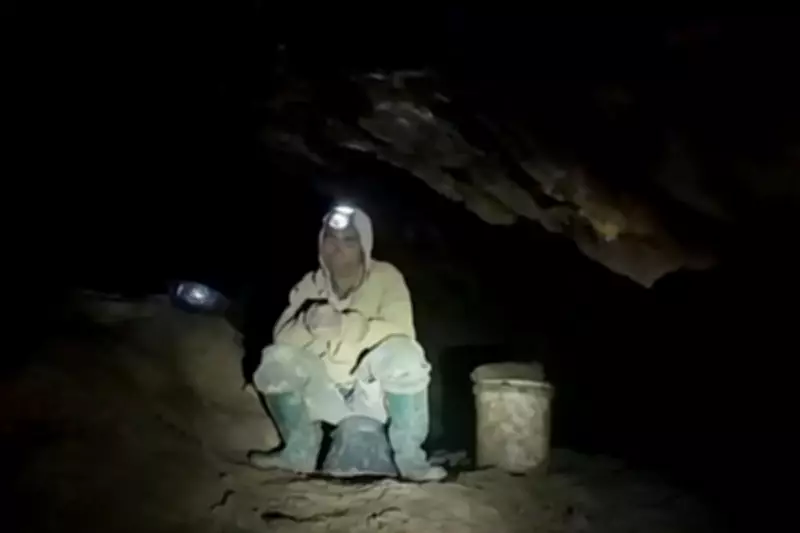
Rescue divers in Laos have evacuated the first of five villagers who have been trapped in a cave for over a week. Lao and Thai rescue teams shared the news Friday, including a video showing the first rescued villager walking unsteadily with assistance. He was handed over to other team members for a medical check amid a waiting crowd.
The five villagers were located by divers Wednesday, but rescue workers still face the dual challenge of extricating the remaining individuals and locating two more who are still missing. Evacuations for the other four were paused until Saturday because they were not yet ready, according to Chakkit Taengtang of the Sai Than Association, one of the Thai rescue organizations on site.
Rescue teams had been pumping water out of the flooded cave passages throughout Friday, but a morning rainstorm complicated their efforts. The trapped men have been supplied with water, soft food, and foil blankets to help them stay warm.

The villagers reportedly entered the cave last week in search of valuable minerals before being caught by flash flooding that blocked their exit. One other villager managed to escape in time and alerted authorities to the seven left behind.
A video filmed inside the cave on Thursday vividly captured the desperation of the trapped men. Thai rescue diver Norrased Palasing spoke with a villager named Khamla, who urgently requested the group be allowed to swim out immediately. "I can't go on. I don't have any strength," he said. Norrased reassured him that the water was being drained, providing blankets and food, and cautioned Khamla to eat slowly to prevent digestive issues.
Rescue teams from Laos and neighboring Thailand were joined by Japanese and Malaysian colleagues. Indonesian and French specialists also had been reported to be coming to the site in a rugged area in the central province of Xaisomboun, about 120 kilometers (75 miles) north of the capital, Vientiane.
Working in the dark in unfamiliar surroundings, divers had to make their way through twisting, narrow, flooded passages with jagged walls. A good rescue plan depends on "the length of the dives involved, the restrictions and the sheer size of the passages that they are in, and the support that's available," said Gary Mitchell, press officer for the South & Mid Wales Cave Rescue Team, which is associated with the British Cave Rescue Council. Other necessities normally include the space and equipment to recharge air or oxygen cylinders, and a medical team.
At the same time, rescuers must weigh the high risks of guiding survivors without diving skills through zero-visibility water against the strategy of waiting for water levels to recede, said Mitchell, who took part in the complicated 2018 cave rescue in northern Thailand of 12 schoolboys and their soccer coach. Several of the divers at the Lao site had also taken part in the Thai rescue.
"You can't leave people underground too long without medical support, without proper food, sustenance, clean water ... before their condition is going to deteriorate," Mitchell warned Thursday from Wales in a video interview.
The five found Wednesday were identified by their first names as Khamla, Mued, Ee, Ing, and Laen. They were reportedly in good health but exhausted from dehydration and lack of food. A video filmed by Norrased showed the emotional moment he and Finnish diving instructor Mikko Paasi emerged from the water and discovered the trapped men sitting on a rock surrounded by floodwater.
Mued delivered a message to his family on camera, saying, "Don't worry mom, dad. I'm still strong, I'm still healthy. Tomorrow I will be home. I love you, mom and dad."
Lao officials say the villagers normally forage in the mountainous surroundings for a living. The villagers had been reported to have entered the cave to look for gold deposits. Bounphong Khammanyvong, a local official in Longcheng, the district where the cave is located, said they had noticed rocks or sand with unusual colors in the cave, so they entered it in the hope of digging them out to see if they were valuable.
Bounphong, in an interview on Thursday with local media outlet Xaisomboun Province Television, said the villagers entered the cave on May 20, contradicting rescuers who put the date at May 19.