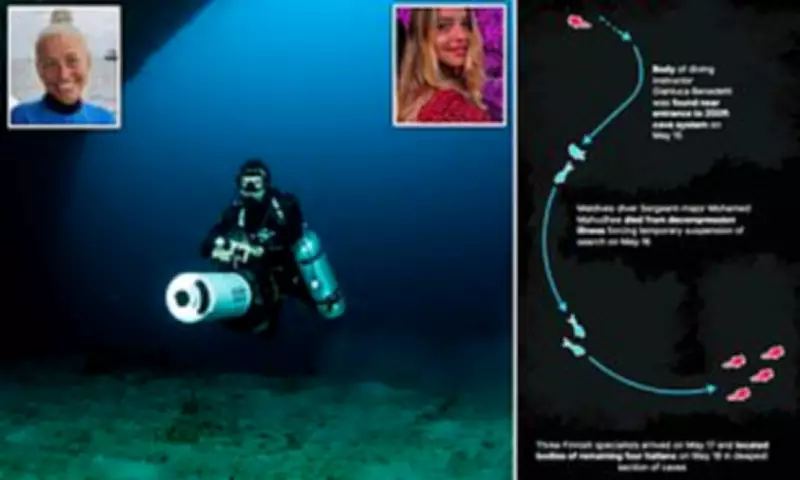
A local expert who has dived in the caves of the Maldives 'countless times' has described the terrifying final moments a group of five divers may have endured, branding the tragedy an accident waiting to happen. Alarm bells were raised on Thursday after five Italians, including a mother and daughter, failed to resurface after attempting to explore caves at a depth of around 165 feet (50 metres). The body of the local instructor who led the group, Gianluca Benedetti, was discovered within the passageway from the mouth of the Thinwana Kandu cave, also known as Shark Cave, on Friday at a depth of around 197 feet (60 metres). The rest of the group was found on Monday by a team of three Finnish divers trapped at the end of the tunnel, deep at the bottom of the cave's third chamber, which is in complete darkness. This incident now ranks among the worst single diving accidents in the history of the Indian Ocean nation.
Expert Insights on the Tragedy
Shafraz Naeem, a former military diver for the Maldives National Defence Force, told the Daily Mail: 'I have visited those caves countless times. There is no current. They swam into that third cave. They chose to go in there.' He added: 'I believe the instructor intentionally swam away from the group. Maybe he legged it up before he ran out of air. The rest of the group died in that third chamber and Benedetti died in the passageway trying to get out.' The cave is divided into three separate chambers, connected by narrow passageways, which are inhabited by sharks, stingrays, and lobsters. Mr Naeem, despite being an expert diver, has intentionally never entered the third chamber due to safety concerns.
The cave opens at 164 feet (50 metres), which is already significantly deeper than the 98-foot (30-metre) recreational diving limit under regulations in the Maldives. The Indian Ocean nation is known as a diving destination that strictly regulates technical diving, making it nearly impossible to conduct such dives while restricting available equipment. 'The cave is unforgiving,' Mr Naeem described. 'It is closed, pitch-black, and you can only see where you shine the light. If something goes wrong, you cannot shoot up to the surface like you can in open dives. You are stopped and restricted, and at that depth of below 55 metres (181 feet), it is just completely dangerous.'

Search and Recovery Efforts
The perilous conditions initially limited the search for the group, conducted by professional divers, due to considerations over oxygen and decompression, as well as rough weather and sea conditions. An initial search operation ended in tragedy on Saturday when Maldivian military rescue diver Mohamed Mahudhee was admitted to hospital and died from decompression sickness after assisting in the recovery effort. Mr Mahudhee was a close friend of Mr Naeem, who is now questioning why the Maldivian government made the decision to send his friend down as an emergency diver who 'doesn't have the proper training and equipment', given the nation's restrictions on technical dives. He added: 'Maybe a politician wanted a badge.'
As well as Benedetti, the other victims have been identified as Monica Montefalcone, an associate professor of ecology at the University of Genoa; her daughter, Giorgia Sommacal; marine biologist Federico Gualtieri; and researcher Muriel Oddenino. Notably, some members of the group seemingly did not have adequate diving qualifications for the cave's depth, Mr Naeem said, nor were well-known safety rules followed. The use of ropes, or lines known as 'Ariadne's thread', is mandatory in certain caves to guide divers and keep them together, especially in darkness or at extreme depths. However, no ropes were found within the cave walls when the trapped bodies were recovered, further implying the group's ill-preparation.

Equipment and Regulatory Failures
Despite visiting the caves numerous times and recovering drowned bodies as a previous profession, Mr Naeem has never traced the group's journey into the third chamber and believes last week's tragedy was 'an accident waiting to happen', due to a lack of knowledge and prior groundwork. He added: 'The talk on the local island is they must have tried to plan it, otherwise they wouldn't have done it.' For a dive of this depth, technical diving equipment is required, yet the group was discovered carrying only recreational gear, used to dive down to 98 feet (30 metres). Mr Naeem explained: 'The body of the guide who was recovered had a single air tank on him. Where is your back up or redundancy? People who are not trained in cave diving or without proper equipment, like this, tend to get knocked by nitrogen narcosis. Then things start to spiral down from there and get worse.'
Nitrogen narcosis is the poisoning of blood due to a lack of oxygen, leaving divers with impaired judgement or anxiety. Normal compressed air can become toxic around 181 feet (55 metres) and affects people differently at different depths, dependent on fitness level. Mr Naeem speculates the group got into difficulty while in the dark depths and, without ropes to guide them back or the appropriate equipment, ran out of oxygen, were hit by nitrogen narcosis, or a combination of these factors.
Operator and Regulatory Context
It is understood that the tour operator Albatros Top Boats is known locally for hosting deep dives on its two boats, breaking the government's diving regulations, as officials fail to check on rule abidance by local companies. 'That operator is well known to do all these deep dives, breaking rules, everybody knows it but don't do anything,' Mr Naeem said. 'The owner doesn't dive herself but the boat managers are known to go deep, breaking the 98-foot (30-metre) regulations.' This is set against the backdrop of the Maldives being the only dive destination in the world where technical diving is banned, meaning the equipment is not readily available. Current diving regulations date back to 1991, with a reform being pushed through government to increase recreational dive limits from 98 feet (30 metres) to 131 feet (40 metres). 'Local dive centres and other companies are appeasing tourists and allowing them to dive deeper, where there may be more sharks,' Mr Naeem said. 'So for them, it is "let's go see the sharks. Let's go see the treasure sharks." A lot of boats go below the legal 98 feet, many going to 131 feet or 164 feet. But this one was life-threatening.'
The Italian tour operator that managed the diving trip has denied authorising or being aware of the deep dive that violated local limits, its lawyer told Italian daily Corriere della Sera on Saturday. Orietta Stella, representing Albatros Top Boat, said the operator 'did not know' the group planned to descend beyond 98 feet – the recreational diving limit in the Maldives. That threshold requires special permission from Maldivian maritime authorities, and the tour operator 'would have never allowed it', she said. The dive far exceeded what was planned for a scientific cruise focused on coral sampling at standard depths, Ms Stella added. The victims were experienced divers, she said, but the equipment used appeared to be standard recreational gear rather than technical equipment suited for deep cave excursions.
Recovery Operation and Expert Analysis
The Divers' Alert Network Europe (DAN), which deployed the three Finnish divers, said on its website that they are technical and cave divers with international experience in search and recovery missions, including operations in 'deep overhead environments, confined spaces, and high-risk scenarios'. The team used advanced technical systems, including closed-circuit rebreathers, a system that recycles exhaled breathing gas and removes carbon dioxide through a chemical scrubber, allowing for 'significantly longer dives', the organisation explained. Monday's operation involved a 'technical cave dive', beginning at 8.30am Italian time and lasting approximately three hours. 'During this first operational intervention, the team of specialists successfully explored the underwater cave system, assessed the environmental and operational conditions, located all four victims still missing, and collected the key information needed to plan the next phases of the operation,' said DAN Europe.
According to local media, one of the most widely accepted hypotheses by the coast guard and experts is oxygen toxicity. This phenomenon occurs if the tank's mixture is inadequate, making oxygen toxic at certain depths. 'At 50 metres of depth in the sea, there are several risks; it's a real tragedy,' says Alfonso Bolognini, president of the Italian Society of Underwater and Hyperbaric Medicine. 'There are several hypotheses we can make right now: an inadequate breathing mix can create a hyperoxic crisis when there's an increase in the partial pressure of oxygen in the tissues and blood plasma, which can cause neurological problems.' He adds that inside a cave at 50 metres of depth, all it takes is a problem for a diver or a panic attack for a diver, as 'the agitation causes the water to become cloudy and can impair visibility.' In such cases, the panic component could lead to even fatal errors.
It is also unclear whether the Italians' dive, being at a depth of over 160 feet, was regulated, according to the MNDF. Meanwhile, it has been revealed that there was no local guide to accompany the group into the cave, as required by Maldivian law. The Maldives, a nation of 1,192 tiny coral islands scattered some 500 miles across the equator in the Indian Ocean, is a luxury holiday destination popular with divers, who often stay at secluded resorts or on dive boats. Diving and water-sport-related accidents are relatively rare in the South Asian nation, although several fatal incidents have been reported in recent years.