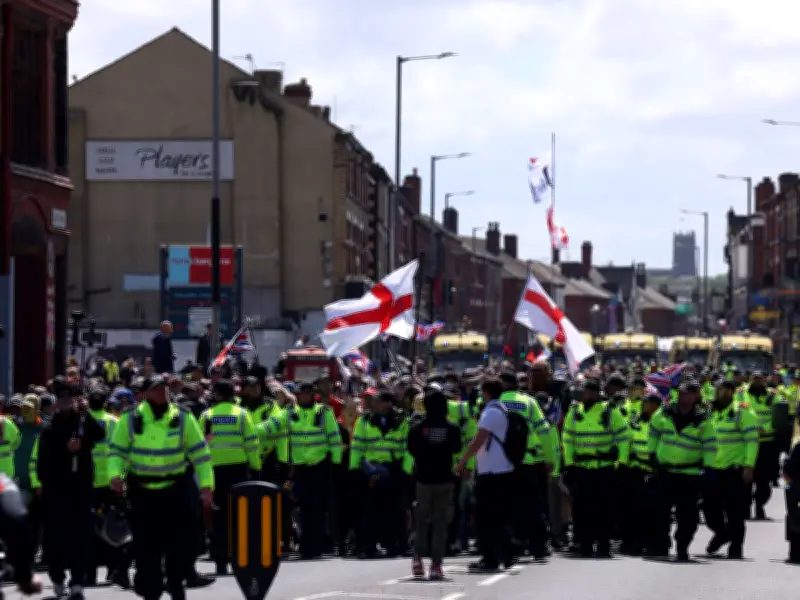
Merseyside Police have been granted unprecedented powers to manage a planned anti-immigration protest and counter-protest on County Road in Walton on Saturday, July 4. The new measures include a dispersal zone and a designated protest area, the latter introduced under legislation that came into effect on June 29.
Dispersal Zone and Designated Protest Area
The dispersal zone will be in effect from 10am on Saturday to 9.59am on Sunday, covering a large area of north Liverpool. Boundaries include Queens Drive, Utting Avenue, Arkles Lane, Wylva Road, Walton Breck Road, Everton Valley, Kirkdale Road, Great Mersey Street, Stanley Road, Melrose Road, Brewster Street and Breeze Hill, along with all roads, transport hubs and public spaces within these limits.
Under the dispersal order, officers can direct individuals suspected of causing or likely to cause crime, nuisance or anti-social behaviour to leave the area and not return for up to 48 hours. They also have the power to seize any items, including vehicles, used in anti-social behaviour. Failure to comply can result in arrest.

A designated protest area will also be in place from 10am to 4pm on Saturday. This is a new power under legislation introduced this week. Merseyside Police Superintendent Col Rooney, force silver commander, told the ECHO: "From June 29, a new offence came into force called concealing identity at a protest. This means that a person commits an offence if they are in a public place within a locality that has been formally designated as a protest area, and wear or use an item that conceals their own identity or another person's identity."
Context of the Protest
The planned demonstration follows a similar protest last month, where large numbers of people marched carrying English flags and banners reading "no more illegals" and "mass deportations." The upcoming protest has been promoted on social media by right-wing accounts. A counter-demonstration supporting Liverpool's refugee community is also expected.
Last month's march drew criticism from local politicians because the area suffered severe damage during the 2024 riots following the murders in Southport, including the destruction of a local library. Liverpool City Council leader Liam Robinson said in an open letter: "Many local people have been in touch with me to say they do not want this march to take place. It is a painful reminder of one of the darkest moments in that area's history. I share their view, but local authorities do not have the power to prevent such marches from taking place."
Liverpool Lib Dem leader Carl Cashman added that people "have the right to protest peacefully but do not have the right to intimidate a community that is still bearing the scars of disorder."
Impact on Local Businesses and Community
The majority of businesses on County Road closed for the day last month, fearing a repeat of the 2024 violence. One business owner, who had lived in the UK for nearly two decades, said: "I don't want to open the shop. I am foreign and people might just attack me because I am foreign."
Police made several arrests during last month's event, with one man charged for punching a police officer. Superintendent Rooney emphasized: "As always, we police by consent. This means policing without fear or favour, remaining politically impartial and working to uphold the rights and safety of all communities. Where individuals commit criminal offences, we will take appropriate and proportionate action."
He acknowledged concerns from the local community: "We recognise there will still be concerns from, and disruption to, the local community regarding the planned events, particularly due to the location. We fully understand the impact this may have on residents, businesses and those living locally, which is why extensive planning and engagement with partners, community representatives, businesses and organisers is taking place."
Rooney also noted the legal limits on police powers: "Although some people believe police can prevent protests from taking place, the legal powers available to restrict or prohibit processions are limited and subject to strict legal thresholds. The law does, however, allow police to impose conditions on processions and assemblies where necessary and proportionate to prevent serious disorder, serious disruption, intimidation or criminality."

He concluded: "We will use all available powers to ensure that disruption is minimal and the area is returned back to normal as soon as possible."