No one was present in the courtroom on Thursday to speak on behalf of the four men whom Randy Santos fatally bludgeoned with a metal bar while they slept on New York City streets. There were no grieving friends or relatives to inform the judge about the abruptly ended lives of Florencio Moran, Nazario Vásquez Villegas, Anthony Manson, and Chuen Kok. No one confronted Santos face-to-face regarding his psychosis-driven rampage through Manhattan's Chinatown neighborhood nearly seven years ago, nor heard him apologize. No one witnessed his sentencing to 40 years to life in prison.
“There are no victim impact statements here today. There’s nobody here to tell this court about their lives and how their absence is a loss,” Manhattan Assistant District Attorney Alfred Peterson informed Judge Laura A. Ward. “But I’m certain this court and this city understands the value of every life, and the gift of life that we’re afforded to live and make choices and have free will,” Peterson added, at times speaking haltingly and emotionally. “That gift was taken away by Randy Santos.”
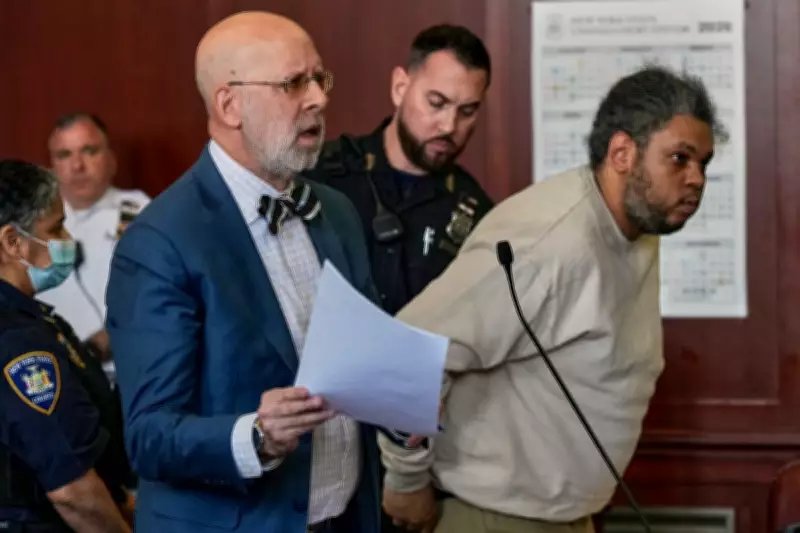
Santos, convicted of first-degree murder in February, sat solemnly between his court-appointed lawyers, listening through headphones as a Spanish interpreter translated the proceedings. A Chinatown activist who arranged Kok’s funeral observed quietly from the courtroom gallery, just a few feet from Santos’ family.

Addressing the court in English, the 31-year-old pleaded for a sentence short enough to allow him to “be somebody” after prison. He told the judge that his mind—which his lawyers claimed had deluded him into believing he had to kill 40 people or die himself—"is much better now” with daily medication. He promised to use his prison time to finish school, improve his English, and learn a trade.
“I just want to say, I’m very sorry for what I did,” Santos said. “I apologize to the people for what I did. I feel very bad about what I did. I wish it never happened.”
Ward described Santos' case as the “coming together of three horrible symptoms of this city: homelessness, mental illness and narcotics abuse.” Those, she said, “are the constant in all our violent crime cases.” Peterson called the case “a study in how the life of a young man can go off track so horribly” and noted that Santos “clearly has his own challenges in life, much like the victims.”
Santos' lawyers argued at trial that his schizophrenia, diagnosed months before the killings, had polluted his mind with irrational thoughts and made him prone to violence. They unsuccessfully tried to convince a jury that he was not criminally responsible for the killings and should be sent to a psychiatric treatment facility instead of prison. Santos has moved between jail and psychiatric facilities since his arrest.
“We ask that Mr. Santos not be sentenced to die in prison,” defense lawyer Arnold Levine told Ward, requesting a sentence of 20 years to life. “He is not incorrigible or beyond redemption or hope.” Ward said she sympathized with Santos but had a "difficult time getting past the fact that Mr. Santos targeted the most vulnerable people in our society. People who were doing nothing but sleeping on the street, homeless.”
Prosecutors had requested a sentence of 50 years to life. In addition to murder charges, Santos was convicted of attempted murder for assaults that left two other men severely injured. Before determining the sentence, Ward reviewed surveillance video of the attacks. The footage showed Santos repeatedly lifting a 4-foot (1.2-meter) bar over his head and bringing it down on one victim's head. A couple on a date witnessed Santos beating another man with the same weapon, which he had found on the street, prosecutors said. The lone survivor of the half-hour killing spree, critically injured 49-year-old David Hernandez, staggered to a nearby street where police were trying to revive another Santos victim.

Police later found Santos carrying the bar, which was covered with blood and hair. Testing revealed his DNA on one end and blood from some victims on the other. The victims ranged in age from 39 to 83. After court officers led Santos out in handcuffs, Chinatown activist Karlin Chan said the sentencing brings closure to the community. “He knew what he was doing,” Chan said, dismissing Santos' apology as performative. “At the end of the day here, he's going to a place where he deserves to be: jail.”