Alabama Inmate Appeals for Clemency Ahead of Scheduled Execution
Charles “Sonny” Burton, a 75-year-old Alabama inmate, is urgently seeking clemency as his execution date approaches on March 12. Burton was convicted for his involvement in a 1991 robbery at an AutoZone store in Talladega, during which a customer was fatally shot. However, Burton maintains that he did not pull the trigger and was unaware of the killing until after the incident.
Details of the 1991 Robbery and Legal Proceedings
During the robbery on August 16, 1991, Doug Battle, a 34-year-old Army veteran and father of four, entered the store as the crime was concluding. Court testimony revealed that Derrick DeBruce, another participant in the robbery, shot and killed Battle after an exchange of words. Burton asserts that he had already left the store and did not hear the gunshot, only learning of the shooting later from DeBruce.
Burton was convicted of capital murder in 1992, with a jury unanimously recommending the death penalty. Over the past 33 years, his conviction and sentence have been reviewed at least nine times by various courts, all of which upheld the original decision. DeBruce, the actual shooter, initially received a death sentence, but it was vacated by a federal court due to inadequate legal representation. He was subsequently resentenced to life imprisonment and died in prison.

Clemency Efforts and Support from Unlikely Allies
Burton’s case has garnered significant attention, with multiple jurors from his 1992 trial now urging that his life be spared. In a remarkable show of compassion, one of Battle’s daughters has written to Alabama Governor Kay Ivey, questioning the legal rationale behind executing Burton. She asked, “how does it legally make sense” to proceed with the execution when Burton did not commit the murder.
Matt Schulz, an assistant federal defender representing Burton, emphasized the unusual nature of the case. “Even people who are strongly in favor of the death penalty recognize that this situation is wrong,” Schulz stated. “Even by the state’s evidence here, Mr. Burton did not kill anyone. Mr. Burton did not order anyone killed. He wasn’t even in the building.”
Governor’s Stance and Legal Precedents
Governor Ivey’s spokesperson, Gina Maiola, confirmed on Friday that the governor reviews each execution case thoroughly. However, she noted that “at this time, as previously noted, Governor Ivey has no plans to grant clemency.” The Alabama Attorney General’s office, led by Steve Marshall, has formally opposed the clemency request, arguing that the legal process has been exhaustive and consistent.
Legal experts point out that the U.S. Supreme Court has permitted the execution of non-triggermen under specific circumstances, particularly when they participate in a felony that results in a death. Robin M. Maher, executive director of the Death Penalty Information Center, highlighted that her organization has documented at least 22 similar cases where individuals were executed for felonies during which another participant killed the victim.
Personal Appeals and Family Reactions
In a heartfelt telephone interview from Holman Correctional Facility, Burton expressed deep remorse and a desire to apologize to Battle’s family. “I’m so sorry. If I had the power to bring him back, I would. I’m so sorry,” he said. Burton also mentioned his gratitude for the forgiveness offered by one of Battle’s children and his hope that Governor Ivey might reconsider.
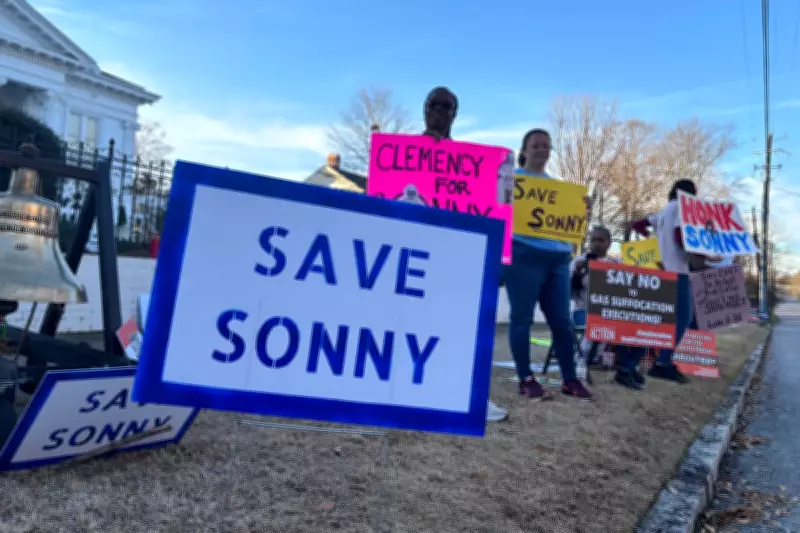
Burton’s daughter, Lois Harris, has been actively campaigning for her father’s clemency, recently holding signs outside the governor’s mansion with messages such as “Save My Daddy” and “Clemency for Sonny.” Harris voiced her frustration, stating, “It’s not fair that he gets the death penalty and the killer gets life. It is just so wrong.”
As the execution date nears, Burton plans to be put to death using nitrogen gas, a method Alabama adopted in 2024. The case continues to spark debate over the application of the death penalty, especially in instances where the convicted individual did not directly cause the victim’s death.