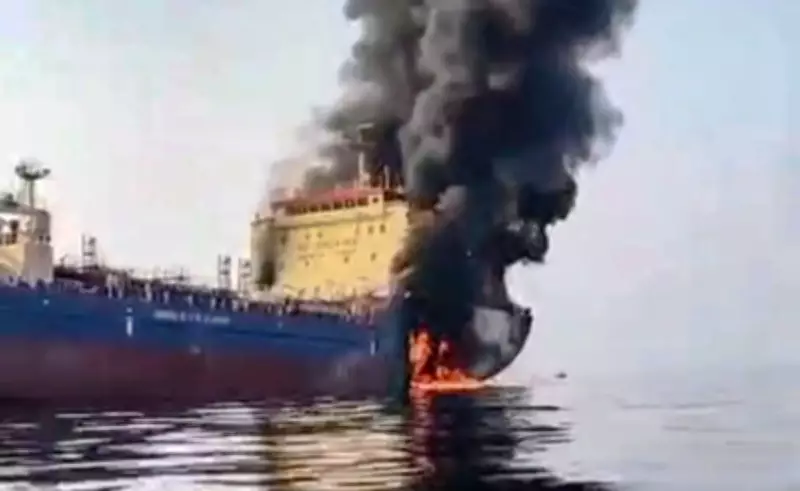
A seafarer who survived a missile strike on the oil tanker MKD Vyom in the Gulf of Oman has described the terrifying moment the blast tore through the engine room, killing his friend and crewmate. The attack occurred on 1 March during US and Israeli airstrikes against Iran.
The survivor, referred to as Basis, told the Guardian that the explosion came without warning. "There were immense shock waves and a fireball," he said. "For one or two seconds, I was knocked out. Everything went black. The power was gone. I looked up – fire and thick black smoke was pouring down."
The Marshall Islands-flagged tanker was bound for Ras Tanura in Saudi Arabia from Amsterdam via the Strait of Hormuz. Amid the escalating conflict, the ship had been instructed to stop and await further instructions. More than 100 miles from Iran, with no ships nearby, no one was unduly worried, Basis said.

Two hours before the MKD Vyom was hit, another tanker, the Skylight, had come under attack, killing one seafarer and leaving another missing. Basis recalled how his training kicked in. In complete darkness, he found the exit and dragged himself up to the bridge. "Twice or three times, I was almost senseless with suffocation. But I thought: 'If I collapse, I will die.' God helped me, I believe, because I do not know how I found the courage."
On deck, an eerie silence engulfed the vessel. It was then he learned that his "beloved colleague" Dixit Solanki, a 32-year-old oiler from Mumbai, remained missing in the engine room, where the fire was still raging. The 21-strong crew fought the flames with fire extinguishers and sand, and even lowered buckets over the side to haul seawater by hand. It took four hours to extinguish the fire, but it was too late. Basis and another crew member found Solanki dead under wrecked metal.
"We tried our best to recover his body, for us and for his family," said Basis. But a second blaze began, spreading via ruptured oil tanks. With 60,000 tonnes of petrol onboard, the captain gave the order to abandon ship. "Leaving the vessel, leaving a colleague behind, trapped in the engine room, was unbearable," Basis said.
Solanki's father, Amratlal Gokal Solanki, described his son as a hero. "He was not just a sailor – he was a son, a protector and the heart of the family. His loss has left an emptiness that can never truly be filled." He called on governments and shipping companies to do more to protect crews in conflict zones.
The family of Ashish Kumar, captain of the Skylight, have not heard from him since before the attack but refuse to believe he is dead. His wife, Ansu Kumari, said: "I have full faith that he is trapped somewhere. He will definitely come back."
Since 1 March, 10 seafarers have been killed in 32 attacks on ships in the Strait of Hormuz and the wider region. Basis stressed he is speaking to highlight the plight of 20,000 innocent seafarers stranded on about 800 ships in the strait, unable to escape. "My fellow seafarers are suffering. They are trapped, worse than prisoners, without communication, with limited food and water."
Mohamed Arrachedi of the International Transport Workers' Federation said he receives 70 WhatsApp messages daily from seafarers in distress, seeking repatriation, unpaid wages, or reporting food shortages. "When you are speaking to a 45-year-old man with a family and he is in tears, saying 'my life is in your hands', but you can't promise any solution, it is a difficult situation."
V Ships Asia, the MKD Vyom's management company, said the incident had sadly resulted in the death of a "greatly valued crew member".