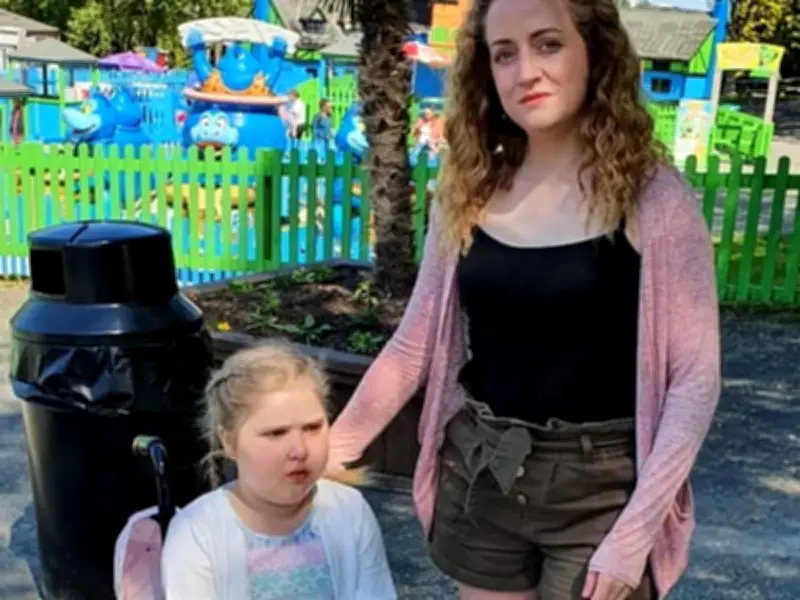
Faye Condon, a 12-year-old girl from Plymouth, endured six rounds of unnecessary chemotherapy after being wrongly diagnosed with an autoimmune condition for seven years. She was initially told she had Juvenile Dermatomyositis (JDM) at age five, after her mother, Christina Condon, noticed she wasn't running and jumping as well as other children her age.
Seven Years of Misdiagnosis
Christina, 36, remained unconvinced by the diagnosis and pressed doctors to investigate other conditions. After seven gruelling years, six courses of chemotherapy, home injections, and a muscle biopsy, Faye was eventually referred to Great Ormond Street Hospital (GOSH), where she received a diagnosis of de novo Emery-Dreifuss muscular dystrophy (EDMD) type 2. There is no known treatment for this condition.
Christina said: "We have spent her entire childhood in and out of hospital, we haven't been on holidays and we don't have a house or car that is wheelchair accessible as we were told she was going to get better. If we had the correct diagnosis seven years ago when Faye was able to walk, we could have gone on holiday and had more fun with her before she was wheelchair bound. We put our lives on hold because we were always told she was going to get better."

Initial Signs and Hospital Visits
In March 2019, Christina took Faye to hospital, sensing something was seriously wrong with her development. She was referred to Bristol Children's Hospital (BCH), where medics carried out preliminary tests. Christina said: "I first took her for hip pain and inability to bear weight, and we knew something was wrong but the doctors couldn't see what I could see as a parent. She couldn't walk 200 yards to school, she would randomly fall, I had to take videos and pictures to prove it. It was subtle but obvious to me as her mum. The doctor was very flippant about it, they just threw medicine at her but nothing would make a difference."
In October 2019, they were categorically told it was not muscular dystrophy, but Christina felt the doctor was looking for her to fit into a rheumatology disease. She said: "Everyone could see there was something wrong, but no one wanted to take responsibility for her and do more tests as tests cost money. The staff at the hospital were very vocal about a financial fight about which department would pay for testing, but as parents we shouldn't be hearing that. Every test for the autoimmune disease was negative, not a single test they did pointed towards JDM. She even had a muscle biopsy which pointed to a congenital muscle disease, not an autoimmune disease, but that was overlooked. In November 2019, we got the JDM diagnosis."
Unnecessary Chemotherapy
Following the JDM diagnosis, Faye embarked on her first course of chemotherapy in January 2021. Christina said: "She was about seven for her first round of chemo and was so sick, it was awful. We couldn't be near anybody and she became really poorly, it was horrific to watch. She then contracted viral meningitis as a side effect of a blood product a doctor gave her and she was forced to stay in a dark room. There is no treatment for muscular dystrophy so she wouldn't have had to have any of this if they diagnosed her properly the first time."
A 2023 British Medical Journal (BMJ) study suggested that diagnostic errors impact approximately one in 18 patients across primary and secondary care settings.
Second Opinion and Correct Diagnosis
Christina begged doctors at her local clinic at Derriford Hospital for a second opinion. One of the initial doctors who examined Faye at Derriford Hospital agreed that the JDM diagnosis was incorrect and advocated for a referral to GOSH. Christina said: "Without the support of doctors at Derriford Hospital, we would never have got the correct diagnosis. They have been amazing from day one, they listened to and believed us as parents and really pushed for someone to listen."

The Derriford physician conducted genetic blood testing and secured a referral to GOSH, where Faye received an accurate diagnosis. Christina said: "The specialist at GOSH took one look at her and named this type of muscular dystrophy. All it took to diagnose her was a blood test with specific genetic testing, but the doctors at BCH were so adamant that it was JDM they never sent for this test. Those doctors ruined my little girl's whole childhood. I feel so let down by everybody."
Current Condition and Impact
As there is no cure for muscular dystrophy, the focus remains on keeping Faye comfortable and pain-free. Christina said: "She is losing the use of her legs very quickly, she was refused entry into a school because her needs changed too much. Our house is not made for a wheelchair user so our house is unsafe. She is currently a ticking time bomb, her heart could stop at any minute and she is on a ventilator at night, so cannot have a sleepover like other girls in her class. Had we known from five years old, and they had diagnosed her correctly, we would have everything in place and wouldn't be in such a desperate situation now. Every appointment we go to is more bad news and Faye is not coping with the new diagnosis, she has lost the ability to be independent. If I was Faye I would have given up by now, but she depends on me."
Formal Complaint
Christina is currently pursuing a formal complaint against BCH. Professor Steve Hams, chief nursing and improvement officer at Bristol NHS Foundation Trust, said: "We are very sorry to hear of the concerns raised by Faye's family and our thoughts are with them. We are reaching out to her mother to listen to and understand her family's experience. We want to approach this with care and compassion and will take the time needed to fully understand what has happened."