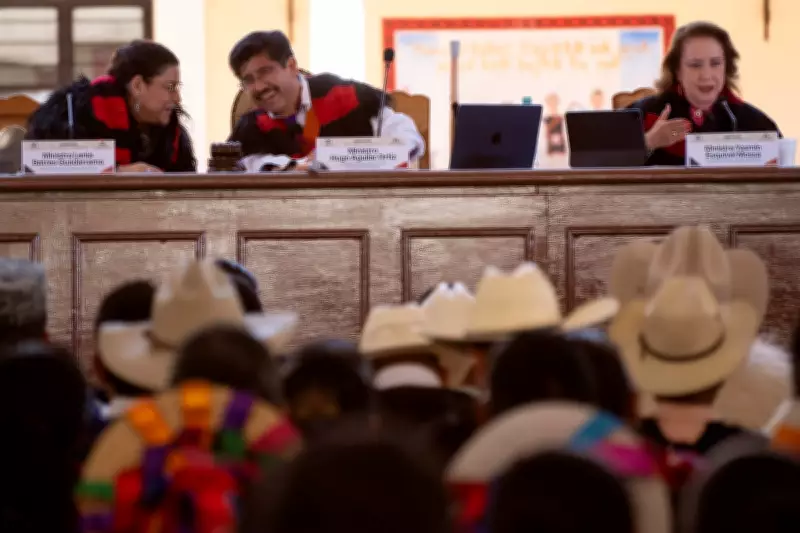
Mexico's Supreme Court Holds Historic First Session Outside Mexico City
Mexico's Supreme Court has embarked on a groundbreaking initiative by holding its first-ever session outside the capital, convening in the southern state of Chiapas. This landmark event marks the beginning of a concerted effort to bring the nation's highest judicial authority to remote and underserved communities across the country.
A Session Under the Tent in Tenejapa
On Thursday, the court's justices deliberated under a tent erected in the central square of Tenejapa, a mountain town in Chiapas. Approximately 2,000 local residents gathered to witness the proceedings, a significant departure from the court's usual neoclassical building in Mexico City. This move represents a tangible step toward greater judicial accessibility and transparency for populations often disconnected from central institutions.
The session included discussions on local issues, notably the case of the community La Candelaria in the municipality of San Cristobal de las Casas, which has long advocated for self-rule. Indigenous leaders and authorities were present, some holding signs proclaiming the "right to self-determination," while others attended simply to be part of this historic moment.

Chief Justice Hugo Aguilar's Vision
Chief Justice Hugo Aguilar, an Indigenous lawyer from the neighboring state of Oaxaca, emphasized the importance of this outreach. "Often in our communities we only feel the effects of a decision taken far away," Aguilar stated. "Now, the goal is that you see how we deliberate, that you know what we say, how we consider and make a decision."
Aguilar's leadership is particularly symbolic, as he heads the first Supreme Court whose justices were popularly elected last year under a constitutional reform. This election aimed to make the court more responsive and accountable, though it faced criticism for potentially politicizing Mexico's highest judicial body. Voter turnout was extremely low, and candidates aligned with the governing party secured most seats.
Community Response and Human Rights Focus
The community's reaction in Tenejapa was overwhelmingly positive, with gratitude expressed for the court's presence. María de la Cruz Velasco, president of a foundation assisting femicide victims, remarked, "It makes me happy that this new minister (Aguilar) comes out to the towns, to cities to carry out justice because we really need to listen to the people."
Velasco highlighted the court's role in defending human rights, sharing her personal experience: when her daughter was killed, local courts resisted classifying the crime as a femicide, but the Supreme Court ultimately recognized its gender dimension, leading to a 55-year prison sentence for the perpetrator. This case underscores the court's progressive stance on human rights, even though some of its rulings have not always been fully implemented.
Traditionally, the Supreme Court has been an ally for Indigenous people and victims of violence, despite its sessions often being tedious and difficult for non-legal professionals to follow. By holding sessions in remote areas, the court aims to bridge this gap and foster greater public understanding of its deliberations.
In Tenejapa, nestled in the mountains of Chiapas, the controversies surrounding the court's recent electoral reform were set aside, focusing instead on the symbolic and practical significance of bringing justice closer to the people. This initiative signals a potential shift toward more inclusive and participatory judicial processes in Mexico.