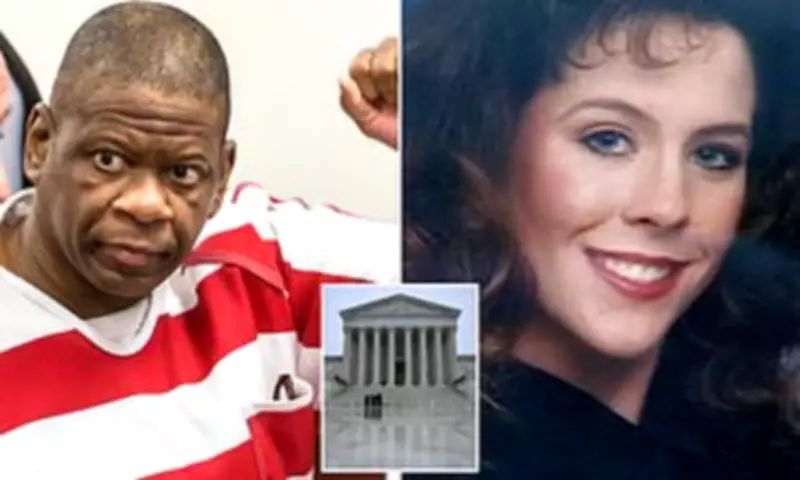
Supreme Court Rejects Rodney Reed's Final DNA Testing Appeal
The United States Supreme Court has delivered a devastating blow to Texas death row inmate Rodney Reed, rejecting his latest appeal to conduct DNA testing on critical crime-scene evidence. This decision effectively clears the path for Reed's execution after nearly three decades of legal battles and maintains the lower court ruling that has consistently blocked forensic examination of the murder weapon.
Decades-Long Legal Battle Reaches Critical Juncture
On Monday, the justices declined to take up Reed's challenge for the second time in less than three years, leaving intact a ruling from the federal appeals court in New Orleans. The court's three liberal justices—Sonia Sotomayor, Elena Kagan, and Ketanji Brown Jackson—filed a dissenting opinion, sharply criticizing the majority's decision as potentially allowing an innocent man to be executed.
Reed was convicted and sentenced to death for the 1996 murder of 19-year-old Stacey Stites in Bastrop, Texas. The central piece of evidence in the case remains a webbed belt used to strangle Stites, which Reed's legal team has fought to test for DNA evidence for years. His attorneys argue that the killer must have left sweat and skin cells where they gripped the belt during the prolonged strangulation.

Contested Evidence and Constitutional Questions
'The killer held that belt tight against her throat for minutes, and must have left his sweat and skin cells—and thus his DNA—where he gripped the belt,' Reed's attorneys wrote in their filings. They described the state's refusal to allow testing as 'inexplicable' given what they characterize as 'compelling evidence' supporting Reed's claim of innocence.
The legal dispute centers on Texas's post-conviction DNA testing law, which prohibits testing on evidence deemed potentially contaminated. Reed's attorneys argue this restriction is arbitrary and violates his constitutional right to due process. State and lower federal courts have consistently sided with prosecutors, ruling that the law doesn't apply to items that may have been compromised.
Prosecution's Position and Alternative Suspect Theory
Texas Attorney General Ken Paxton has vigorously defended the state's position, arguing that concerns about contamination are directly tied to maintaining the chain of custody for forensic evidence. He maintains that state lawmakers—not federal courts—should determine how inmates access post-conviction DNA testing.
Reed has consistently maintained that Stites' fiancé, former police officer Jimmy Fennell, was the real killer, alleging Fennell was enraged over Stites' alleged interracial relationship with Reed. Prosecutors, however, assert that Reed raped and murdered Stites, a claim he has consistently denied while insisting their relationship was consensual. Fennell, who later served prison time for an unrelated sexual assault, has denied any involvement in Stites' killing.
Judicial Dissent and Celebrity Advocacy
In her dissenting opinion, Justice Sonia Sotomayor wrote that it is 'inexplicable' that prosecutors would not allow DNA testing 'despite the very substantial possibility that such testing would exculpate Reed and identify the real killer.' She warned that 'the State will likely execute Reed without the world ever knowing whether Reed's or Fennell's DNA is on the murder weapon.'
Reed's case has attracted widespread attention and celebrity advocacy, with prominent figures including Beyoncé, Kim Kardashian, Dr. Phil, Oprah Winfrey, and Rihanna publicly supporting his push for DNA testing. In 2019, Kardashian claimed substantial evidence existed that would exonerate Reed, while Rihanna urged supporters to sign petitions asking Texas Governor Gregg Abbott to stay the execution.
Legal Precedents and Future Implications
This decision marks another chapter in Reed's decades-long legal fight, which saw a temporary victory in 2023 when the Supreme Court ruled 6-3 to revive his case, allowing him to challenge whether he had waited too long to seek DNA testing. However, Monday's ruling shuts down one of his final avenues for relief.

The Supreme Court has recently grappled with similar issues in other cases. Earlier this year, the justices ruled in favor of another Texas death row inmate, Ruben Gutierrez, allowing his bid to test evidence he says could prevent his execution to proceed. This contrast highlights the complex and often inconsistent application of post-conviction DNA testing laws across different cases.
With this latest Supreme Court refusal, the central question that has defined Reed's case for nearly three decades remains unresolved: whether the DNA evidence he has long sought would confirm his guilt or finally prove his innocence. The decision leaves Reed's supporters devastated and raises broader questions about access to forensic testing in capital punishment cases across the United States.